A Day in Astronomy: The Birth of Philip K. Dick

Credit: Gollancz

On this day in 1928, American science fiction writer Philip Kindred Dick was born in Chicago, IL. He would go on to write some of the best known books on science fiction, including:

  • The Man in the High Castle (1963), which won the Hugo Award;
  • Do Androids Dream of Electric Sheep? (1968), later made into the film Blade Runner; and
  • Flow My Tears, the Policeman Said (1974), which won the John W. Campbell Memorial Award for Best Science Fiction Novel and was nominated for both a Hugo Award and a Nebula Award.

Mr. Dick had a troubled life with multiple wives, yet he created some of the most memorable characters and fiction. You may recall some of his other books and stories that became films in recent years, including Total Recall with Arnold Schwarzenegger, Minority Report with Tom Cruise, and A Scanner Darkly with Keanu Reeves.

In his last interview of his life, Mr. Dick discussed how he left behind his writing in the late 1950s:

Many writers had left the field. We could not make a living. I had gone to work making jewelry with my wife. I wasn’t happy. I didn’t enjoy making jewelry. I had no talent whatsoever. She had the talent. She is still a jeweler and a very fine one, making gorgeous stuff which she sells to places like Neiman-Marcus. It’s great art. But I couldn’t do anything except polish what she made.

Fortunately, he returned to writing, thereby provided all of us with amazing stories that live on today.

A Day in Astronomy: The Birth of Ursula Le Guin

On this day in 1929, Ursula K. Le Guin was born in Berkeley, California. She would gain her masters degree in French only to later become a well known author of many fantasy and science fiction stories, including the Earthsea series and stories set in a Hainish universe of her making. She would go on to win eight Hugo Awards and six Nebula Awards.

Her style was different from many other authors of her period, focusing more on planetary culture than spacecraft hardware. When asked about her style, she stated the following:

The “hard”–science fiction writers dismiss everything except, well, physics, astronomy, and maybe chemistry. Biology, sociology, anthropology—that’s not science to them, that’s soft stuff. They’re not that interested in what human beings do, really. But I am. I draw on the social sciences a great deal. I get a lot of ideas from them, particularly from anthropology. When I create another planet, another world, with a society on it, I try to hint at the complexity of the society I’m creating, instead of just referring to an empire or something like that.

Given that her mother an anthropologist, it is not surprising that she saw a different way of telling story.

Her books represented a unique part of the science fiction genre that has only expanded over time as the writing community has expanded.

If you need an entry point to her work, you cannot go wrong starting with the short story “The Ones Who Walk Away from Omelas.” However, one of my favorite short stories is “The Island of the Immortals,” which you can find here.

I doubt you will be able to stop with one short story.

A Day in Astronomy: The Birth of Ray Bradbury

On this day in 1920, Ray Douglas Bradbury was born in Waukegan, Illinois. Mr. Bradybury would grow up to be a famous American author and screenwriter.

One of his science fiction works,The Martian Chronicles stories, tells the story of mankind’s colonization of Mars and the ultimate effect on the colonizers.

He wrote numerous other famous books and short story collections, including Fahrenheit 541, Something Wicked This Way Comes, The Illustrated Man, and Dandelion Wine.

Speaking on science fiction, Mr. Bradbury once stated:

Science fiction is any idea that occurs in the head and doesn’t exist yet, but soon will, and will change everything for everybody, and nothing will ever be the same again. As soon as you have an idea that changes some small part of the world you are writing science fiction. It is always the art of the possible, never the impossible.

Asked in a 2004 interview what he thought about the US space program, he stated:

It’s too late, isn’t it? We’ve let 30 years go by. It’s stupid. It’s stupid. We should have stayed on the moon. We should have made moon the base, instead of building space stations, which are fragile and which fly apart. The moon is a good, solid base to build a space travel organization in the community. Then we take off from the moon and we go to Mars. But it’s terribly late. We’ve let too much time go by. We’ve been busy with war instead of being busy with peace. And that’s what space travel is all about. It’s all about peace and exploration and wonder and beauty.

Fortunately, it is not too late to visit the Moon or Mars, as demonstrated by NASA’s Artemis program. It’s the art (and science) of the possible.

Podcast: Discussion with Ray Kurzweil

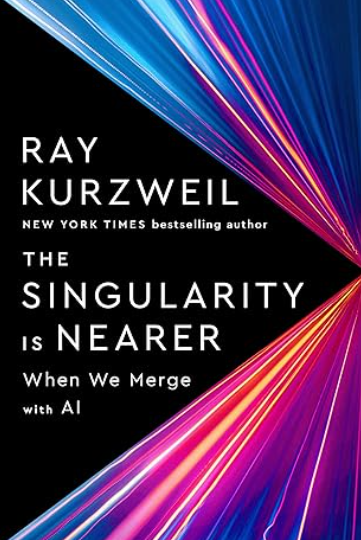
Neil deGrasse Tyson interviews futurist Ray Kurzweil in this repeat StarTalk episode from November 2022 titled “Could We Someday Liver Forever? With Ray Kurzweil.” It is a heavy conversation about living forever as we integrate technology even more into our lives. Throughout the conversation Neil makes reference to a book coming out in 2023. In fact, the book came out in June of this year, which is probably why the episode is available again.

Here is a description of the new book from the publisher:

In this entirely new book Ray Kurzweil brings a fresh perspective to advances toward the Singularity—assessing his 1999 prediction that AI will reach human level intelligence by 2029 and examining the exponential growth of technology—that, in the near future, will expand human intelligence a millionfold and change human life forever. Among the topics he discusses are rebuilding the world, atom by atom with devices like nanobots; radical life extension beyond the current age limit of 120; reinventing intelligence by connecting our brains to the cloud; how exponential technologies are propelling innovation forward in all industries and improving all aspects of our well-being such as declining poverty and violence; and the growth of renewable energy and 3-D printing. He also considers the potential perils of biotechnology, nanotechnology, and artificial intelligence, including such topics of current controversy as how AI will impact employment and the safety of autonomous cars, and “After Life” technology, which aims to virtually revive deceased individuals through a combination of their data and DNA.

The culmination of six decades of research on artificial intelligence, The Singularity Is Nearer is Ray Kurzweil’s crowning contribution to the story of this science and the revolution that is to come.

You will want listen to the podcast interview, and afterward you might even want to pick up the book.

Credit: Viking

Recent Book: The Wrong Stuff

Credit: PublicAffairs

Here is a book released this month that may be worth taking to the beach.

The Wrong Stuff: How the Soviet Space Program Crashed and Burned is a tale about a space program that wowed the world in the 1950s and 1960s until the U.S. stole the show with the first man on the Moon. However, the Soviet space program may have had problems long before the U.S. leapfrogged it. If you are interested in the space race, then this is the book for you.

This is a summary from the book:

In the wake of World War II, with America ascendant and the Soviet Union devastated by the conflict, the Space Race should have been over before it started. But the underdog Soviets scored a series of victories–starting with the 1957 launch of Sputnik and continuing in the years following–that seemed to achieve the impossible. It was proof, it seemed, that the USSR had manpower and collective will that went beyond America’s material advantages. They had asserted themselves as a world power.

But in The Wrong Stuff, John Strausbaugh tells a different story. These achievements were amazing, yes, but they were also PR victories as much as scientific ones. The world saw a Potemkin spaceport; the internal facts were much sloppier, less impressive, more dysfunctional. The Soviet supply chain was a disaster, and many of its machines barely worked. The cosmonauts aboard its iconic launch of the Vostok 1 rocket had to go on a special diet, and take off their space suits, just to fit inside without causing a failure. Soviet scientists, under intense government pressure, had essentially made their rocket out of spit and band aids, and hurried to hide their work as soon as their worldwide demonstration was complete.

As we watch the Russian military struggle in Ukraine, we are reminded that the Russians and others (North Korea?) have been good at putting on a show, but the truth can be very different.

None of this takes away from the bravery of the Soviet cosmonauts who thrived and died in that space program. As always, the rot was in the system, which could only stand for so long.

Maybe Putin should put this on his beach reading list as he continues to rattle his saber. It may do him and the world some good.