Television/Book Review: Beacon 23

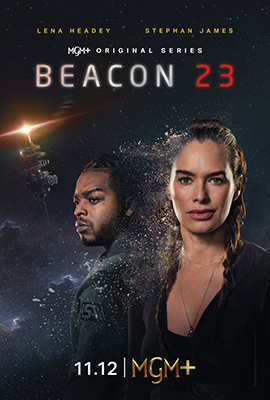
You probably already subscribe to half a dozen streaming platforms, but does it include MGM+ (formerly known as Epix)? If not, you will miss the November 12th premiere of a new eight-episode series called Beacon 23.

Here is the basic story from MGM+ (and here is the trailer):

Beacon 23 takes place in the farthest reaches of the Milky Way and follows Aster (Lena Headey), a government agent, and Halan (Stephan James), a stoic ex-military man, whose fates become entangled after they find themselves trapped together inside one of many Beacons that serve as a lighthouse for intergalactic travelers. Every Beacon is run by one highly trained human and a specialized Artificial Intelligence. Aster mysteriously finds her way to the lonely Beacon-keeper Halan, and a tense battle of wills unfolds. Halan begins to question whether Aster is friend or foe, as her ability to disguise her agenda and motives could make her a formidable opponent.

It looks intriguing. And the anticipation has been building since this project was announced more than two-and-a-half years ago (in the middle of Covid). Luckily, not even the writers strike killed this one.

It is based on the book of the same name, which had good reviews. Here are a few comments on the book:

It’s a quick, easy read, especially since most of the events involve only one character. It’s quite good in its way, too, a bit like “The Martian” if the astronaut in that novel had just kind of hung out back in the Hab without working very hard on his survival. Our hero is flawed, hailed for an act that he views as cowardly, and in the end readers are left to wonder if he’s actually a hero or a fool. (The Oklahoman)

It’s a book for adult readers, but I think younger readers would have a lot of fun with it. The voice is irresistible and it’s both funny and sad. In some ways it’s a cross between Andy Weir’s The Martian and David Bowie’s Space Oddity. Beacon 23 tells the story of a man whose job it is to stand sentry in what is effectively an interstellar lighthouse, making sure passing ships don’t crash into nearby asteroids. The main character’s name is never given, and the story is told in the first person so it could almost be anyone’s story. It’s very easy to relate to the narrator who is ex-military and living out his retirement all alone in the beacon with only his thoughts and the odd (often wry and hilarious) communications with NASA to keep him company. (Luna Station Quarterly)

Beacon 23 is a loose combination of Dark Star and The Martian. At times I found the story very funny, particularly the dialogue with Rocky, as well as some interesting interchanges with NASA, imagined and real. There are also the inevitable technical issues to overcome when you are on your own and help is not an inconsiderable distance away. And to top it all the Operator of Beacon 23 is almost certainly suffering from Post Traumatic Stress Disorder, or in his own words “…just a little bit crazy.” (Book Lore)

I guess the key point in all of these is that the story reminds them of The Martian. All you need now is one more streaming platform. Or you can await broader distribution of the series. Whichever way you go, this one may be worth a second look.
Podcasts: The Search for Intelligent Life in the Galaxy

Credit: University of Arizona Press

Last month there were a few podcasts worth checking out on our search for intelligent life elsewhere in the galaxy.

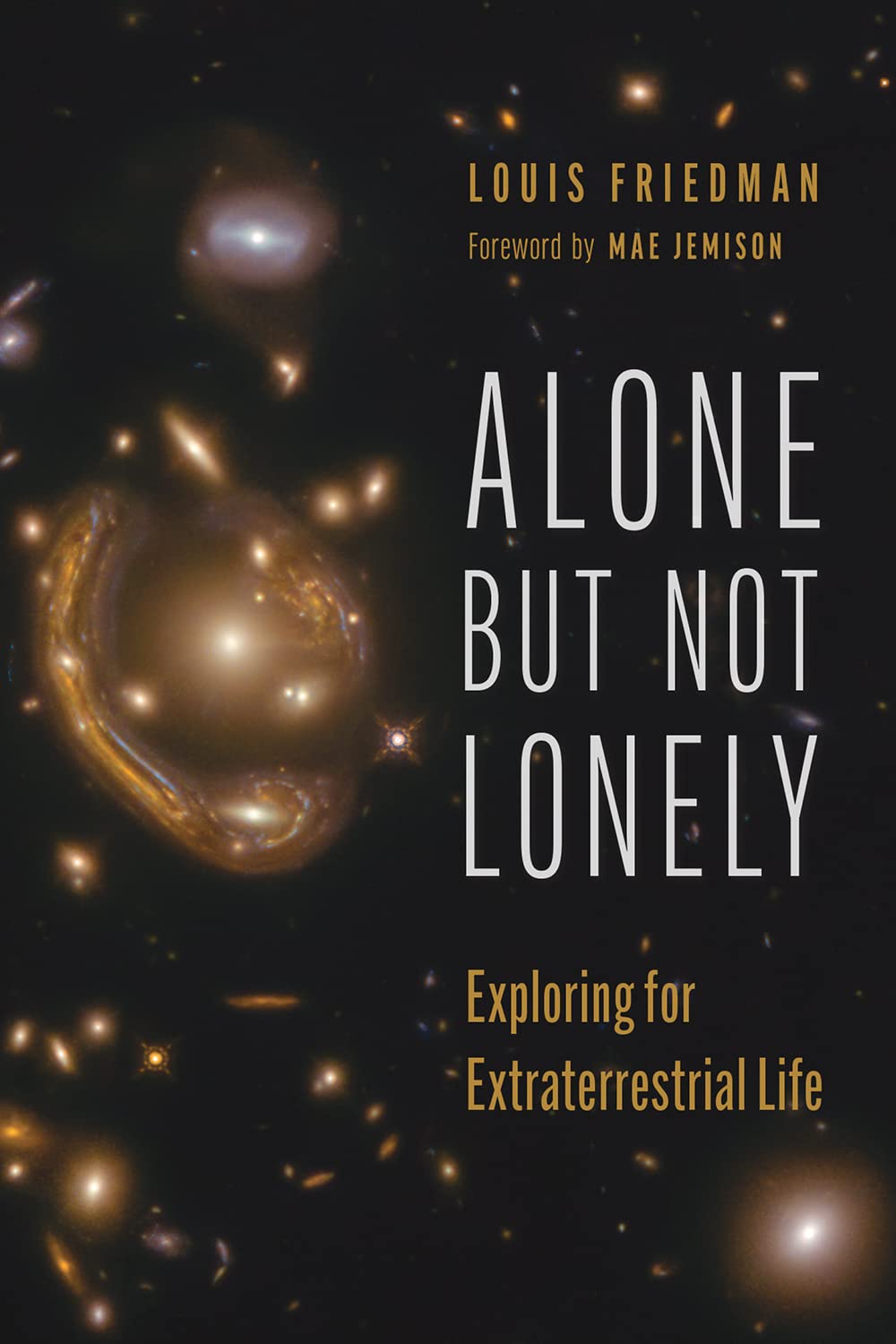
The first was an episode from The Planetary Society’s podcast Planetary Radio titled Alone but not lonely with Louis Friedman. Dr. Friedman, co-founder of The Planetary Society, is very skeptical about the Search for Extraterrestrial Life (SETI) efforts, believing we are most likely alone in the universe in terms of intelligent life and, even if there were other lifeforms out there, they are too far away for us to engage with it. That said, he does have ideas for studying exoplanets, such as a solar gravity lens that could significantly magnify the objects we are viewing.

He also discusses The Planetary Society’s solar sail spacecraft and how it could be left floating in our solar system awaiting and then inspecting incoming objects from outside our solar system. Its a great idea. You can read more about his ideas in his latest book (shown above).

The second episode is from Cool Worlds Lab titled Adam Frank – Technosignatures, Semantic Information, Galactic Colonization. Dr. Frank, a Professor of Physics and Astronomy at Rochester University, is much more optimistic about our ability to eventually find intelligent life in the galaxy and discusses the methods being used today to do so (going beyond the decades old SETI approach). He agrees with Dr. Friedman that we are dealing with great distances that may preclude human travel to these locations.

Dr. Frank even discusses the idea that maybe we were visited by alien civilizations in the past and we don’t know it because we were not here at the time. He discussed this very topic an much more in an earlier Scientific American article, “Alone in a Crowded Milky Way,” stating:

Perhaps long, long ago aliens came and went. A number of scientists have, over the years, discussed the possibility of looking for artifacts that might have been left behind after such visitations of our solar system. The necessary scope of a complete search is hard to predict, but the situation on Earth alone turns out to be a bit more manageable. In 2018 another of my colleagues, Gavin Schmidt of the NASA Goddard Institute for Space Studies, together with Frank, produced a critical assessment of whether we could even tell if there had been an earlier industrial civilization on our planet.

As fantastic as it may seem, Schmidt and Frank argue—as do most planetary scientists—that it is actually very easy for time to erase essentially all signs of technological life on Earth. The only real evidence after a million or more years would boil down to isotopic or chemical stratigraphic anomalies—odd features such as synthetic molecules, plastics or radioactive fallout. Fossil remains and other paleontological markers are so rare and so contingent on special conditions of formation that they might not tell us anything in this case.

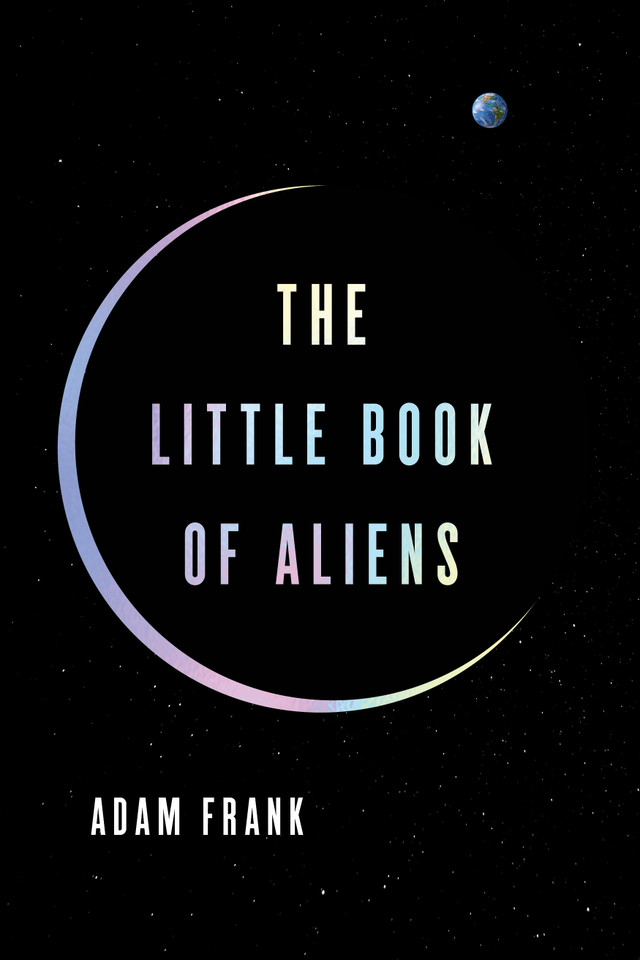
It’s a terrific article that also argues that we may be in a part of the galaxy that gets fewer visitors. I recommend listening to the podcast and then reading the article (or checking out his book on the topic, shown below).

Credit: HarperCollinsPublishers

Queen’s Brian May and Bennu?

Credit: University of Arizona Press.

I was surprised to hear from Queen’s Brian May regarding the recent landing of the asteroid Bennu sample in the Utah desert. Here is what he posted and stated on his page:

“Today is the day – the long awaited day – when the sample of a piece of material From Bennu – the asteroid most likely to hit the Earth in the future, is recovered to Earth. This box when it is opened of material from the surface of Bennu can tell us untold secret of the origins of the universe, the origins or our planet and the origins of life itself. What an incredibly exciting day. Tune into Nasa TV. Go to the OSIRIS-REx website. Read my new book for the full story – Bennu 3-D – written with leader of the mission, Dante Lauretta. And enjoy this wonderful forward step in our knowledge of the universe.”

As you can see above, Brian May is named on the book about the asteroid. He is also credited with assisting NASA with the location of the sample landing. I was not aware of his deep involvement with the Bennu mission, or astronomy in general. In addition to the points above, it is worth noted that Mr. May (per Wikipedia):

  • earned a PhD degree in astrophysics from Imperial College London in 2007;
  • was a “science team collaborator” with NASA’s New Horizons Pluto mission;
  • is a co-founder of the awareness campaign Asteroid Day; and
  • has an asteroid named after him – Asteroid 52665 Brianmay.

Pretty impressive for a guy with a singing day job.

Some Science Fiction Beach Books

Credit: Tor Books

After going through Amazon’s list of top science fiction books, I pulled the top five involving interplanetary travel that may be of interest to readers. I am not endorsing these (nor would I in some clear cases), but rather pointing them out if you left for the beach and forgot to bring a book or two. It’s a good idea to have a backup book, and I also recommend you start at the beginning of each series just to make life easier.

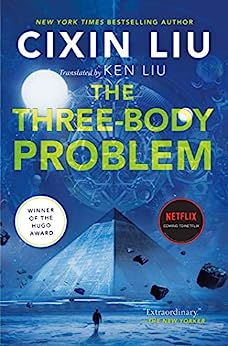
  • The Three-Body Problem by Cixin Liu (1 of 4 in the series)

Set against the backdrop of China’s Cultural Revolution, a secret military project sends signals into space to establish contact with aliens. An alien civilization on the brink of destruction captures the signal and plans to invade Earth. Meanwhile, on Earth, different camps start forming, planning to either welcome the superior beings and help them take over a world seen as corrupt, or to fight against the invasion. The result is a science fiction masterpiece of enormous scope and vision.

  • Light Bringer: A Red Rising Novel  by Pierce Brown (6 of 7 in the series)

The Reaper is a legend, more myth than man: the savior of worlds, the leader of the Rising, the breaker of chains.

But the Reaper is also Darrow, born of the red soil of Mars: a husband, a father, a friend.

Marooned far from home after a devastating defeat on the battlefields of Mercury, Darrow longs to return to his wife and sovereign, Virginia, to defend Mars from its bloodthirsty would-be conqueror Lysander.

Lysander longs to destroy the Rising and restore the supremacy of Gold, and will raze the worlds to realize his ambitions.

The worlds once needed the Reaper. But now they need Darrow, and Darrow needs the people he loves—Virginia, Cassius, Sevro—in order to defend the Republic.

So begins Darrow’s long voyage home, an interplanetary adventure where old friends will reunite, new alliances will be forged, and rivals will clash on the battlefield.

Because Eo’s dream is still alive—and after the dark age will come a new age: of light, of victory, of hope.

  • Ice Planet Barbarians by Ruby Dixon ( 1 of 21 in the series)

You’d think being abducted by aliens would be the worst thing that could happen to me. And you’d be wrong. Because now, the aliens are having ship trouble, and they’ve left their cargo of human women – including me – on an ice planet. And the only native inhabitant I’ve met? He’s big, horned, blue, and really, really has a thing for me…

  • Backyard Starship: Constant Sorrow by J.N. Chaney and Terry Maggert (15 of 16 in the series)

Humans have been in the stars far longer than Van originally thought, and they’ve been busy.

But not every visitor to or from Earth has good intentions, and the Peacemakers are faced with an uncomfortable reality. The Earth is about to meet aliens. Some of the aliens are bringing goods to trade. And among those items—are weapons.

When a secret cabal of humans who want to exploit the Earth is revealed, Van has to decide how and where to fight this threat. Along the way, he reveals a secret history that began in the Great War—and ends with mass chaos on his home planet.

Van won’t let that happen—at least not without a fight, and to hold back the gears of war, he’s going to need a lot of help. With Torina at his side, the crew faces a decision that will change the future of the stars themselves, and challenge the Guild, the Earth, and the Equal Grasp as the universe gets smaller with each contact between humans and aliens.

How can Van manage the clash, save earth, and deliver peace?

If he can, what will it cost him?

  • Defiance of the Fall 10: A LitRPG Adventure by TheFirstDefier and JF Brink (10 of 11 in the series)

A storm of fate is gathering, and Zac finds himself at its center.

Having escaped the Orom’s prison, Zac has finally returned to Earth. Much has changed during his years off-world, with war brewing in the Zecia Sector. Struggle is the System’s mandate, where the strong thrive, and the weak suffer.

Zac and the Atwood Empire are racing against time to accumulate the power needed to survive. With danger comes opportunity, and all clues point toward the chaotic Million Gates Territory. That’s where the invaders are hiding, and that’s where Ogras is trapped. But first, Zac needs a spaceship.

Meanwhile, ancient forces from the depths of the Multiverse stir, their gazes pointed toward the desolate frontier.

Television: Season Two of Foundation

Image (Credit): Poster for season two of Foundation. (Apple TV+)

If you are not watching Foundation on Apple TV+, I recommend you give it a try. Season two begins today.

We need it during a summer with very few if any films touching on space fantasies (without Marvel or DC Comics superheros). The season two trailer will show you what is in store this season, but you need to start from the beginning with season one. You do not want to miss a minute of this series.

The Foundation television series is a cross between Dune and Game of Thrones, with plenty of corrupt dynasties, rebel alliances, and moral dilemmas. However, you should not expect it to closely track Issac Asimov’s books. It deviates from and expands on the themes from the books, but this television story is its own creature. You should enjoy the book and television series separately.

Back in 2021, Belen Edwards wrote a good piece for Mashable called “How Apple TV’s ‘Foundation’ is different from the books.” You will not need it if you are new to the overall story or willing to trust Apple TV+ to give you a good show, but if you are curious about the variations on a theme then this will satisfy that itch.

I am just happy that we have a summer space blockbuster to keep us satisfied. And it is a welcome addition to the constant renewal of Star Trek and Star Wars series. Don’t get me wrong. I want all of it. But Asimov’s universe is another great place to travel if only to better understand the world back here.