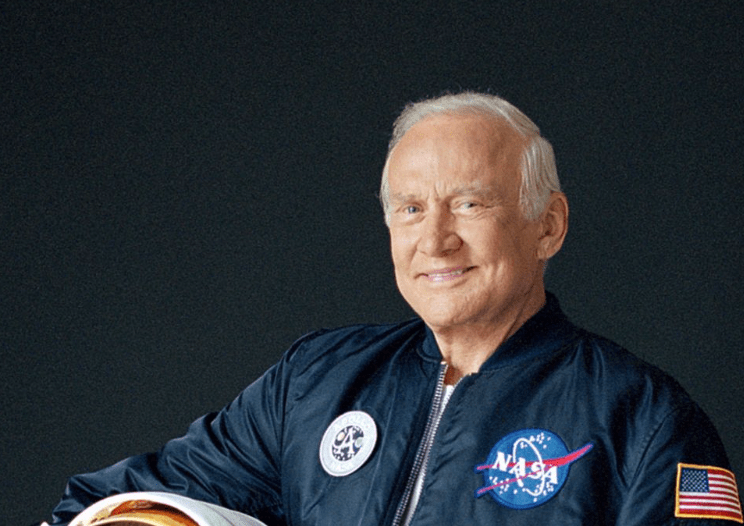
On this day in 1930, Edwin Eugene (Buzz) Aldrin Jr. came into the world. Since that day, he has been busy with adventures in the sky (US Air Force fighter pilot), in orbit (Gemini 12), and on the Moon (Apollo 11). He will always be remembered as part of the first pair of humans (Neil Armstrong being the other half) to step on the lunar surface.
Here are a few other interesting facts about Mr. Aldrin:
“Buzz” came from his sister mispronouncing “brother” as “buzzer”;
his father wanted him to go to the Naval Academy, but Buzz’s seasickness steered hims towards West Point;
he flew 66 combat missions in Korea;
the was the first astronaut with a doctoral degree;
the first person to hold a religious ceremony on the Moon;
following the Apollo 11 mission, Buzz, Neil Armstrong, and Michael Collins toured Michael Collins toured 22 countries over 38 days;
he was the oldest person to reach the South Pole at age 86;
he has written numerous books, including his autobiography Magnificent Desolation.
Both Andy Weir (author of The Martian, Artemis, and Project Hail Mary) and Rob Manning (Chief Engineer at the Jet Propulsion Laboratory) were shooting the you-know-what as they chatted about science fiction books they read as teenagers, the role of real science in fictional tales, astronomical conspiracy theories, and mankind’s need to expand into the unknown.
It was interesting to hear Andy Weir talk about curiosity being humanity’s survival mechanism. He pointed out that curiosity has allowed humanity to survive disasters here on Earth because we were all spread out rather than clustered on one flood plain. The same applies to expansion beyond the Earth.
Check it out for yourself. You may want to check out some of the earlier podcasts as well, such as:
On a recent episode of the Clear + Vivid podcast, Alan Alda interviewed NASA engineer Les Johnson about his efforts to develop a solar sail that can take us to the stars. He is the Principal Investigator for the NEA Scout, which was launched into space during the Artemis I mission and is now heading towards a near-Earth asteroid via solar sails (see above).
During the interview, Mr. Johnson discussed the NEA Scout as well as his hopes for future human travel to the stars using solar sails, noting that while slow, the sails can outperform modern rocket engines in the long-run. He also pointed out that a solar sail may be able to get us to Proxima Centauri, the closest neighboring star, in hundreds of years versus the 70,000 years it will take the Voyager spacecraft to travel that same distance. I like how he puts such a mission in perspective, pointing out it took hundreds of years to build some of the great cathedrals.
Messrs. Alda and Johnson also discussed the ethics of space travel considering astronauts will be spending generations in space with many humans never seeing either the Earth or the destination in their lifetime. Mr. Johnson said space lasers may be another option for interstellar travel at some point in the future, reducing the travel time to Proxima Centauri to 40-50 years. Given the time spans, he said it may make sense to initially send robots into space first.
Finally, the podcast covered missions closer to Earth, such as mining asteroids for water and minerals, as well as 3D printing to create what we need in space. It sounded a lot like the situation in find in the science fiction TV series The Expanse.
Overall, it was a great conversation worth a few minutes of your day. Check it out.
Extra: Mr. Johnson is also the author of several books, including the co-authored Saving Proxima. Here is a quick summary of that tale:
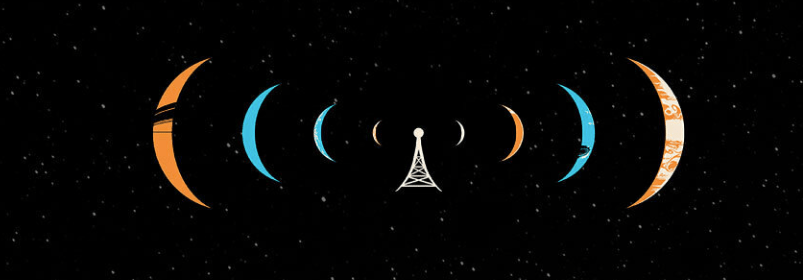
2072. At the lunar farside radio observatory, an old-school radio broadcast is detected, similar to those broadcast on Earth in the 1940s, but in an unknown language, coming from an impossible source—Proxima Centauri. While the nations of Earth debate making first contact, they learn that the Proximans are facing an extinction-level disaster, forcing a decision: will Earth send a ship on a multiyear trip to render aid?
Interstellar travel is not easy, and by traveling at the speeds required to arrive before disaster strikes at Proxima, humans will learn firsthand the time-dilating effects of Einstein’s Special Relativity and be forced to ponder ultimate questions: What does it mean to be human? What will it take to share the stars with another form of life? What if I return younger than my own children? The answers are far from academic, for they may determine the fate of not one, but two, civilizations.
If you are looking for another gift idea for the holidays, maybe you should consider one of the many popular astronomy books. Here are the 10 most popular from Goodreads:
It’s great to see that Carl Sagan is still educating the public so many years after his death. As with the Voyager spacecraft, his words and contributions are traveling far and wide.
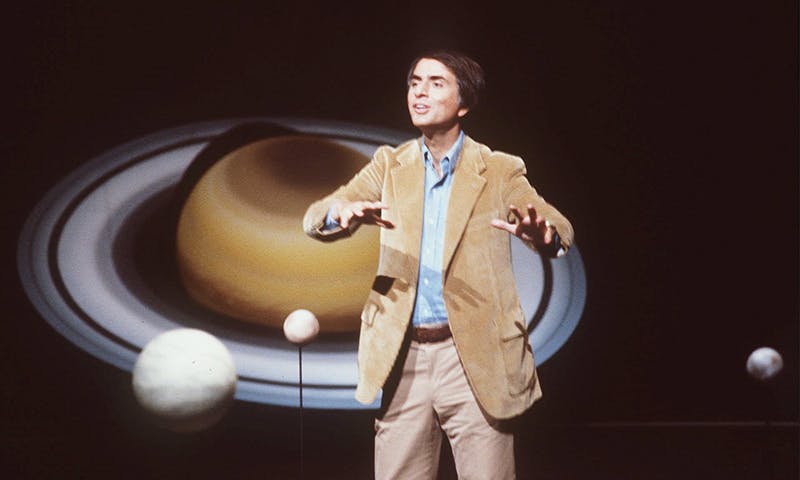
Image (Credit): Astrobiologist Carl Sagan. (Nautilus.us)
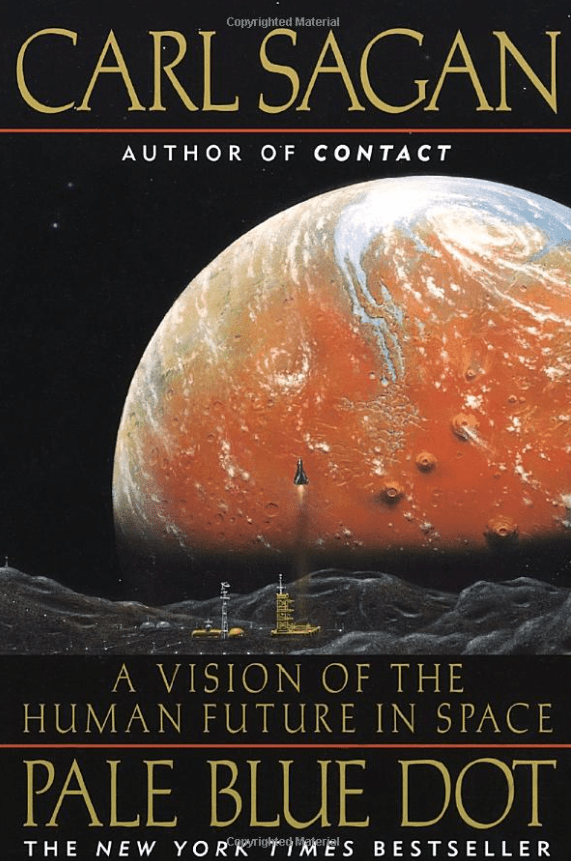
On this day in 1934, scientist and communicator Carl Edward Sagan was born in Brooklyn, NY. He was to become a great communicator of all things related to astronomy. He has played a key role over the years introducing millions to our place in the universe through his books, television series, speeches, and scientific work. His television series Cosmos was a milestone in educational television, bringing the stars and planets into everyone’s living room, while his books (Contact, Pale Blue Dot, The Dragons of Eden) continue to encourage the next generation of astronomers.
Dr. Sagan has a long resume, but I am most fascinated with his work to communicate with extraterrestrial life. He was a strong supporter of the Search for Extra-Terrestrial Intelligence (SETI) and worked with NASA to ensure our spacecraft were equipped with a record of human activity to educate other planetary civilizations, including the gold records placed on the Pioneer 10 and 11 space probes as well as the two Voyager space probes.
Years ago, the Smithsonian magazine had a good summary of Dr. Sagan’s life in the article “Why Carl Sagan is Truly Irreplaceable.” I recommend the article as a good way to get to know the man, though delving into his books is even better.
Credit: Ballantine Books
Extra: Carl Sagan was also the founder and first president of the Planetary Society. Visit this Planetary Society site, Ann Druyan wishes you a happy Sagan Day, for more on Dr. Sagan’s work.




 Our Awesome Universe