While everyone is pretty excited about NASA’s ability to nudge a distant asteroid via its Double Asteroid Redirection Test (DART) mission, there is more than one way to look at this event. While many see this as a new tool to protect the Earth from approaching peril, Carl Sagan saw this it more as a double-edged sword.
Can we humans be trusted with civilization-threatening technologies? If the chance is almost one in a thousand that much of the human population will be killed by an impact in the next century, isn’t it more likely that asteroid deflection technology will get into the wrong hands in another century—some misanthropic sociopath like a Hitler or a Stalin eager to kill everybody, a megalomaniac lusting after “greatness” and “glory,” a victim of ethnic violence bent on revenge, someone in the grip of unusually severe testosterone poisoning, some religious fanatic hastening the Day of Judgment, or just technicians incompetent or insufficiently vigilant in handling the controls and safeguards? Such people exist. The risks seem far worse than the benefits, the cure worse than the disease.
You might also remember the stealth asteroids directed at Earth by terrorists in the fifth season of the television series The Expanse. Yes, it is science fiction, but so wasn’t the idea of landing humans on the Moon until it was a fact.
As we watch the Middle East burn again, it is not hard to imagine a battle involving sociopaths, ethnic violence victims, leaders with severe testosterone poisoning, religious fanatics, or even incompetent individuals without guardrails making more of a mess of the Earth and its surroundings.
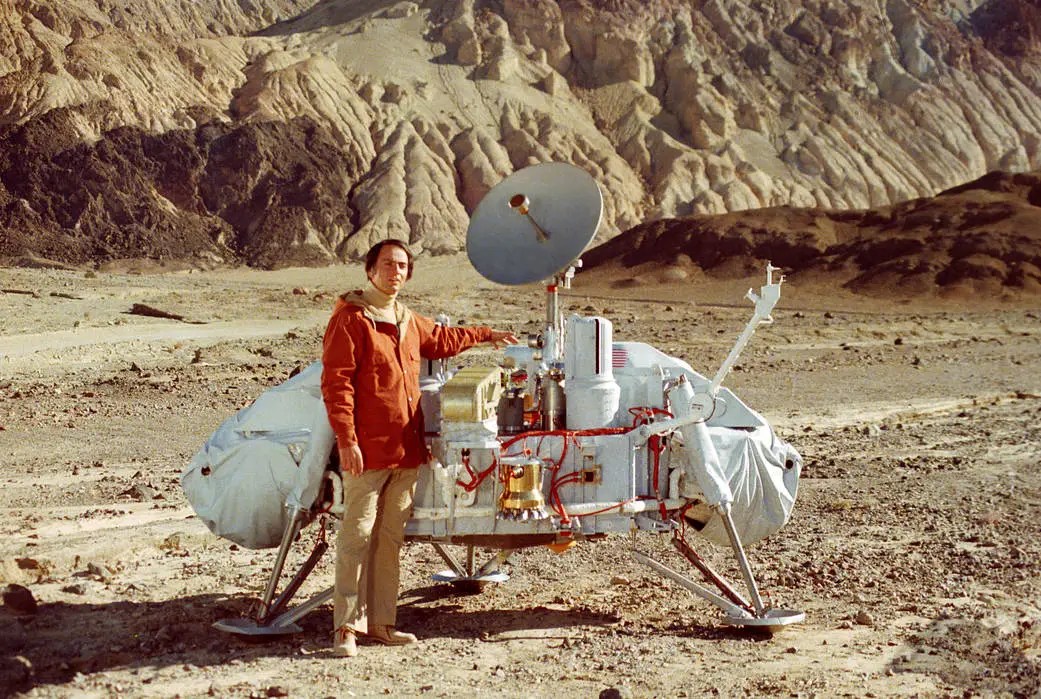
Image (Credit): Dr. Carl Sagan poses with a model of the Viking lander in Death Valley, California. (NASA)
AI can do a number of things well, including astronomy-related tasks, but it also has a tendency to step on toes and steal other peoples creations. This was certainly the case with the editing program Grammarly, which wanted to go beyond simple grammar-related corrections. Instead, it started bragging about how it could edit like various famous writers and other well known individuals via a service called Expert Review.
Would you like Carl Sagan to edit your work? Well, Expert Review can help. How about Neil deGrasse Tyson? Sure, why not?
The problem is that Grammarly never obtained permission to mimic these parties, so now it faced a multi-million dollar lawsuit. The Guardian newspaper cites an company official who stated that Expert Review has already been taken down for redesign. That sounds a lot like a “rapid disassembly” of the service.
Many would like the equivalent of a Carl Sagan to be only a click away for advice and input, but this is not the way to do it.
We can only hope that AI services, currently backed by billions in investment funds, can one of these days figure out a way to (1) seek permission beforehand for data use and (2) share the wealth with true creators.
Until then, AI should stick to the raw AI astronomy data and stop impersonating the astronomers.
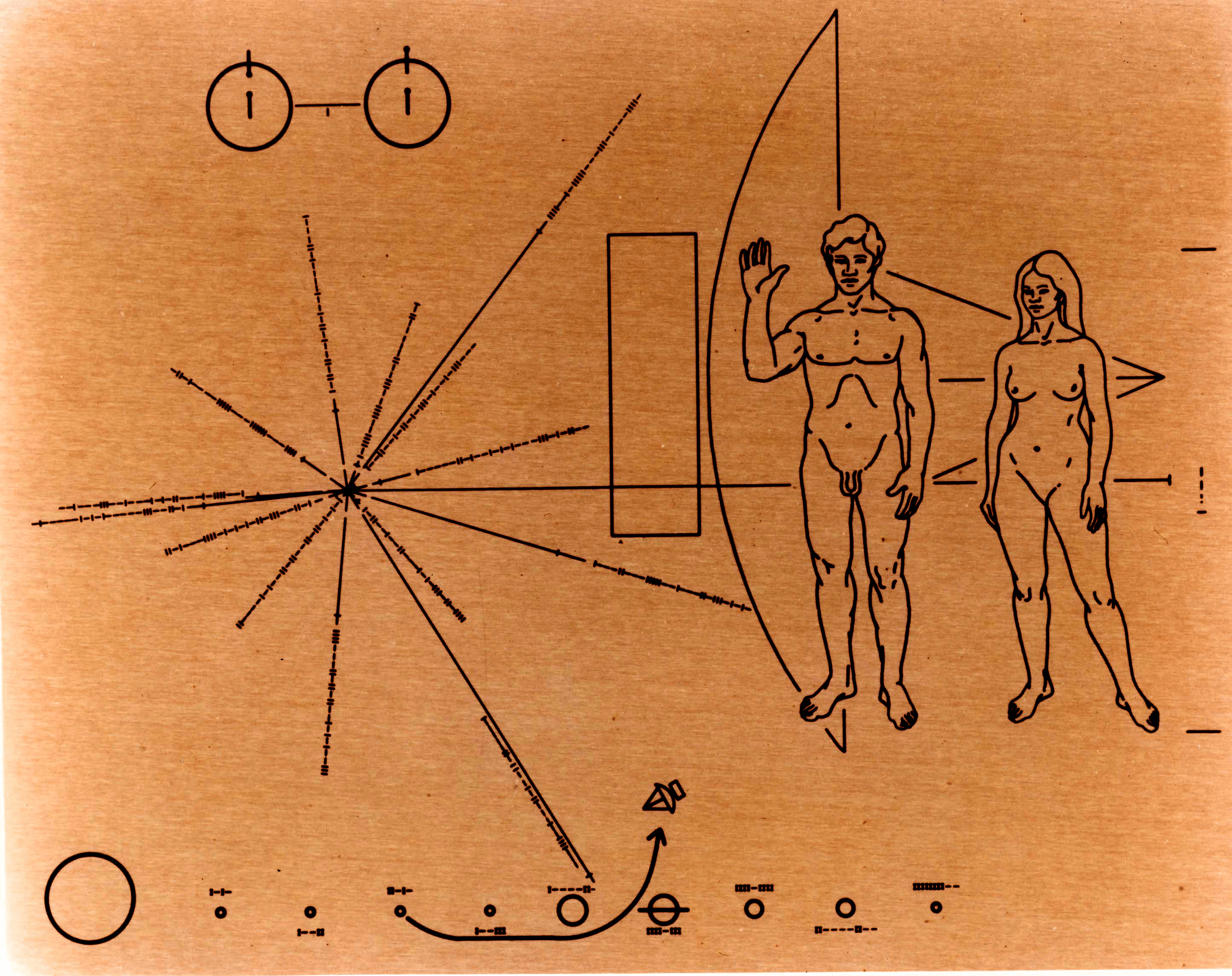
Image (Credit): The visual message on the Pioneer 10 and 11 plaques. (NASA Ames)
On this day in 2003, NASA heard its last message from Pioneer 10, the Jupiter space probe. Launched in 1972, it was the first spacecraft to cross the asteroid belt between Mars and Jupiter on its way to the outer planets. It is also one of only five spacecraft to leave our solar system.
If all goes well, in about 2 million years the Pioneer 10 spacecraft will encounter the star Aldebaran. Maybe some civilization in that solar system will be arguing about this object floating through the neighborhood the way we have argued about the origins of the interstellar object we call 3I/ATLAS.
Image (Credit): Mission patch for Pioneer 10 and 11. (NASA)
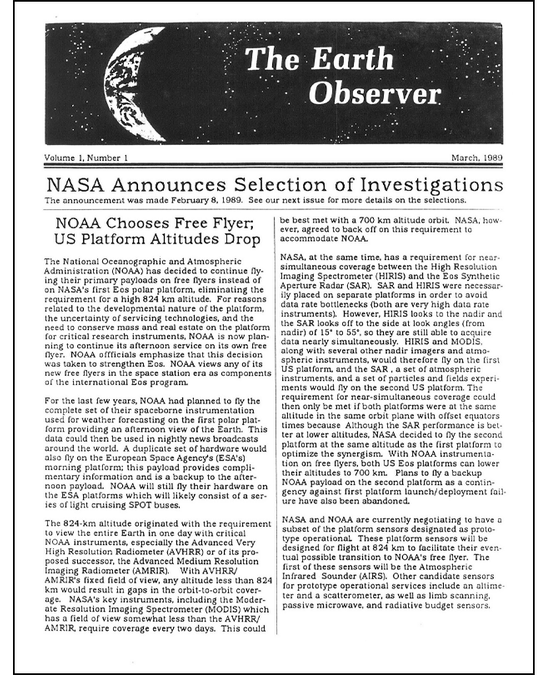
Image (Credit): The first edition of The Earth Observer from March 1989. (NASA)
While most of the press stories have been focused on this week’s closing of a NASA largest research library located at the Goddard Space Flight Center in Maryland, NASA is quietly shutting down a key news source called The Earth Observer. This newsletter was a source of information and data related to the multiple satellites surrounding the Earth and monitoring its health.
It is with a heavy heart that I announce that NASA Earth Science Communications has directed The Earth Observer to conduct an orderly shutdown of the publication. No new content will be published after Dec. 31, 2025.
This comes at a time when the White House is drastically cutting the Earth science programs at NASA, somehow assuming that if we don’t know what it happening with our planet then we do not need to worry. NASA is being told to shift its focus to other distant worlds where we will probably never go instead of helping to preserve the only world we have.
Space Dailyreported that we have already witnessing the end of three critical satellites monitoring Earth as a natural product of time – Terra, Aqua, and Aura – but they are not being replaced to keep the monitoring alive.
In the article, Space Daily noted:
Satellite aging was expected. What was not, Earth scientists say, is the policy shift coming from Washington. The FY26 presidential budget request would cut NASA’s Science Mission Directorate by nearly half, with Earth science funding falling from about 2.14 billion dollars to roughly 1.04 billion dollars, a 52 percent reduction. Commentators and advocacy groups describe the proposal as the steepest single year hit to NASA science since the post Apollo drawdown.
Shutting libraries, deleting data, and ending investments in the future will come back to bite us. Many in the world are interested in keeping this world vibrant and alive, and will do so with our without the United States. While cost-cutting can be justified if it done intelligently, the ongoing scientific suicide is something else entirely.
We’ve arranged a global civilization in which most crucial elements profoundly depend on science and technology. We have also arranged things so that almost no one understands science and technology. This is a prescription for disaster. We might get away with it for a while, but sooner or later this combustible mixture of ignorance and power is going to blow up in our faces.
If you have questions about UFOs, now fashionable called Unidentified Anomalous Phenomena (UAP) to presumably add some seriousness and move it away from the kooky crowd, you might want to check out the upcoming film The Age of Disclosure. It will be available on November 21 on Amazon Prime as well as at select theaters.
Here is the trailer, which might entice you. It has the draw of many entertainment thrillers, and reminds me of the endless videos on YouTube and even Netflix describing secrets only a few know. It comes across as an updated version of the search for Bigfoot and the Arch of the Covenant rolled into one.
The film description states:
The Age of Disclosure is an unprecedented and revelatory film –featuring 34 senior members of the U.S. Government, military, and intelligence community– revealing a cover-up of the existence of non-human intelligent life and a secret war to reverse engineer technology of non-human origin.
The film exposes the profound impact the situation has on the future of humanity, while providing a look behind-the-scenes with those at the forefront of the bi-partisan disclosure effort.
An explosive documentary that reveals an 80-year global cover-up of non-human intelligent life and a secret war among major nations to reverse-engineer advanced technology of non-human origin. Featuring testimony from 34 U.S. Government, military, and intelligence community insiders, the film exposes the profound stakes for the future of humanity.
One of the officials in the trailer is Senator Marco Rubio, now Secretary of State Rubio. If there is any bit of truth to all of this, we should be asking for these UAP files instead of the Epstein files.
The films creator, Dan Farah, was on Real Time with Bill Maher last week discussing the film. You can find the podcast here. Mr. Farah discusses how these non-human actors live in the sea and seem to have appeared right around the time the nuclear age started. Of course, this is also after World War II when new forms of flight and related spying was underway, but why mess up the story.
Mr. Farah also seems surprised they are seen around our military facilities, as if this would not be a prime target for any outside party, human or otherwise. He then states:
…there’s been a few events where UAP activity over nuclear weapon sites has activated the missiles in some case and then turned them off in some cases. And it’s obviously a display of power of some sort. You know, your guess is as good as mine of what the intention is, but it’s concerning.
All of this sounds pretty amazing, yet I think it is more an amazing paste job of various quotes that are then repurposed to create a more dramatic story. For that reason, it may be better for the uninitiated, or just the regular newspaper readers who do not get their news from social media, to first go through the material from the very group set up to study all of this, the All-domain Anomaly Resolution Office, as well as various congressional hearings on this matter. Then you can make up your own mind.
Here are a few congressional hearings to get you started on your search:
We already have too many conspiracies upsetting the public and breeding mistrust of all government entities. Its time to breath and read up on this material yourself.
Science arouses a soaring sense of wonder. But so does pseudoscience. Sparse and poor popularizations of science abandon ecological niches that pseudoscience promptly fills. If it were widely understood that claims to knowledge require adequate evidence before they can be accepted, there would be no room for pseudoscience. But a kind of Gresham’s Law prevails in popular culture by which bad science drives out good.



 Our Awesome Universe