Image (Credit): China’s Zhurong Mars rover. (CNSA Watcher)
This week’s image shows the China’s Zhurong Mars rover on the surface of the Red Planet. Part of the Tianwen-1 mission, the rover landed on Mars May 14, 2021. The photo, tweeted out by the Chinese National Space Administration (CNSA) Watcher site, was taken by a disposable camera dropped by the rover.
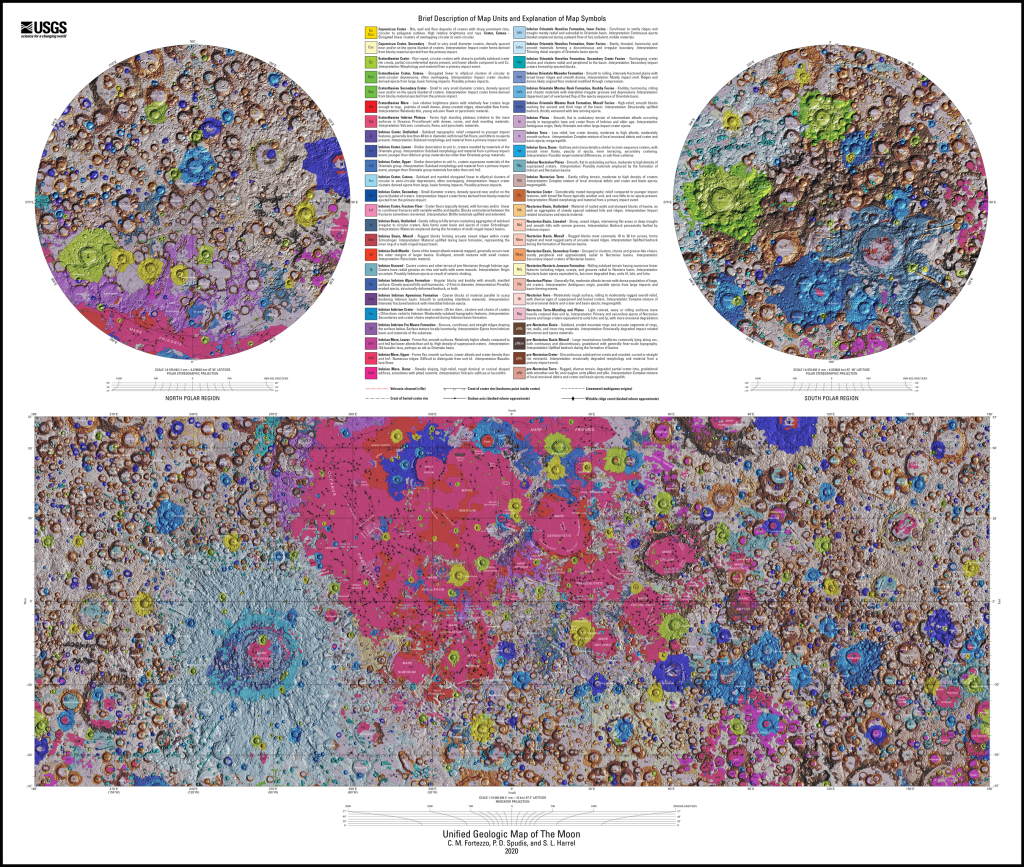
Image (Credit): Map of the Moon’s surface. (NSSDC Space Science Article Data Repository)
Earlier this month, China released a geological map of the Moon’s surface. It is to a scale of 1:2,500,000. Here is the accompanying description of the map:
Geologic maps of the Moon provide comprehensive information about the geologic strata, structural features, lithologies, and chronology of the lunar crustal surface, which reflect the evolution of the lunar crust under igneous processes, catastrophic impacts, and volcanic activities. The map in this repository is the first 1:2,500,000-scale lunar global geologic map, which incorporates the most comprehensive knowledge about the Moon by taking advantage of the latest exploration results and scientific findings. An updated lunar time scale is employed in this map to better reflect the dynamic evolution of the Moon. The map provides a state-of-the-art illustration of impact basins and craters of different periods, the distributions of 17 types of rocks and 14 types of structures.
With numerous countries considering lunar bases, greater details about the Moon’s surface could be very useful. I would have liked an overlay showing the various lunar mission remains already sitting on the Moon’s surface.
By the way, while the press is calling this the first comprehensive lunar map, there have been others, including the map below released two years ago by the U.S. Geological Survey’s (USGS) Astrogeology Science Center in Flagstaff, Arizona. I say the more maps the better for everyone.
Image (Credit): This new work represents a seamless, globally consistent, 1:5,000,000-scale geologic map derived from the six digitally renovated geologic maps. (USGS)
Have you read about the Chinese car company with space ambitions? In a June 2 press release, we learn that a unit of the Chinese automaker Geely (owner of Volvo, Polestar, and Group Lotus) already sent 9 communications satellites into orbit this year, with plans for a total of 240 such satellites in a constellation that will assist car drivers with autonomous driving.
Of course, automaker Elon Musk is also launching satellites into space as part of the Starlink program, but that is about the end of the similarities for now. In addition to planning to launch fewer satellites with a more restricted mission, Geely will depend upon Chinese government rockets to launch these satellites. Mr. Musk has his own SpaceX rockets to assist Starlink.
That does not mean Geely lacks in ambition elsewhere. In the same press release, Geely stated:
With the successful launch and operation of Geespace’s first satellites, the company will become one of the world’s first providers of combined commercial Precise Point Positioning and Real-Time Kinematic services (PPP-RTK)…
Tony Wang, CEO and Chief Scientist of Geespace said: “Many favourable factors such as policy support and market demand is accelerating the growth of the commercial aerospace sector...new opportunities to develop have been opened in various sectors including smart mobility, consumer electronics, unmanned systems, smart cities, and environmental protection.”
And while Geely is not building rockets at this time, it is building satellites:
Early in September 2021, Geely’s Intelligent Satellite Production and Testing Centre began mass production of commercial satellites with an annual production capacity of 500 units. Through intelligent modular manufacturing, Geespace is able to produce high-quality, easily customizable satellites to meet the growing global demand for commercial satellites. The GeeSAT-1 is only the first of many new satellite models from Geespace and its successful launch into orbit is just the first of many to come.
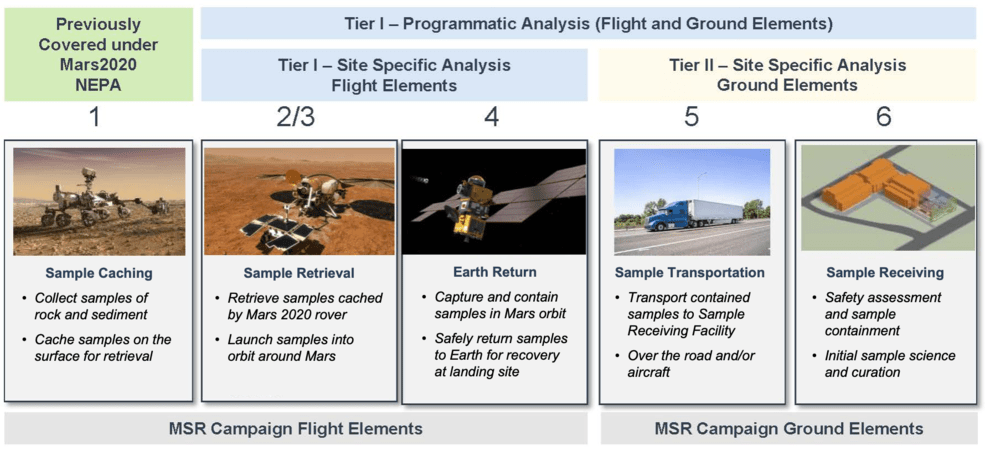
Image (Credit): Mars Sample Return campaign poster. (NASA)
NASA and the European Space Agency are still looking for comments on the process to return Martian rock samples to Earth. Of the six steps needed to collect and return the samples (see graphic above), only the first step is currently underway with the Perseverance Rover exploring Mars. Now we need to get those samples home. You have until May 15th to get comments back to NASA on this.
And what is the time frame for getting these samples back to Earth? The current goal is 2033, assuming all goes well. You may recall that China also wants to collect and return Martian samples by 2030. I expect more delays on both sides. When you add this to the race back to the Moon, the space race is getting more interesting every day.
Image (Credit): USSR’s Luna 2 spacecraft. (Worldhistoryproject.org)
So who owned the rocket stage that hit the Moon earlier this month? I had earlier noted the speculation pertaining to both SpaceX and then the Chinese rockets. Surprisingly, it is still is not clear who owned that rocket stage and maybe we will never know. That is not a good answer for the European Space Agency’s Space Safety Programme, which stated:
The upcoming lunar impact illustrates well the need for a comprehensive regulatory regime in space, not only for the economically crucial orbits around Earth but also applying to the Moon.
While that case has yet to be solved, we are pretty certain about the first Earth-launched rocked to hit the Moon. We can blame the Soviets for that strike back in 1959 with its Luna 2 (nicknamed the Lunik 2). At least the goal in that case was to hit the Moon.
Launched on September 12, 1959, it took 35 hours to travel the distance between the Earth and Moon. Luna 1, launched by the Soviets earlier that year, was supposed to hit the Moon but it missed by about 3,700 miles. You can see more about Luna 2 via this dated news clip.




 Our Awesome Universe