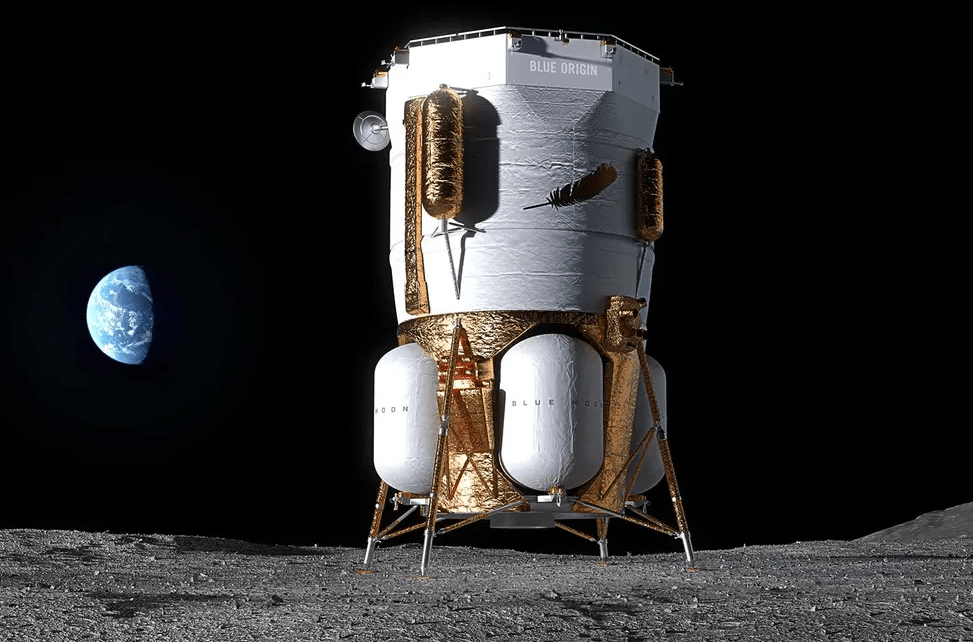
Image (Credit): Artist’s rendering of Blue Origin’s Blue Moon Mark 1, which is a single-launch, lunar cargo lander. (Blue Origin)
President Trump has had a change of heart on Jared Isaacman, his initial nominee for NASA administrator until he withdrew that nomination earlier this year.
Earlier today, the President posted the following:
Jared’s passion for Space, astronaut experience, and dedication to pushing the boundaries of exploration, unlocking the mysteries of the universe, and advancing the new space economy, make him ideally suited to lead NASA into a bold new era.
So what has changed in the last few months to make Mr. Isaacman “ideally suited” to lead NASA as compared to when he was determine unsuitable? I cannot think of anything other than the end of the President’s feud with Elon Musk. Of course, that was recently replaced with Elon Musk’s feud with acting NASA Administrator Sean Duffy, who proposed reopening competition for the first manned Moon landing this century due to delays with SpaceX’s Starship.
Will Mr. Isaacman save Musk’s Moon mission? He may calm some of the acrimony for the time being, but any new NASA administrator had better have a solid plan to get Americans back on the Moon before China does. Mr. Isaacman may be friends with Mr. Musk, but should he be confirmed he will head a weakened space agency that is struggling with a complex Moon mission that may be much less complex without the Starship refueling plans. In fact, Blue Origin just submitted a new Moon mission plan that drops this refueling altogether.
It is not impossible the winds will shift again, leaving Mr. Isaacman adrift once more. That is how it is in Washington these days. Fickle leadership leads to fickle decision-making and fickle planning.
The Chinese are not having these issues at the moment as they aim to be on the Moon by 2030.
The U.S. has plenty of issues regarding the pace of its space programs in the face of Chinese achievements, as noted multiple times in posts on this site. We should not see this as anything new. U.S. politicians and citizens had plenty of similar complaints during the space race with the USSR, and we also have evidence of similar complaints within the USSR.
For instance, on this day in 1965, Yuri Gagarin, the first man in space, wrote a letter with other cosmonauts to the USSR’s General Secretary Brezhnev with a list of concerns. The letter stated, in part:
The USA have not only caught up with us, but even surpassed us in certain areas. The flights of space vehicles Ranger-7, Ranger-8, Mariner-4, Gemini-5, and others are serious achievements of American scientists. This lagging behind of our homeland in space exploration is especially objectionable to us, cosmonauts, but it also damages the prestige of the Soviet Union and has a negative effect on the defense efforts of the countries from the socialist camp…Why is the Soviet Union losing its leading position in space research? A common answer to this question answer is as follows: the USA have developed a very wide front of research in space; they allocate enormous funds for space research. In the past 5 years they spent more than 20 billion dollars, and in 1965 alone 7 billion dollars. This answer is basically correct. It is well known that the USA spend on space exploration much more than does the USSR.
The letter covers other issues, including battles between the various organizations involved in space affairs as well as a stated preference by some for robotic flights rather than manned-flights.
It is an interesting reminder that the same issues constantly crop up to potentially cripple space initiatives, and today’s leader in space can quickly fall behind.
Image (Credit): An earlier image of Bill Nye showing his support for NASA employees. (The Planetary Society)
You may have heard that the federal government has shut down, but that did not stop the Planetary Society’s CEO Bill Nye from traveling to Washington, DC to protest NASA cuts. He was there with almost two dozen other organizations to protest the White House’s plans to cut 24 percent of NASA’s budget.
Highlighting the potential impact of cuts to NASA’s programs, Bill Nye stated:
The China National Space Administration is going fast, doing a lot of extraordinary missions very similar, almost mission for mission, to what the United States is doing and I’m telling you there’s going to be a Sputnik moment when Taikonauts, China National Space Administration space travelers, are on the moon in the next five years.
A recent report by the Ranking Member of the Senate’s Committee on Commerce, Science, and Transportation, titled The Destruction of NASA’s Mission, states the Trump Administration is already implementing the 2026 cuts at NASA even thought Congress has yet to approve a budget. The report summary notes:
As part of Ranking Member Cantwell’s oversight of the potential impacts of President Trump’s budget request (PBR) for Fiscal Year 2026 (FY26), Democratic staff of the Senate Commerce, Science, and Transportation have uncovered evidence of an illegal plot already in motion. Based on whistleblower documents and interviews, this staff report finds that the White House Office of Management and Budget (OMB) has been directing NASA —since early summer— to begin implementing the devastating cuts demanded in President Trump’s proposed budget for FY26, in clear violation of the Constitution and without regard for the impacts on NASA’s science missions and workforce.
Not surprisingly, the law seems to be no barrier to bad behavior for this administration, yet Mr. Nye and others are not giving in or giving up. Nor should anyone who believes NASA represents the best of what our astronomers and scientists can accomplish. The size of the proposed NASA cuts for FY 2026 are shown below. It is brutal.
You can show your support for NASA by visiting the Planetary Society’s Save NASA Science page.
Image (Credit): Proposed cuts to NASA’s FY 2026 budget. (Senate Committee on Commerce, Science, and Transportation)
The processes driving the formation and distribution of lunar water (OH/H2O), particularly in the subsurface, remain poorly understood. An opportunity to study subsurface water comes from lander plumes, which can displace and expose millimetre- to centimetre-sized regolith during the descent of the lander. Here we analyse data from the Chang’e-6 landing site and find that plume-disturbed areas exhibit distinct temperature and water-content patterns, which are driven by the redistribution of fine regolith. The average water content of the exposed fine regolith of the shallow subsurface is ~76 ppm, which is lower than the surface abundance of ~105 ppm measured at the surface. The Chang’e-6 landing site also contains on average approximately twice the water content than the Chang’e-5 one. Temporal variations of water content are observed at identical locations but different local times, exhibiting a minimum at local noon. We suggest that the differences in water content are correlated with the regolith glass abundance, particle sizes, depths and local times, reinforcing the hypothesis that solar wind implantation and impact gardening govern lunar water formation and distribution.
Citation: Liu, B., Zeng, X., Xu, R. et al. Lunar surface and subsurface water revealed by Chang’e-6. Nat Astron (2025).
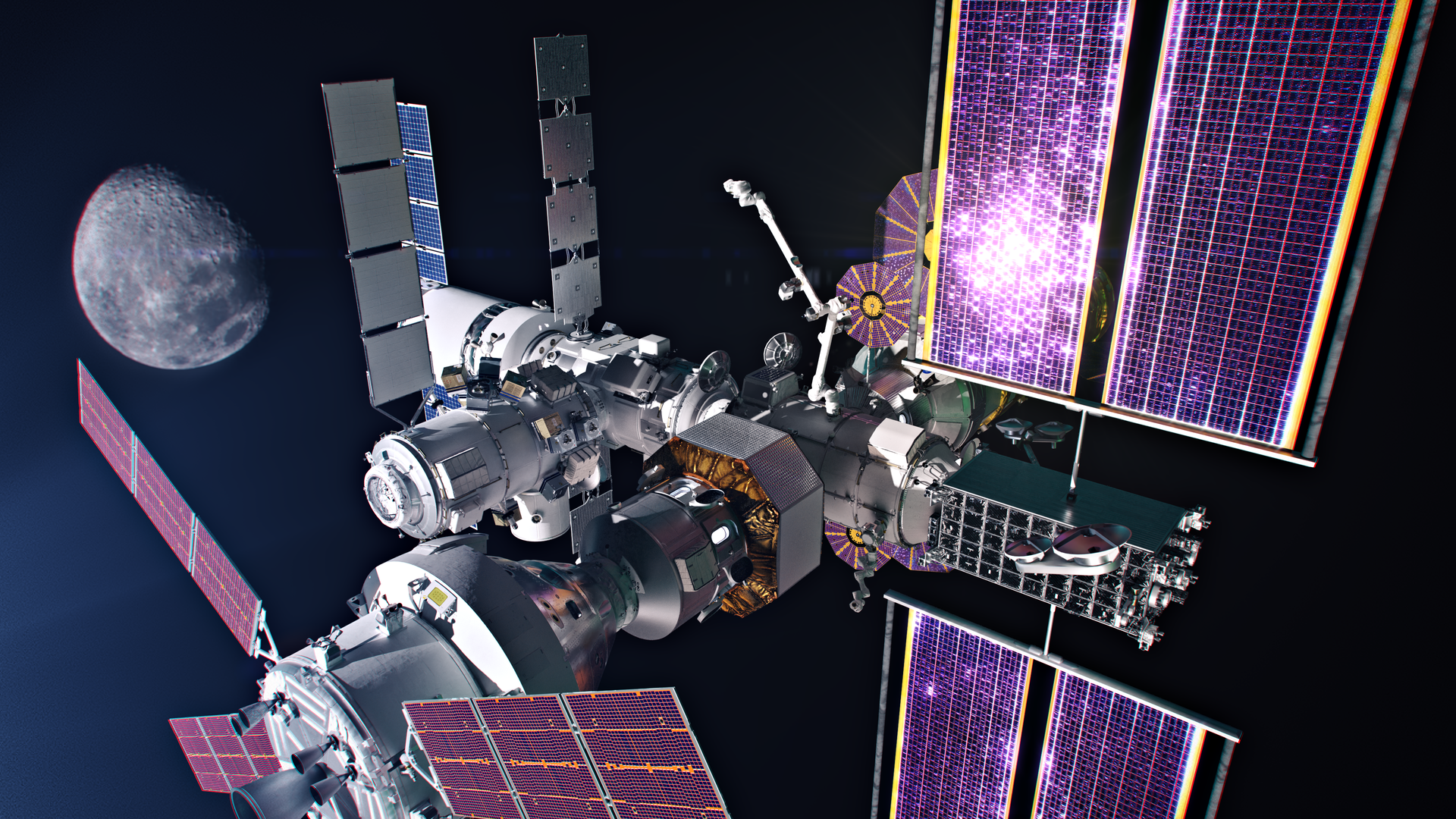
Image (Credit): Artist’s rendering of the Artemis Gateway. (NASA)
The hearing earlier this week held by the Senate Committee on Commerce, Science, and Transportation contained some clear warnings about the future of the US space program. In addition to comments by the Chairman and Ranking Member, we heard plenty from the witnesses about the importance of Artemis program in terms of political and economic outcomes, concerns about how the program is currently structured, and frustration with the continuing uncertainty about long term funding.
For instance, James Bridenstine, a Former Administrator for NASA, stated these concerns about NASA’s ability to land on the Moon under the Artemis program:
While the United States should celebrate orbiting the Moon in 2026, the United States does not have a lander. Unless something changes, it is highly unlikely the United States will beat China’s projected timeline to the Moon’s surface. Our complicated architecture requires a dozen or more launches in a short time frame, relies on very challenging technologies that have yet to be developed like cryogenic in-space refueling, and still needs to be human rated. While the capability could be transformational over time if payload capacity increases (so far it has decreased), the complexity of the architecture precludes alacrity.
Michael Gold, President of Civil and International Space for Redwire, emphasized the need for NASA to continue to resist White House cuts, such as the planned elimination of the Gateway piece in the initial budget proposal, in order to keep the program on track. He stated:
NASA’s waffling on Gateway has left our international partners confused, frustrated, and exploring alternatives to American partnerships. If we fail to continue with Gateway, we will force our partners to consider shifting support from Artemis and America, to China and its International Lunar Research Station (ILRS) program. Unlike the U.S., China has maintained strong and consistent continuity for its lunar beyond [low Earth orbit] spaceflight program, making a collaboration with China potentially far less risky than gambling on what, prior to Artemis, has been a mercurial American beyond LEO space strategy. If our international partners make such a shift to China, it will not only impact the space field but will have substantial diplomatic, geopolitical, and economic consequences on Earth.
And not to be outdone, Lieutenant General John Shaw, Former Deputy Commander of the U.S. Space Command, wanted to ensure the Artemis program was part of a “grand strategy” that could match the Chinese grand strategy integrating the exploration, economic opportunities, and security needs. In his testimony, he stated:
During my military career, I watched and studied – as any good soldier would of a potential adversary – as China slowly but surely developed and deployed its own civilian and military space capabilities and set its own agenda for space achievements. It is clear to me that the Chinese Communist Party is already employing its own integrated grand strategy for the earthmoon system, with only superficial distinction between civil, commercial, and national security activities, and all focused on a common purpose. I believe if we do not unify and synchronize our efforts, we will find ourselves, rather than the space leaders we are today, instead in a position of increasing disadvantage in space as we progress further into this century.
It was clear from what was said throughout the hearing that everyone in the room saw the benefits of a thriving Artemis mission that continued far beyond Artemis II. In fact, Artemis IX was mentioned as well. The real question was whether the US was willing to commit to a Moon and Mars mission for the long term and fund it appropriately so that our country, our commercial partners, and our country partners can realize the benefits for years to come.
That is the question that no one can answer here. However, the Chinese have already answered it for themselves. We can either watch them succeed, or fully commit to the Artemis program and win this latest space race.



 Our Awesome Universe