Image (Credit): Shan Shan (left) and Xiao Bao. (South China Morning Post)
On this day in 1966, China launched a male puppy named Xiao Bao (meaning Little Leopard) into space. He was used to test the effects of space and was safely recovered after the flight.
Thirteen days later a female puppy named Shan Shan (meaning Coral) was also launched into space. She too was safely recovered.
This is a much better tale than that of Laika, the dog that the USSR sent into orbit in 1957. As stray dog from the streets of Moscow, she only lasted a few hours after the launch, eventually dying of hyperthermia.
Image (Credit): Laika in a training capsule before her mission to space. (Sputnik / Alamy)
In response to recent flooding near Kerrville, Texas, NASA deployed two aircraft to assist state and local authorities in ongoing recovery operations. The aircraft are part of the response from NASA’s Disasters Response Coordination System, which is activated to support emergency response for the flooding and is working closely with the Texas Division of Emergency Management, the Federal Emergency Management Agency (FEMA), and the humanitarian groups Save the Children and GiveDirectly.
Two remote-controlled Chinese satellites appear to have docked in high orbit to allow refueling and servicing for the first time. The achievement, which has yet to be matched by the U.S, involved autonomous spacecraft Shijian-21 and Shijian-25, completing the task in geostationary orbit earlier this month. Geostationary orbits occur at 22,236 miles above the surface, and are typically used for communications satellites so that they can move with the rotation of the Earth. However, the high orbit and need for satellites to maintain speeds with the Earth’s rotation makes docking extremely difficult.
The answer to whether tiny bacterial lifeforms really do exist in the clouds of Venus could be revealed once-and-for-all by a UK-backed mission. Over the past five years researchers have detected the presence of two potential biomarkers – the gases phosphine and ammonia – which on Earth can only be produced by biological activity and industrial processes. Their existence in the Venusian clouds cannot easily be explained by known atmospheric or geological phenomena, so Cardiff University’s Professor Jane Greaves and her team are plotting a way to get to the bottom of it. Revealing a new mission concept at the Royal Astronomical Society’s National Astronomy Meeting 2025 in Durham, they plan to search and map phosphine, ammonia, and other gases rich in hydrogen that shouldn’t be on Venus.
Image (Credit): Signatories of the Artemis Accords. (NASA)
With the recent addition of Norway, 55 nations have now signed the Artemis Accords.
And what do the Artemis Accords ask of nations? Here is the purpose of the agreement, which started back in 2020:
The purpose of these Accords is to establish a common vision via a practical set of principles, guidelines, and best practices to enhance the governance of the civil exploration and use of outer space with the intention of advancing the Artemis Program. Adherence to a practical set of principles, guidelines, and best practices in carrying out activities in outer space is intended to increase the safety of operations, reduce uncertainty, and promote the sustainable and beneficial use of space for all humankind. The Accords represent a political commitment to the principles described herein, many of which provide for operational implementation of important obligationscontained in the Outer Space Treaty and other instruments.
This includes the sharing of scientific findings and related material, such as China’s recent sharing of lunar samples. Specifically, Section 8, Item 2 of the Accords states:
The Signatories are committed to the open sharing of scientific data. The Signatories plan to make the scientific results obtained from cooperative activities under these Accords available to the public and the international scientific community, as appropriate, in a timely manner.
While the validity of international trade treaties have come into question under this US president, let’s hope the scientific promises are honored. Heck, even Russia knows how to behave with the scientific community on the International Space Station and elsewhere.
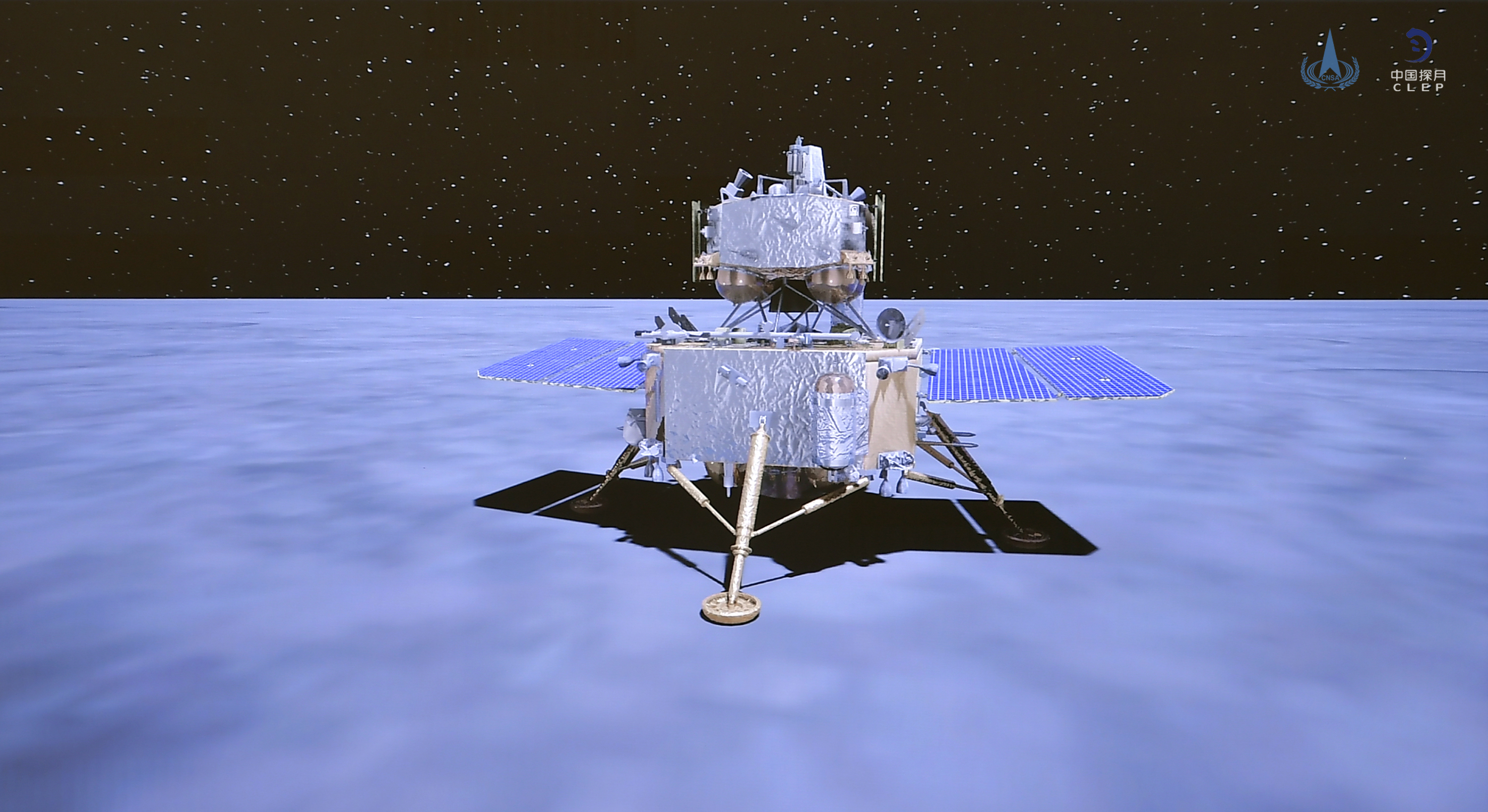
Image (Credit): China’s Chang’e-5 lunar lander. (China National Space Administration)
“I wish that every country would follow in the footsteps of the U.S. and now China.”
–Statement by Frédéric Moynier, a cosmochemist at the Paris Institute of Planetary Physics, regarding China’s sharing of lunar samples from its 2020 Chang’e-5 mission. Seven institutions in six countries now have access to these samples, including two institutions in the United States. Unfortunately, the sample sharing goes only one way because the US Congress bans the sharing of space samples and technology with China.
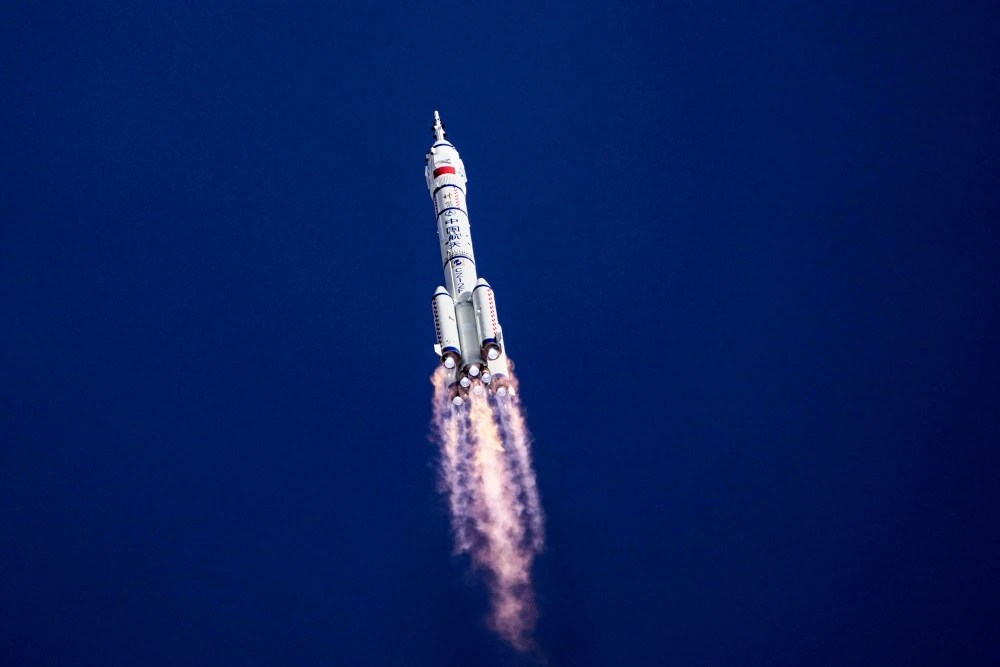
Image (Credit): The successful launch of three astronauts to the Tiangong space station via China’s Long March 2F rocket on April 24. 2025. (Andy Wong/AP)
The Chinese space program continues to operate and advance as NASA faces daunting cuts and general disorientation under the Department of Government Efficiency (a misnomer if there ever was one).
On April 24, China sent three new astronauts (the Shenzhou-20 crew) to its Tiangong space station, while three astronauts (the Shenzhou-19 crew) safely returned from the space station last week after six months in space.
It is important to remember that the rest of the world wants to advance in space even if the US chooses to chase its tail and destroy its own asset and reputation. None of this is necessary, but that is where we are.
One might even say the US is undergoing a ridiculous DEI purge at NASA and throughout the government in the same way China went through its ill-fated Cultural Revolution in the 1960s and 1970s.
Once you’ve seen the parallel between what MAGA is trying to do and China’s Cultural Revolution, the similarities are everywhere. Maoists sent schoolteachers to do farm labor; Trumpists are talking about putting civil servants to work in factories.



 Our Awesome Universe