Space Stories: ESA Drill Going to the Moon, ROMAN Takes on the Ever-changing Universe, and Six New Worlds Discovered

Image (Credit): The Hadley-Apennine region of the Moon photographed during the Apollo 15 mission of 1971. (NASA)

Here are some recent stories of interest.

European Space AgencyEuropean Drill and Mini Lab Secure Ride to the Moon

ESA’s Prospect package, including drill and a miniaturised laboratory, will fly to the Moon’s South Polar region in search of volatiles, including water ice, as part of NASA’s Commercial Lunar Payload Services initiative…NASA has selected Intuitive Machines for a flight opportunity in 2027 that will deepen our understanding of the Moon and answer key questions about where and how volatiles can be found on the lunar surface.V olatiles, such as water ice, are chemical components that easily evaporate or vaporise under certain conditions. Prospect is a suite of instruments that will drill up to at least one metre depth beneath the lunar surface, extract samples, and process them in a mini lab. The combination of robotic drill and sample analysis package aims to identify volatiles trapped beneath the surface at extremely cold temperatures down to –150 °C.

Space Telescope Science InstituteNASA’s Roman Space Telescope to Investigate Galactic Fossils

The universe may seem static, only capable of being captured in still frames, but that is far from the truth. It is actually ever-changing, just not on timescales clearly visible to humans. NASA’s upcoming Roman Space Telescope will bridge this gap in time, opening the way to the dynamic universe. RINGS, the Roman Infrared Nearby Galaxy Survey, will specifically uncover the dynamic universe by searching galaxies for fossils of their formation history. RINGS will also lead scientists to clues about the true nature of dark matter, the mysterious substance that makes up the majority of the mass in our universe. Roman will launch in 2027, prepared to revolutionize how scientists understand our universe and give them access to the vision of the universe as it truly is: changing.

Science DailySix New Rogue Worlds: Star Birth Clues

The James Webb Space Telescope has spotted six likely rogue worlds — objects with planet-like masses but untethered from any star’s gravity — including the lightest ever identified with a dusty disk around it. The elusive objects offer new evidence that the same cosmic processes that give birth to stars may also play a common role in making objects only slightly bigger than Jupiter.

SpaceX Rockets: The Good and Bad News

Image (Credit): Launch of a SpaceX Falcon 9 rocket on August 31, 2024. (SpaceX)

First the good news. SpaceX is able to launch its Falcon 9 rockets following a booster issue last week. That led to the immediate launch yesterday of two back-to-back launches of Starlink satellites.

Now the bad news. Russian scientists have reported that SpaceX’s second launch of its Starship rocket last November created a hole in the ionosphere. Specifically, an exploding engine generated the shock wave that created this hole. The scientists claim this is the first time a “human-caused explosion” has had this impact on the ionosphere.

This is the “plain language summary” from the Russian study:

On 18 November 2023, SpaceX launched the Starship, the tallest and the most powerful rocket ever built. About 2 min and 40 s after the liftoff, the Super Heavy engine separated from the Starship spacecraft and exploded at an altitude of 90 km. The main core Starship continued to rise to 149 km and exploded as well. The rocket launch and explosion produced an unexpected response in the ionosphere—the ionized part of the Earth’s atmosphere. The Starship flew at a velocity, exceeding the local sound speed, and generated cone-like atmospheric shock-acoustic waves. Most unexpectedly, the observed disturbances represented long and intensive multi-oscillation wave structures that propagated northward, which is unusual for disturbances driven by a rocket launch. The Starship explosion also generated a large-amplitude total electron content depletion that could have been reinforced by the impact of the spacecraft’s fuel exhaust in the lower atmosphere. This study appears to be the first-time detection of a non-chemical ionospheric hole produced by a man-made explosion.

I like the fact that Russian’s can share results in plain language. However, it is a little disturbing that we needed the Russians to fill us in on the destructive impact of the Starship rockets. Nature noted that “Ionospheric disturbances can affect not only satellite navigation but also communications and radio astronomy.”

We have seen the mess that the rockets can leave on the ground, but this is something else. We need to understand the impact of such launches and related issues if this is to become the new way of doing things. The FAA and NASA should be looking into this matter.

SpaceX Grounded Before Start of the Polaris Dawn Mission

For the second time in two months, a SpaceX Falcon 9 rocket launch has had problems, leading to a temporary grounding of the rocket by the Federal Aviation Administration. In the latest case, a rocket booster crashed into the Atlantic Ocean after a successful launch of Starlink satellites.

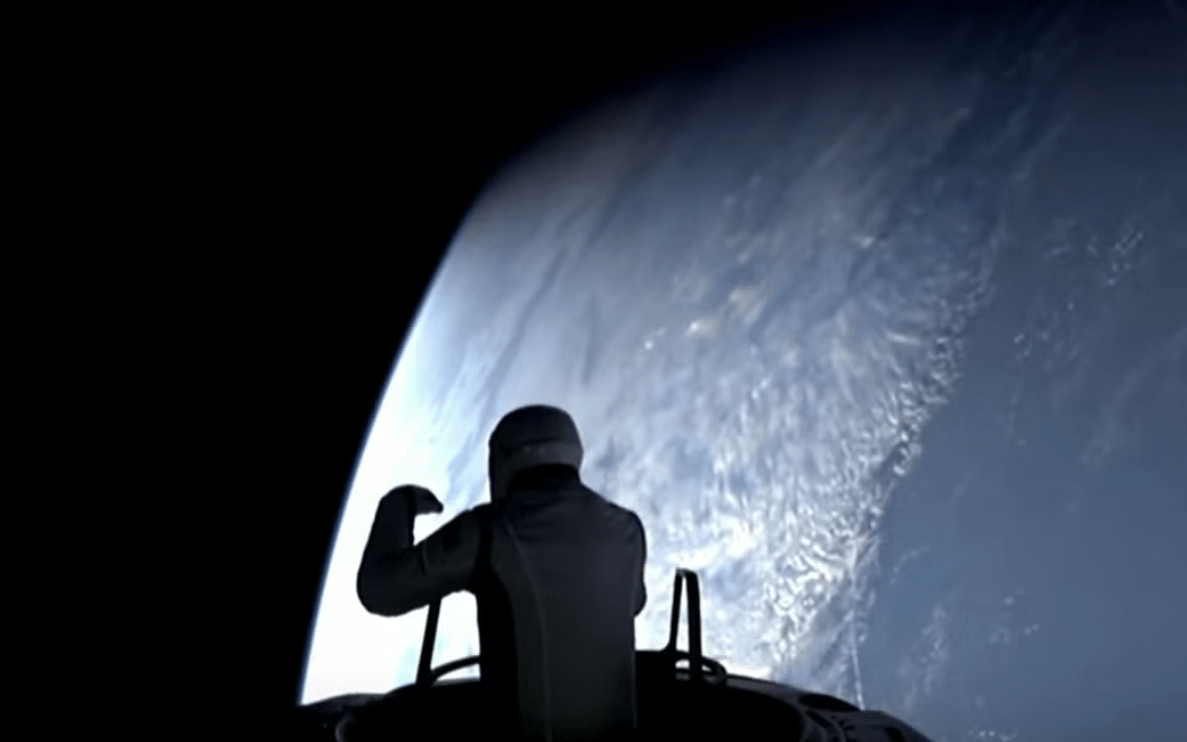
As a result of the malfunction, the privately-funded Polaris Dawn mission scheduled for this Friday will most likely need to be delayed. One of the goals for the Polaris Dawn mission is a spacewalk, which will be the first private space walk to date.

Of greater concern is the role of the Falcon 9 in upcoming International Space Station launches, be it crewed or uncrewed. With the Boeing capsule stuck at the station, SpaceX is currently the one game in town for NASA’s station needs.

Space Stories: Oceans on Ariel, Dinosaur-Killer Asteroid from Beyond Jupiter, and the Launch of the Polaris Dawn Mission

Image (Credit): Uranus and distant galaxies as seen by the James Webb Space Telescope. (NASA, ESA, CSA, STScI)

Here are some recent stories of interest.

ForbesNASA’s Webb Telescope Finds Evidence For An Ocean World Around Uranus

New observations by the James Webb Space Telescope suggest that an icy moon around Uranus may have an underground liquid ocean. Ariel is one of 27 moons around Uranus, the seventh planet from the sun and the third largest planet in the solar system. It’s one of four moons that scientists have long been interested in as part of a search for water across the solar system, the others being Umbriel, Titania and Oberon.

Nature: Dinosaur-killing Chicxulub Asteroid Formed in Solar System’s Outer Reaches

The object that smashed into Earth and kick-started the extinction that wiped out almost all dinosaurs 66 million years ago was an asteroid that originally formed beyond the orbit of Jupiter, according to geochemical evidence from the impact site in Chicxulub, Mexico. The findings, published on 15 August in Science, suggest that the mass extinction was the result of a train of events that began during the birth of the Solar System. Scientists had long suspected that the Chicxulub impactor, as it is known, was an asteroid from the outer Solar System, and these observations bolster the case.

Space DailyPolaris Dawn Mission Set for August 26 to Advance Commercial Space Exploration

The Polaris Program, focused on testing and developing new spaceflight technology, is preparing to launch its first mission, Polaris Dawn, aboard SpaceX’s Falcon 9 rocket on Monday, August 26, 2024. This mission marks a significant step forward in commercial space exploration. Key objectives include testing a next-generation spacesuit during the first commercial spacewalk, attempting to achieve the highest altitude for a human spaceflight since the Apollo missions, and evaluating a new communication system through Starlink.

One More Wrinkle Related to the Starliner Delay

Credit: NASA

As if NASA needed another issue with the Boeing Starliner stranded at the International Space Station (ISS), the media (particularly the Indian media) is now reporting that one of the Starliner astronauts is having eyesight issues.

According to one media source, Astronaut Sunita Williams is experiencing eyesight problems that may be linked to her exposure to microgravity. The issue, called Spaceflight Associated Neuro-ocular Syndrome (SANS), is not an uncommon symptom related to space flight. It can lead to blurred vision over time and worsens over time.

NASA has noted that:

Most astronauts’ eyes and brain structure change in space…Weightlessness causes blood and cerebrospinal fluid to shift toward the head. This fluid shift is believed to be the underlying cause of the eye and brain structural changes…The longer they are in space, the more they may be impacted. Many astronauts only experience effects in space, but some changes may be permanent in some astronauts.

This has only become an issue now that an 8-day tour has turned into a potential 8-month tour. This Gilligan’s Island tour needs to come to an end so that the ISS can return to regular operations.

Image (Credit): Scene from the television show Gilligan’s Island. (CBS Television Network)