Podcast: Jerod Isaacman Speaks with Ross Douthat

Image (Credit): NASA Administrator Jared Isaacman and New York Times columnist Ross Douthat speaking on the Interesting Times program. (New York Times)

New York Times columnist Ross Douthat sat down with NASA Administrator Jared Isaacman recently to discuss the future of NASA and more. You can listen to the interview, titled ‘The New Space Race,” via the New York TimesInteresting Times podcast or watch it on YouTube.

I was a little skeptical about what I would learn from NASA’s new administrator, a billionaire space tourist until recently, but Jared Isaacman was well spoken during the interview. He seemed both candid with his answers as well as well comfortable with everything Ross tossed his way. His only stumble in my opinion was when he was trying to cover for the proposed draconian cuts to NASA by the White House in 2025. Fortunately, Congress saved the agency and his butt, though you would not know that from his answer.

I particularly liked his openness about his own space travels as well as the return mission to the Moon. In terms of himself, he compared his own gravity-free experience in space as the equivalent of being an upside down chipmunk. He also did not appear overwhelmed by his privileged view of the Earth from low Earth orbit. He said the high-definition images from the International Space Station (ISS) over the years has given everyone a great view of the Earth.

As far as establishing an early settlement on the Moon, he did not try to oversell it. He stated:

For the first maybe, I don’t know, 10 years, it’s going to look like a pretty cool futuristic junkyard with lots of landers and rovers around.

Mr. Isaacman also restated his critique of NASA’s handing of the Boeing Starliner mission to the ISS, did not exaggerate the profits to be made in space at the moment, expressed his opinions on intelligent life elsewhere as well as the public’s interest in UFOs, and stated he expected a manned mission to land on Mars within about 10 years.

Check it out for yourself if you want to learn a little more about the man running NASA. The interview runs for about an hour.

Space Stories: More Artemis II Delays, Starliner a Type A Mishap, and James Webb Space Telescope Studies Atmosphere of Uranus

Credit; NASA

Here are some recent space-related stories of interest.

NPR:NASA’s Artemis II Lunar Mission May Not Launch in March After All

Just one day after NASA said it was eyeing a potential March 6 launch date for the Artemis II lunar mission, the space agency said Saturday that complications with the rocket could delay all launch attempts in March from the Kennedy Space Center in Florida...In a blog post, NASA said it is “taking steps to potentially roll back the Artemis II rocket and Orion spacecraft to the Vehicle Assembly Building,” after technicians observed an “interrupted flow of helium” to the rocket system. NASA says its teams are “actively reviewing data” and taking steps to “address the issue as soon as possible while engineers determine the best path forward.”

Astronomy Magazine:NASA Report Declares Starliner Incident a Type A Mishap

On Thursday, NASA released sobering results from an independent investigation into the 2024 crewed Boeing Starliner test flight that left two astronauts stranded in space for months, placing blame not only on hardware failures, but the agency’s own leadership and culture. In a press conference, NASA Administrator Jared Isaacman said the agency had now categorized the incident as a type A mishap — the same classification applied to the Columbia and Challenger shuttle disasters — something he believes should have happened from the start.

European Space Agency: Webb Maps Uranus’s Mysterious Upper Atmosphere

For the first time, an international team of astronomers have mapped the vertical structure of Uranus’s upper atmosphere, uncovering how temperature and charged particles vary with height across the planet. Using NASA/ESA/CSA James Webb Space Telescope’s NIRSpec instrument, the team observed Uranus for nearly a full rotation, detecting the faint glow from molecules high above the clouds. The results offer a new window into how ice-giant planets distribute energy in their upper layers.

When is the Next Starship Launch?

Image (Credit): Artist’s rendering of SpaceX’s Starship HLS preparing for a Moon landing. (SpaceX)

Mr. Musk seems to move like a weather vane regarding where SpaceX is going next, but whether SpaceX is heading for the Moon or Mars it still needs a functioning Starship.

First the confusion. For all of Musk’s ongoing criticism of a Moon mission, it appears he is finally focusing on Artemis III. On Sunday, he tweeted:

For those unaware, SpaceX has already shifted focus to building a self-growing city on the Moon, as we can potentially achieve that in less than 10 years, whereas Mars would take 20+ years.

The mission of SpaceX remains the same: extend consciousness and life as we know it to the stars.

It is only possible to travel to Mars when the planets align every 26 months (six month trip time), whereas we can launch to the Moon every 10 days (2 day trip time). This means we can iterate much faster to complete a Moon city than a Mars city.

That said, SpaceX will also strive to build a Mars city and begin doing so in about 5 to 7 years, but the overriding priority is securing the future of civilization and the Moon is faster.

It seems that someone explained planetary alignment to him over the weekend, but that’s a point for another day.

So the target this week will be the Moon. But a crewed landing on the Moon depends on SpaceX’s Human Landing System (HLS) at the moment, which is where the Starship comes in. Or, more to the point, this is where a multitude of Starships come into play between the refueling in orbit as well and the HLS.

Given that SpaceX planned for 25 Starship launches in 2025 yet achieved only 5, we have an issue Houston (or should I say “Starbase”?).

All indications are that the first launch in 2026 will be early next month (based on one sentence from Musk on January 26th stating “Starship launch in six weeks”), following the last launch of October 13th. Five months between launches is not a very robust schedule given that the Starship not only needs to work but also needs to test the idea of fueling in space before landing a crew on the Moon in 2028.

So far the only parts of Artemis that have proven to work are the Space Launch System and Orion capsule, which are also the two most demonized components said to be substandard based on what the private sector can provide. However, waiting on SpaceX for a workable Moon model is becoming about as logical as waiting for Twitter to become profitable.

Remember, Musk was supposed to have a crew on Mars two years ago. As the Planetary Society noted in 2017:

SpaceX’s previous plan called for landing its first transport ship on Mars in 2022. The timeline Musk gave today was similar; two cargo landers would land on Mars in 2022, with four vehicles launching in 2024. Two of those 2024 ships would be crewed, meaning, in Musk’s timeline, humans could walk on Mars in just seven years.

It now seems like 50/50 that SpaceX can get a crew on the Moon before the Chinese. NASA may need the help of Blue Origin before it has a workable plan.

It may be time to ignore SpaceX’s promises and plan for some new players without tossing out the older technology just yet.

Space Tourism Ends for Now at Blue Origin

Image (Credit): The 38th and last New Shepard crew for some time. The crew from left to right is Alain Fernandez, Dr. Linda Edwards, Dr. Laura Stiles, Tim Drexler, Alberto Gutiérrez, and Jim Hendren. (Blue Origin)

If you didn’t find your way into orbit yet, your chances to do so in the near future have dropped precipitously.

Blue Origin is ending its New Shepard rocket flights for tourists starting immediately. The pause will last for at least two years while the company focuses on the upcoming Artemis III lunar mission.

In a press release, the company stated:

Blue Origin today announced it will pause its New Shepard flights and shift resources to further accelerate development of the company’s human lunar capabilities. The decision reflects Blue Origin’s commitment to the nation’s goal of returning to the Moon and establishing a permanent, sustained lunar presence.  

New Shepard is the first reusable spaceflight system to vertically land and has flown 38 times and carried 98 humans above the Kármán line to date. New Shepard has launched more than 200 scientific and research payloads from students, academia, research organizations, and NASA. This consistent and reliable performance, combined with an exceptional customer experience, has resulted in a multi-year customer backlog. 

Blur Origin is working to be part of the first lunar lander craft on the moon, not just a later one as planned, due to SpaceX’s difficultly meeting its milestones. If only Mr. Musk took the lunar mission as seriously rather than spending his energy on right-wing politics and questionable AI projects.

Second Launch by German Rocket Company Happens Soon

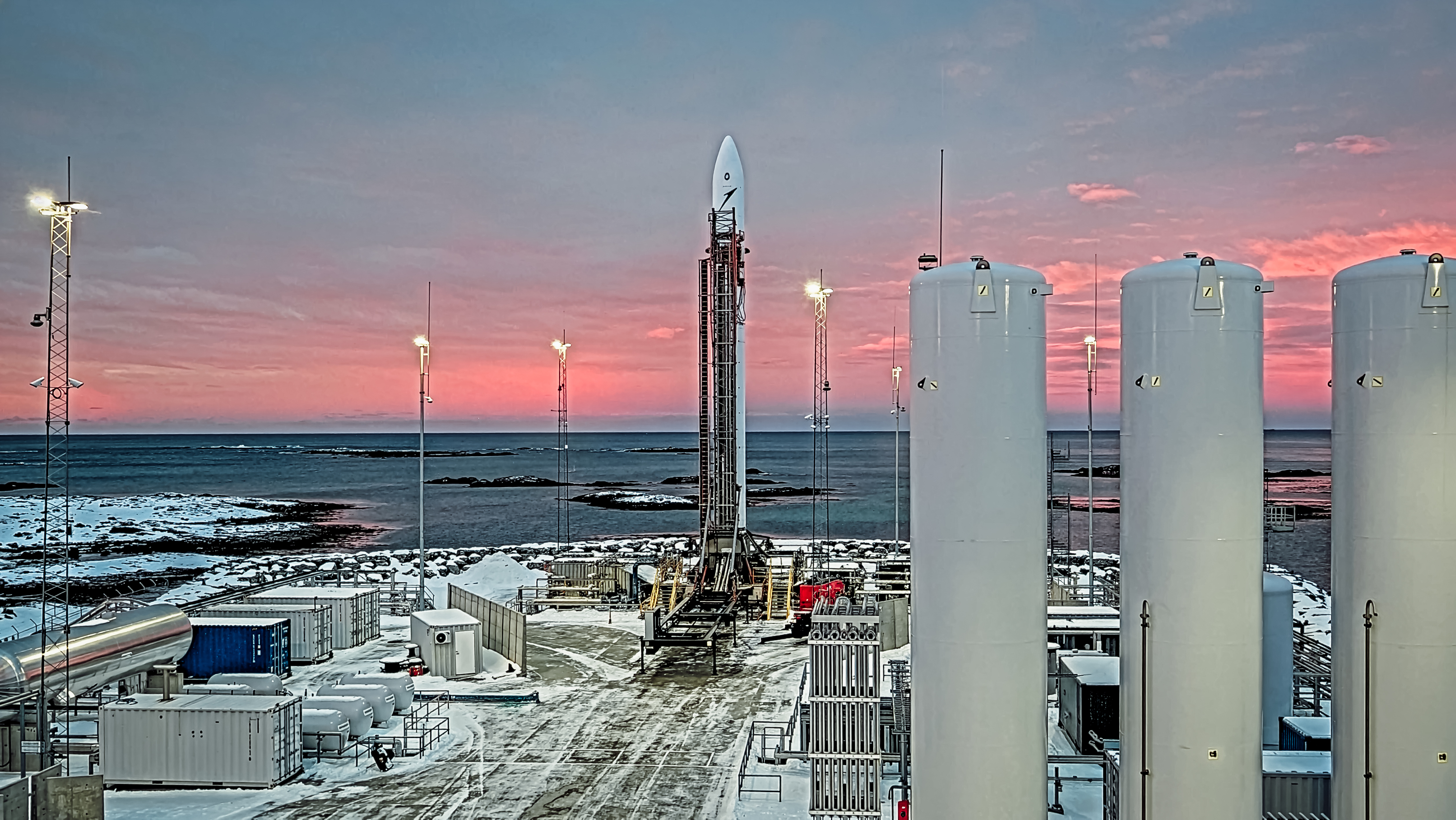
Credit: Isar Aerospace.

You may remember the name Isar Aerospace from its attempt last year to launch a rocket from the Andoya Space Centre in Norway. It was the first test of the German company’s Spectrum two-stage rocket, and it lasted for less than a minute into launch. That’s how these tests often go.

The second launch, labeled “Onward and Upward,” is scheduled to happen shortly. While it was initially scheduled for January 21st, it has been delayed until March 19th due to pressurization valve issues.

This second time the Germans seem a little more confident given that the launch will include payloads – five CubeSats and one experiment. The company is also securing more space in Munich, Germany, Sweden (Esrange Space Center) and French Guyana (Guiana Space Centre).

When Dr. Markus Söder, Minister President of Bavaria, visited the Isar Aerospace facility last year, he stated:

The success story of our space program continues – and Isar Aerospace is playing a decisive role in writing it. …We are Germany’s Space Valley: Europe’s largest faculty for aerospace is being established at the Technical University of Munich – and 550 companies and 65,000 employees now work in this sector in Bavaria. The future looks bright. With the Bavarian high-tech agenda, we are investing a total of six billion euros in research and science. Live long and prosper, Isar Aerospace!”

Germany is no stranger to rocketry, which benefited the US in no small degree following WWII. With all of this energy directed towards the space industry, Germany and Europe become stronger players in this area and be somewhat less reliant on the US for future payloads.