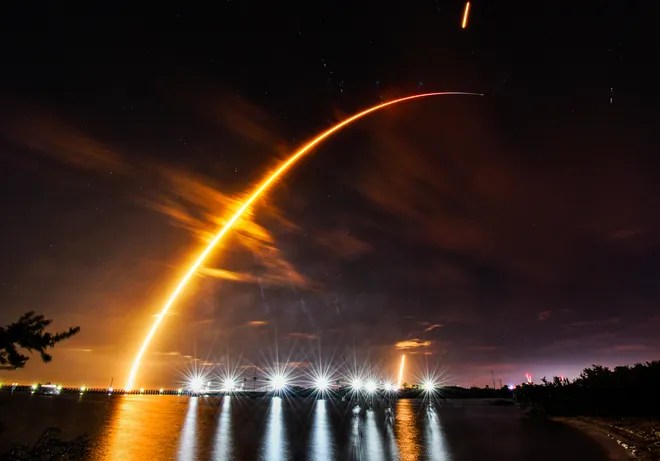
Image (Credit): Today’s launch of the Intuitive Machines IM-1 mission from the Kennedy Space Center. (Malcolm Denemark/Florida Today)
This week’s image shows the early morning launch of Intuitive Machines’ IM-1 mission via a SpaceX Falcon 9 rocket. The rocket carries the Nova-C robotic lander, also called “Odysseus,” that includes both NASA and commercial payloads. If all goes well, the lander will be on the surface of the moon next week.
This image from Florida Today is unique in that it is a time exposure showing both the launch from the Kennedy Space Center as well as the booster landing shortly afterward.
Image (Credit): Intuitive Machines IM-1 mission on the launch pad at NASA’s Kennedy Space Center in Florida. (SpaceX)
The second NASA-related commercial Moon mission was set to launch earlier today, but SpaceX called it off at the last moment due to a methane issue with its Falcon 9 rocket. SpaceX is expected to try the launch tomorrow.
The launch of the Intuitive Machines IM-1 mission is related to NASA’s Commercial Lunar Payload Services (CLPS) initiative, and will serve as one of the first lunar-based pieces of the Artemis program.
Intuitive Machines’ Nova-C lander is expected to land on the Moon Thursday, Feb. 22. Among the items on its lander, the IM-1 mission will carry NASA science and technology instruments focusing on plume-surface interactions, space weather/lunar surface interactions, radio astronomy, precision landing technologies, and a communication and navigation node for future autonomous navigation technologies.
The Moon mission that failed last month was also part of NASA’s CLPS initiative. This program is off to a slow start, but hopefully it can be relied on to be a key component of the lunar space program going forward.
If you are looking for some good news, I can report that Russia’s Progress MS-26 International Space Station resupply mission successfully launched earlier today.
Collins Aerospace, a private company hired to create spacesuits for use outside the International Space Station (ISS), has tested its suit aboard a commercial microgravity flight, passing a milestone that lets engineers move forward toward critical design review…During the test, the plane executed “roller-coaster-like maneuvers” to induce weightlessness and allow someone wearing a prototype to see if it actually lets someone move around in it under those conditions.
Water has been found on the surface of two asteroids for the first time, scientists said in a new paper. Two silicate-rich asteroids were detected by the retired Stratospheric Observatory for Infrared Astronomy (SOFIA) that were giving off a specific wavelength of light that indicated the presence of molecules of water, according to research published in The Planetary Science Journal.The discovery may have major implications for theories about how water initially made its way to our own planet. It could have been delivered via asteroid impact.
When China’s first lunar lander, Chang’e 3, touched down in Mare Imbrium on the Moon in 2013, it was the pinnacle of the country’s space endeavors. The robotic lander and its small Yutu rover companion were the first spacecraft to operate on the Moon since the 1970s, and provided new insights into our planet’s natural satellite…Since then, China’s space activities have exploded in range, frequency, and ambition. The country now rivals the U.S. for the most launches per year, with around 80 missions having been planned for 2023. The nation has its own modular space station, named Tiangong, which is expected to be continuously occupied by a rotating crew of three astronauts for at least a decade.
Starlab Space, the joint venture developing the Starlab commercial space station, has selected SpaceX’s Starship to launch the station on a single flight. Starlab Space, a joint venture of Voyager Space and Airbus Space and Defence, announced Jan. 31 it reached an agreement with SpaceX to launch the Starlab station on Starship. The companies did not disclose terms of the agreement or a projected launch date, although a spokesperson for Starlab Space said the company was confident that Starlab would be launched before the decommissioning of the International Space Station, currently scheduled for 2030.
Alexander Grebenkin, a former Russian military officer and current Roscosmos cosmonaut, is set to travel to the International Space Station as part of the NASA team, as announced on the NASA website, where Ukrainians have commented their outrage. NASA, in collaboration with SpaceX, plans to launch Crew-8 to the International Space Station no earlier than Thursday, Feb. 22.
The European Space Agency (ESA) has launched what it says is the “first metal 3D printer” to be hosted on the International Space Station (ISS).While plastic 3D printers have been used aboard the ISS since 2014, a machine that prints stainless steel would be new and could allow astronauts greater self-sufficiency, including the ability to make complex metallic structures in orbit, as well as at future Moon and Mars bases, ESA said Jan. 30.
You may have been told that the earlier space program gave us Tang and Velcro. Well, that is not really true.
For instance, Tang was already at your local supermarket back in 1959. It was not until 1962 when Tang was taken into space with John Glenn on Friendship 7 and only then did it become a “space age drink” used by the Gemini through Apollo programs.
In the case of Velcro, it was invented by a Swiss engineer who based it on burrs that clung to the fur of his dog. Later on, NASA found it to be very useful for astronauts.
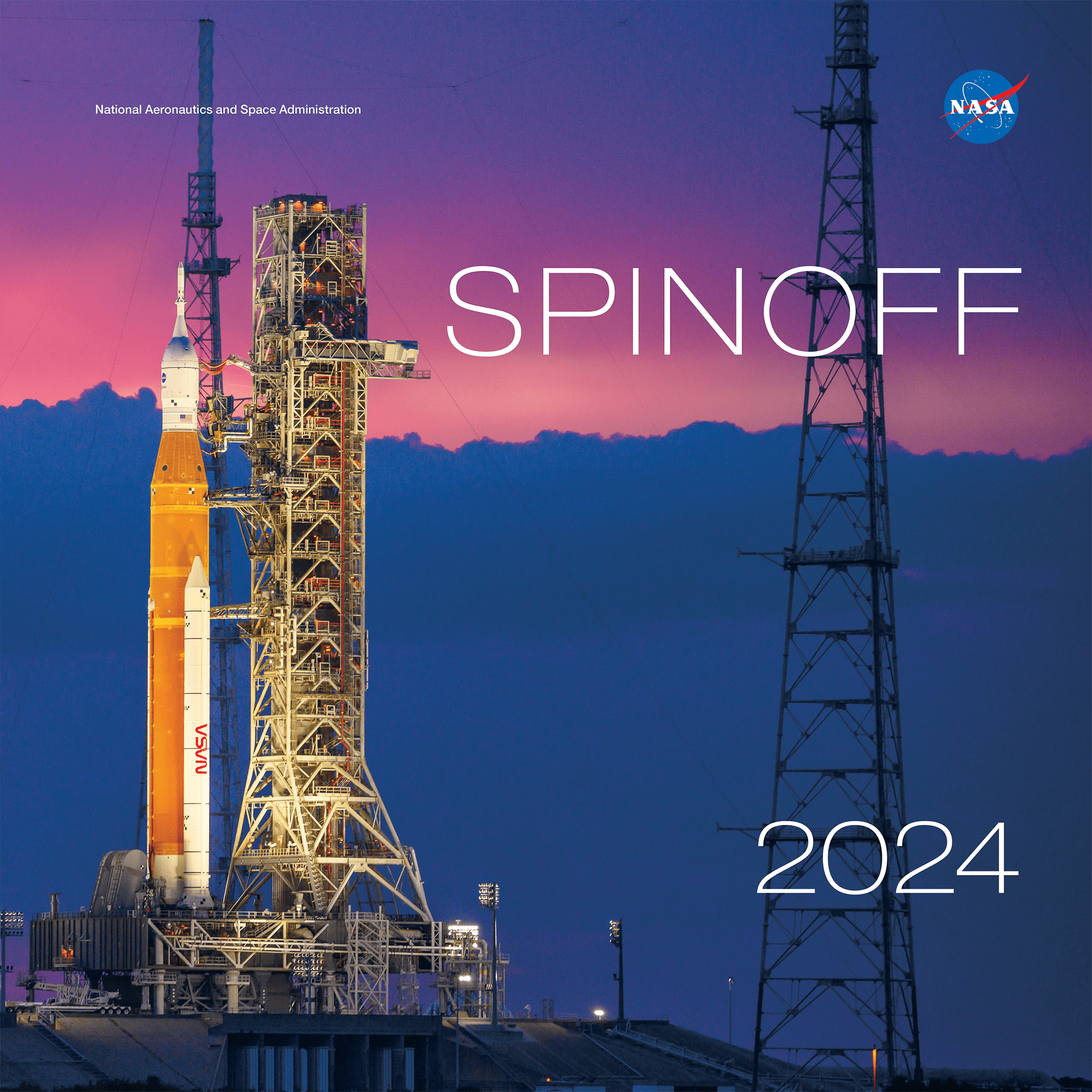
So what did NASA introduce to the world? Fortunately, NASA’s 2024 Spinoffreport can provide you with plenty of answers. In an article on the report, NASA highlighted the following commercial applications of space technology:
Spherical “squishy” robots capable of dropping into dangerous situations before first responders enter;
Lighter, more durable disc brake designs that produce less dust than traditional disc brakes;
Computer software to help businesses and communities cope with and recover from natural disasters like wildfires; and
New 3D printing methods to additively manufacture rocket engines and other large aluminum parts.
If you go to the full report, you can find other commercial applications that are more readily relatable to your everyday, including:
NASA-funded molecular research enables better disease detection;
Radiation-resistant microbe studied in space leads to fewer wrinkles, less sun damage on Earth;
Technology pioneered for space plant-growth chambers cleans indoor air; and
Materials for coating spaceplanes maintain comfort in outerwear, sports uniforms, jeans.
Take a look at the report yourself for more examples. It is full of good stories about how the space program can assist us here on Earth.
I am sure we can find similar reports related to the defense industry, but I would prefer our goal be better products generated from a space race rather than an arms race.



 Our Awesome Universe