The Damage Assessment and Recovery Team has completed their assessment of the center and its facilities, and determined that employees can safely return on-site to resume working.
The damage identified is manageable and in-line with the items the Ride Out Teams previously identified, including minor impacts such as ripped awning, and damage to doors and traffic lights.
It is interesting that NASA is using DART in a whole way here compared to yesterday’s story about the European Space Agency’s Hera mission. I just hope that the DART mission never leads to a DART event here on Earth.
Image (Credit): Visitors at ESA’s control center in Germany watching the Hera launch. (ESA / J.Mai)
This week’s image shows a crowd in Germany watching the launch of the European Space Agency’s (ESA) Hera mission on October 7, 2024. The launch itself took place from Cape Canaveral Space Force Station in Florida via a SpaceX Falcon 9.
Hera’s goal is to study how binary asteroid systems like Didymos form and function to learn more about to defend the Earth from approaching asteroids. You may remember Didymos from the earlier NASA Double Asteroid Redirection Test (DART) mission.
Hera’s first deep space manoeuvre will begin in late October and put the spacecraft on course for its next major milestone, a flyby of Mars in March 2025. During this flyby, Hera will use its instruments to study Deimos, the smaller and more enigmatic of Mars’s two moons. This will serve as an important test for many of the spacecraft’s instruments, ensuring they are fully operational before the spacecraft arrives at its final destination, Didymos.
Hera will perform a second deep space manoeuvre in February 2026. An ‘impulsive rendezvous’ in October 2026 will bring Hera into the vicinity of the Didymos asteroid system. The spacecraft will begin its detailed survey of the moonlet Dimorphos in 2027, which will turn the 151 m asteroid into one of the most studied objects in the Solar System.
Image (Credit): Illustration of how DART’s impact altered the orbit of Dimorphos about Didymos. (https://dart.jhuapl.edu/)
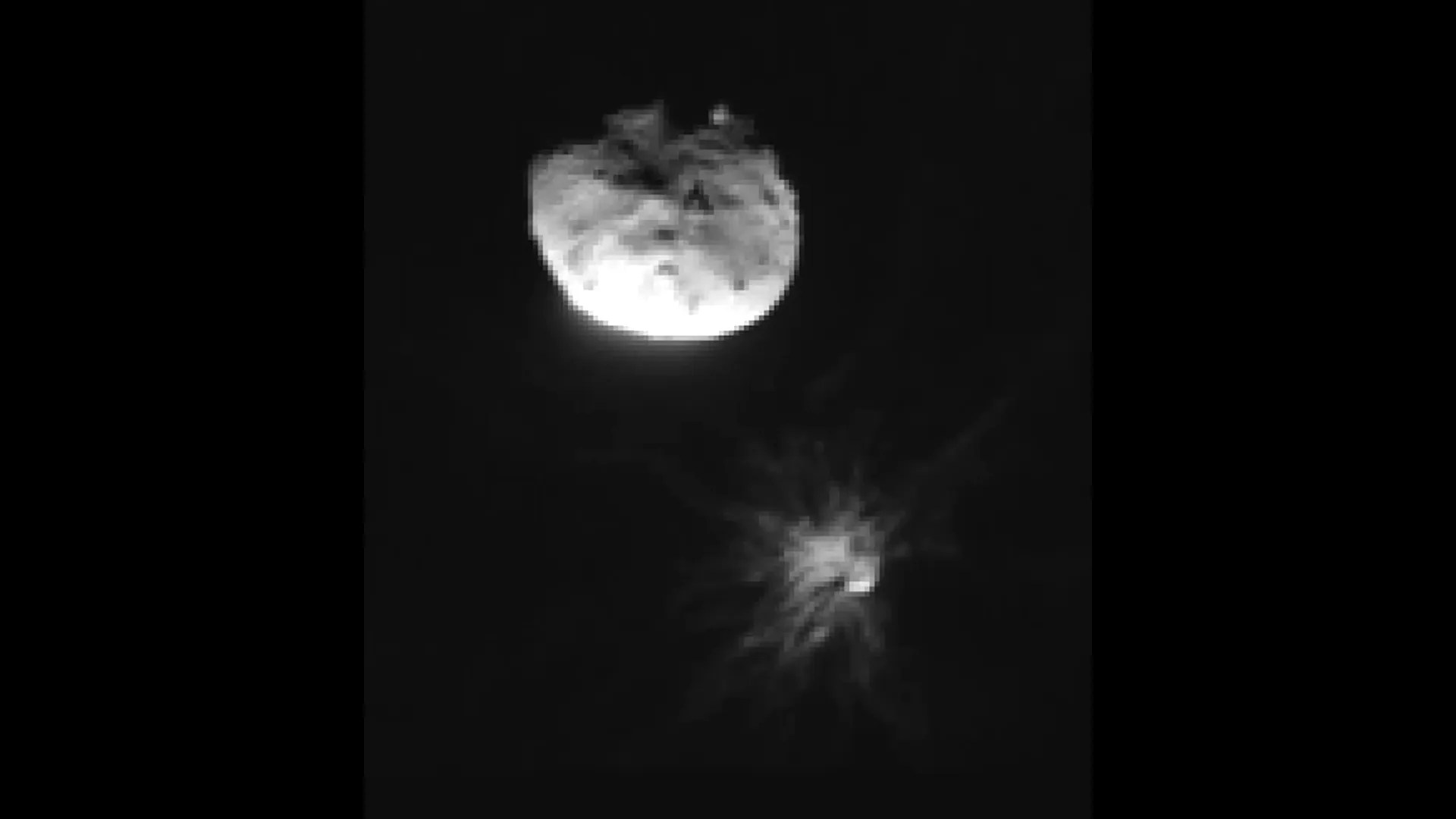
You may remember how NASA’s Double Asteroid Redirection Test (DART) mission was a great success in that it demonstrated that we can divert an asteroid, should it be necessary.
Well, that’s not the whole story. A new study has found that the redirected asteroid debris may threaten Mars in the future. How far into the future? In one case, it will be 6,000 years into the future, and the second about 15,000 years into the future.
It would be nice to think that we will have habitats if not cities on Mars at that point (and maybe even a Musk Mountain looming over one of the cities), so this could be relevant. So maybe today’s practice run will be tomorrow’s disaster. Then again, I am pretty sure that such a future society will also have the ability to deflect these asteroids, possible building on what we learned from DART.
All of this does make you think about other areas where our tampering may come back to bite us.
A recent study suggests NASA’s DART mission, designed to test asteroid deflection methods, may have revealed more than planned. While successfully altering the target asteroid’s trajectory, scientists now believe the impact also significantly changed its shape, hinting at a surprising composition. Previously thought to be a solid rock, Dimorphos, the impacted asteroid, may actually be a loose collection of debris. This conclusion stems from the unexpected level of deformation observed after the collision. Unlike a typical crater, the impact appears to have caused a broader, flatter dent, resembling an M&M candy.
India on Tuesday introduced four crew members for its maiden ‘Gaganyaan’ space voyage, as it aims to become the world’s fourth country to send a crewed mission into space just months after a historic landing on the south pole of the moon. Gaganyaan, or “sky craft” in Hindi, is the first mission of its kind for India and will cost about 90.23 billion rupees ($1.1 billion). It involves the launch of a habitable space capsule over the next year to an orbit of 400 km (250 miles) and its return via a landing in the Indian Ocean.
Japan’s space agency made contact with its SLIM moon lander Sunday, despite the spacecraft not being expected to function after lunar night. Contact with the Smart Lander for Investigating Moon (SLIM) spacecraft was reestablished on Sunday, Feb. 25, the Japan Aerospace Exploration Agency (JAXA) announced via its dedicated SLIM account on X, formerly known as Twitter, early Feb. 26.
Nearly a year ago, NASA successfully smashed an asteroid for the first time, in a landmark test to see whether we could divert a killer space rock before disaster — but now, the asteroid in question is behaving strangely. As New Scientist reports, a schoolteacher and his pupils seem to have discovered that the orbit of Dimorphos, the space rock socked by the Double Asteroid Redirection Test (DART) last September, has apparently continued slowing down, unexpectedly, in the year since the refrigerator-sized craft smashed into it.
Researchers from Japan predict, based on computer simulations, the likely existence of an Earth-like planet in the distant Kuiper Belt. There are many unexplained anomalies in the orbits and distribution of trans-Neptunian objects, small celestial bodies located at the outer reaches of the solar system. Now, based on detailed computer simulations of the early outer solar system, researchers from Japan predict the possibility of an undiscovered Earth-like planet beyond Neptune orbiting the Sun. Should this prediction come true, it could revolutionize our understanding of the history of the solar system.
The Japan Aerospace Exploration Agency’s (JAXA) X-Ray Imaging and Spectroscopy Mission (XRISM) lifted off on a H-IIA rocket from the Tanegashima Space Center in Japan at 08:42 JST / 00:42 BST / 01:42 CEST on 7 September 2023. The successful launch marks the beginning of an ambitious mission to explore the growth of galaxy clusters, the chemical make-up of the Universe, and the extremes of spacetime. XRISM is a collaboration between JAXA and NASA, with significant participation from ESA.