DART: Watch the Asteroid Impact

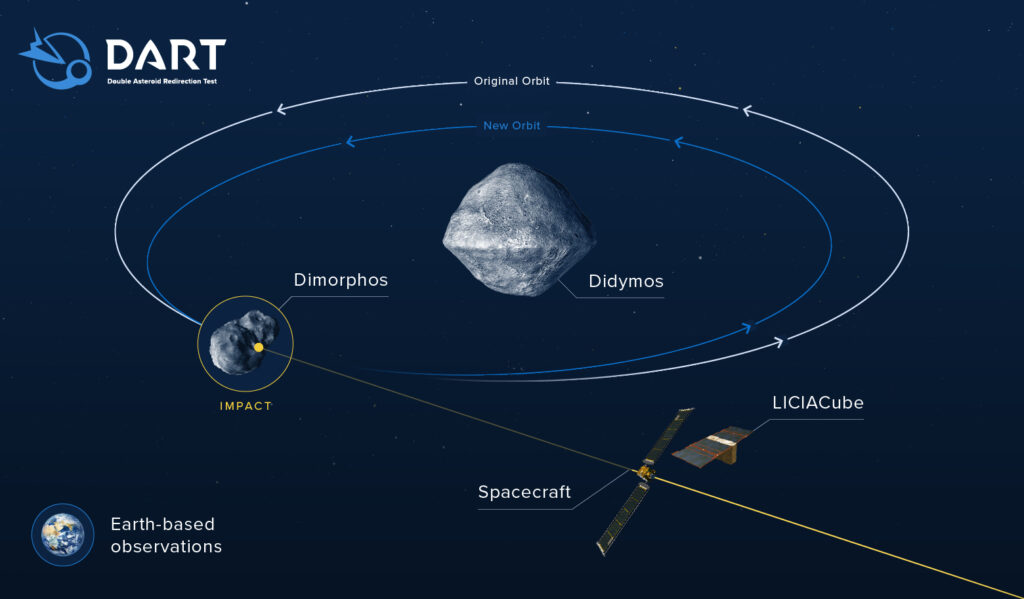
Image (Credit): Artist’s rendering of NASA’s DART spacecraft and the Italian Space Agency’s LICIACube prior to impact at the Didymos binary system. (NASA)

The Americans and Italians are putting on a show tomorrow night. NASA’s Double Asteroid Redirection Test (DART) spacecraft is ready to strike Dimorphos, which is a moonlet to the asteroid Didymos. All of it should be captured by Italy’s Light Italian CubeSat for Imaging Asteroids (LICIACub) in addition to DART’s own camera called the Didymos Reconnaissance and Asteroid Camera for Optical navigation (DRACO). Are you overwhelmed with acronyms yet?

The mission is a practice run on diverting an asteroid. While we are not threatened by this pair of asteroids, we may be threatened by others in the future, so what we learn here is critical.

You can view the impact later tomorrow via this NASA site starting at 6pm ET (the collision is expected at 7:14pm ET).

Extra: Here is another DART site to watch from The Johns Hopkins University Applied Physics Laboratory.

Image (Credit): NASA live broadcast for the DART mission. (NASA)

Update: The mission was a success. The video showing the DART spacecraft approaching the dirty potato called Dimorphos was impressive. The actual moonlet shown below is considerably different than the smooth asteroid in the artist’s rendering above.

Image (Credit): Moonlet Dimorphos as the DART spacecraft approaches. (NASA)

Movies: Look Up at NASA’s Work

Source: Leonardo DiCaprio shown in Netflix’s Don’t Look Up.

You may have already watched the star-studded movie Don’t Look Up released by Netflix over the holidays about a comet on its way to destroy our planet. It is an amusing film. Hopefully, it will also move people towards NASA and away from politicians, not that politicians really have much of a following. The more interesting story that should capture the public’s attention pertains to a little NASA spacecraft, part of the Double Asteroid Redirection Test (DART) mission, that will crash into a real asteroid next fall to determine whether or not we are able to nudge one of these monsters in a new direction – that is, away from Earth. The asteroid in question is called Dimorphos, which is about 160 meters in diameter and would create an explosion equivalent to approximately 500 megatons of TNT should it strike our planet. The atomic bomb dropped on Hiroshima was equivalent to about 16,000 tons of TNT. So this test is pretty important in terms of long term planning as well as survival. Check out the DART link above to read more about the mission.

Source: NASA.

Extra: Astronomy.com has an interesting story worth checking out – “Astronomer Amy Mainzer spent hours chatting with Leonardo DiCaprio for Netflix’s Don’t Look Up.”