Image (Credit): The Virgo galaxy cluster as captured by the Vera C. Rubin Observatory. (NSF–DOE Vera C. Rubin Observatory)
This week’s image comes from the Planetary Society’s recent competition to find the best space exploration images. It shows the Virgo galaxy cluster, which was the winning entry. The image was released on June 23, 2025 by the Vera C. Rubin Observatory located in Chile.
The Virgo galaxy cluster is comprised of anywhere between 1,300 and 2,000 galaxies. What you can see in this image is an impressive array of galaxies, some of them intertwined. How many different worlds within this cluster may be peering back at us? Of course, the Virgo galaxy cluster is 65 million light-years away, so the image of the Milky Way appearing on their telescopes right now was from the time when dinosaurs still walked on the Earth.
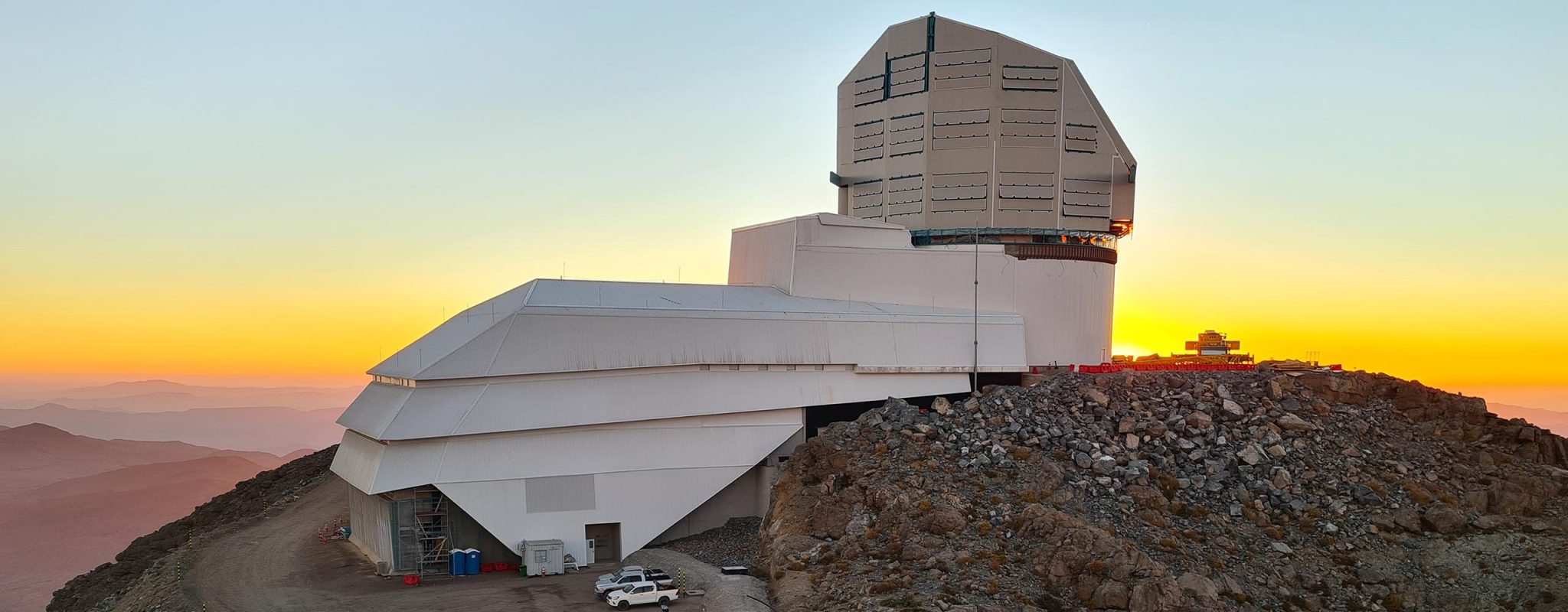
The Thirty Meter Telescope (TMT) was conceived more than two decades ago as the largest and most advanced telescope in the Northern Hemisphere. However, the telescope has encountered significant roadblocks, from funding uncertainties — now heightened by President Trump’s proposed budget cuts — to local resistance to building the telescope on Mauna Kea, a volcanic mountain in Hawai‘i that’s sacred to native communities. Now, the telescope might find a new home in La Palma on the Canary Islands of Spain. In July, the Spanish government offered to host the telescope, with an investment of up to €400 million ($460 million) to help cover some of the costs. In a brief statement posted on November 11th, the TMT announced that it is officially considering the move to La Palma.
In its latest shakeup to the Commercial Crew Program, NASA announced on Monday it has reduced the number of missions Boeing is required to fly to the International Space Station and changing the next flight from a crew mission to a cargo mission. The original contract NASA awarded to Boeing and SpaceX called for each to fly an uncrewed demonstration flight to the ISS, followed by a crewed demo mission and then conduct six regular crew rotation missions.
In the airless, radiation-saturated void outside of the International Space Station, researchers tested whether a common moss species known as Physcomitrium patens could survive at all, and if it could, for how long. The answers are yes and probably forever if it wants...Tomomichi Fujita, the study’s lead author, thinks moss could last up to 15 years in space, knowledge that could help build future extraterrestrial farms or entire ecosystems on the Moon or Mars.
Image (Credit): Percival Lowell’s mausoleum just steps away from the Lowell Observatory in Flagstaff, AZ. (Atlas Obscura)
On this day in 1916, American astronomer Percival Lowell died at the age of 61 in Flagstaff, AZ. He will forever be remembered for his incorrect theory concerning canals on Mars as well as his better theory about a ninth planet, which contributed to the discovery of Pluto 14 years by Clyde Tombaugh, who was working at the Lowell Observatory in Flagstaff.
Some interesting facts about Mr. Lowell’s life includes:
After graduating from Harvard with a degree in mathematics yet spent six years running a cotton mill;
He traveled extensively to Asia and wrote numerous books about the region;
He was a dedicated pacifist; and
His greatest contribution to astronomy related to the preferred placement of observatories.
Speculation has been singularly fruitful as to what these markings on our next to nearest neighbor in space may mean. Each astronomer holds a different pet theory on the subject, and pooh-poohs those of all the others. Nevertheless, the most self-evident explanation from the markings themselves is probably the true one; namely, that in them we are looking upon the result of the work of some sort of intelligent beings. . . . The amazing blue network on Mars hints that one planet besides our own is actually inhabited now.
Now when we think that each of these stars is probably the centre of a solar system grander than our own, we cannot seriously take ourselves to be the only minds in it all.
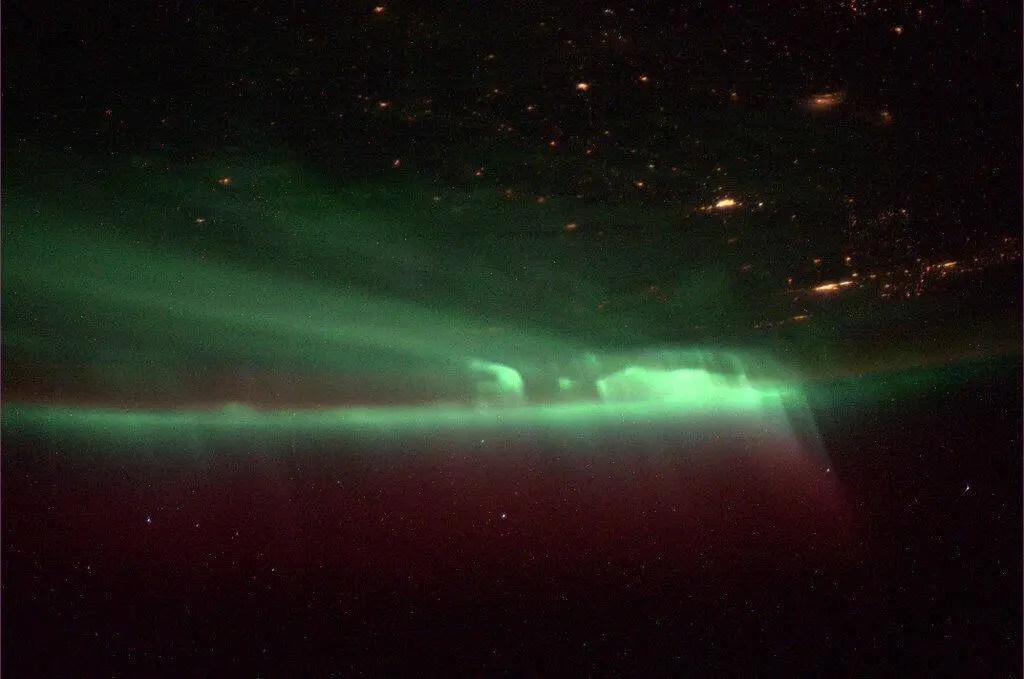
One of the largest antennas in NASA’s Deep Space Network was damaged in September and may be out of service for an extended period, further straining the system. NASA’s Jet Propulsion Laboratory confirmed Nov. 10 that the 70-meter antenna at the Deep Space Network (DSN) site in Goldstone, California, has been offline since Sept. 16, with no timetable for its return to service.
Does dark matter follow the same laws as ordinary matter? The mystery of this invisible and hypothetical component of our universe—which neither emits nor reflects light—remains unsolved. A team involving members from the University of Geneva (UNIGE) set out to determine whether, on a cosmological scale, this matter behaves like ordinary matter or whether other forces come into play.Their findings, published in Nature Communications, suggest a similar behavior, while leaving open the possibility of an as-yet-unknown interaction. This breakthrough sheds a little more light on the properties of this elusive matter, which is five times more abundant than ordinary matter.
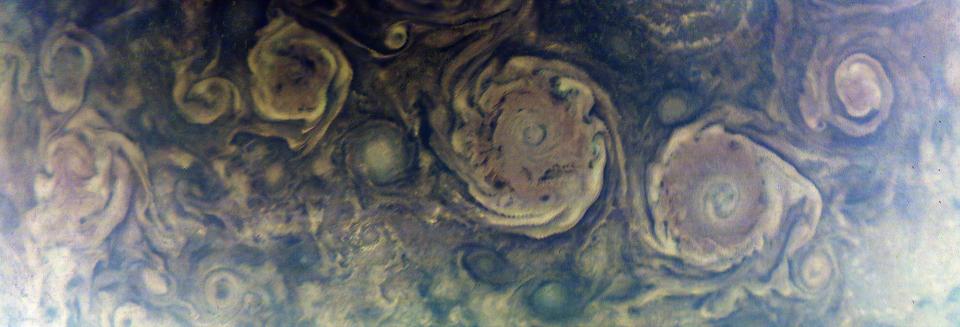
A new study led by researchers from Oxford University and Southwest Research Institute and the Planetary Science Institute in Tucson, Arizona has provided the first evidence of significant heat flow at Enceladus’ north pole, overturning previous assumptions that heat loss was confined to its active south pole. This finding confirms that the icy moon is emitting far more heat than would be expected if it were simply a passive body, strengthening the case that it could support life.
Image (Credit): Asteroid 2015 TB145 as captured by the Arecibo Observatory in Puerto Rico on October 30, 2015. (NAIC-Arecibo/NSF)
This spooky image of a dead comet was captured 10 years ago, but it still serves this purpose this time of year. It passed the Earth on Halloween evening that year at a distance of about 302,000 miles.
Scientists observing asteroid 2015 TB145 with NASA’s Infrared Telescope Facility (IRTF) on Mauna Kea, Hawaii, have determined that the celestial object is more than likely a dead comet that has shed its volatiles after numerous passes around the sun.
The belated comet has also been observed by optical and radar observatories around the world, providing even more data, including our first close-up views of its surface…
The first radar images of the dead comet were generated by the National Science Foundation’s 305-meter (1,000-foot) Arecibo Observatory in Puerto Rico. The radar images from Arecibo indicate the object is spherical in shape and approximately 2,000 feet (600 meters) in diameter and completes a rotation about once every five hours.
“The IRTF data may indicate that the object might be a dead comet, but in the Arecibo images it appears to have donned a skull costume for its Halloween flyby,” said Kelly Fast, IRTF program scientist at NASA Headquarters and acting program manager for NASA’s NEO Observations Program.