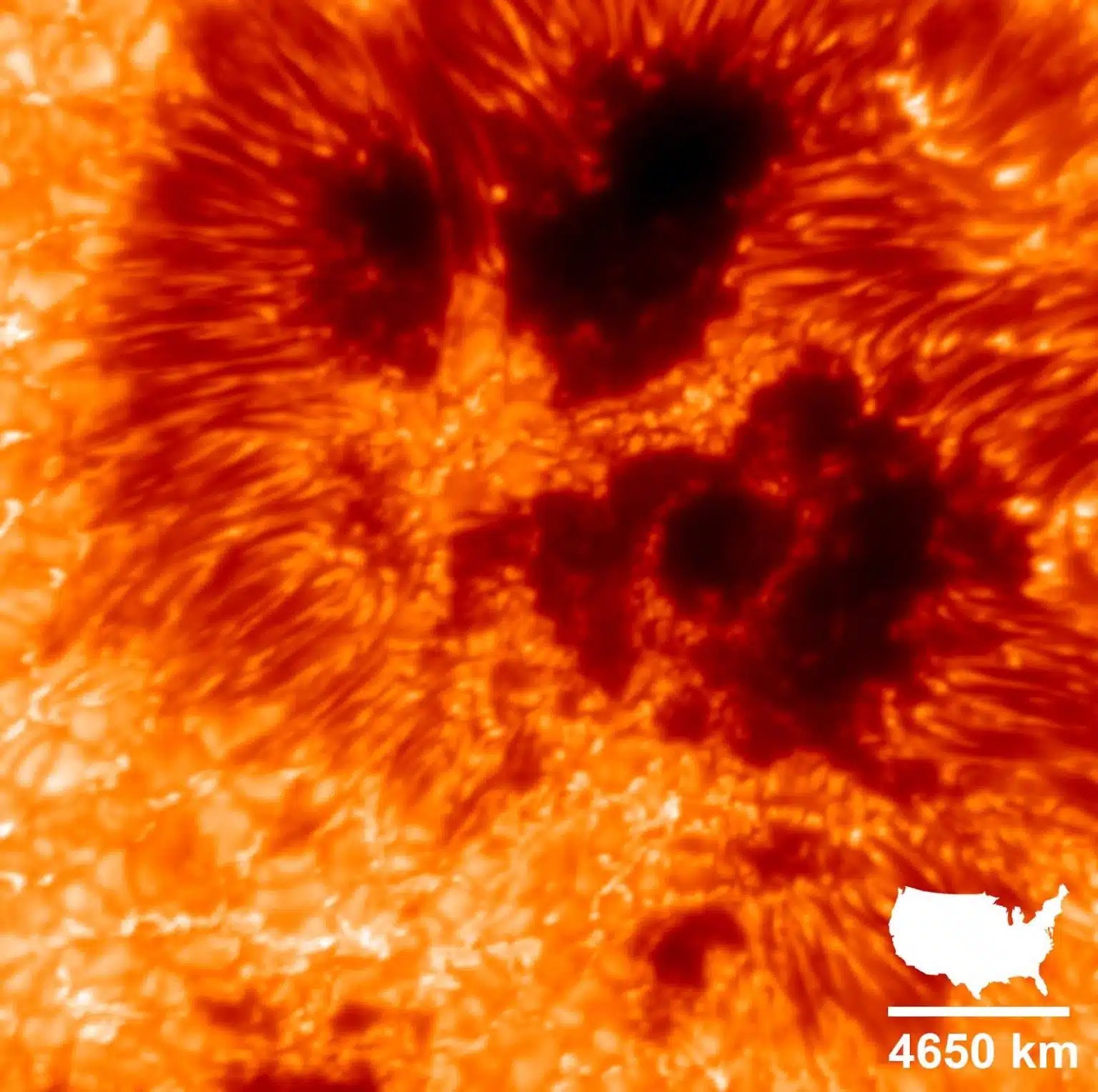
Image (Credit): Image of a sunspot on our Sun (with the United States in the corner for the purpose of comparison) captured by the Daniel K. Inouye Solar Telescope using its Visible Tunable Filter. (VTF/KIS/NSF/NSO/AURA)
This week’s image comes from the National Science Foundation’s (NSF) Daniel K. Inouye Solar Telescope. Using a newly developed Visible Tunable Filter, it is able to produce detailed images of the Sun’s surface.
Carrie Black, NSF program director for the NSF National Solar Observatory, stated:
When powerful solar storms hit Earth, they impact critical infrastructure across the globe and in space. High-resolution observations of the sun are necessary to improve predictions of such damaging storms…The NSF Inouye Solar Telescope puts the U.S. at the forefront of worldwide efforts to produce high-resolution solar observations and the Visible Tunable Filter will complete its initial arsenal of scientific instruments.
You can read much more about the telescope and its filter here.
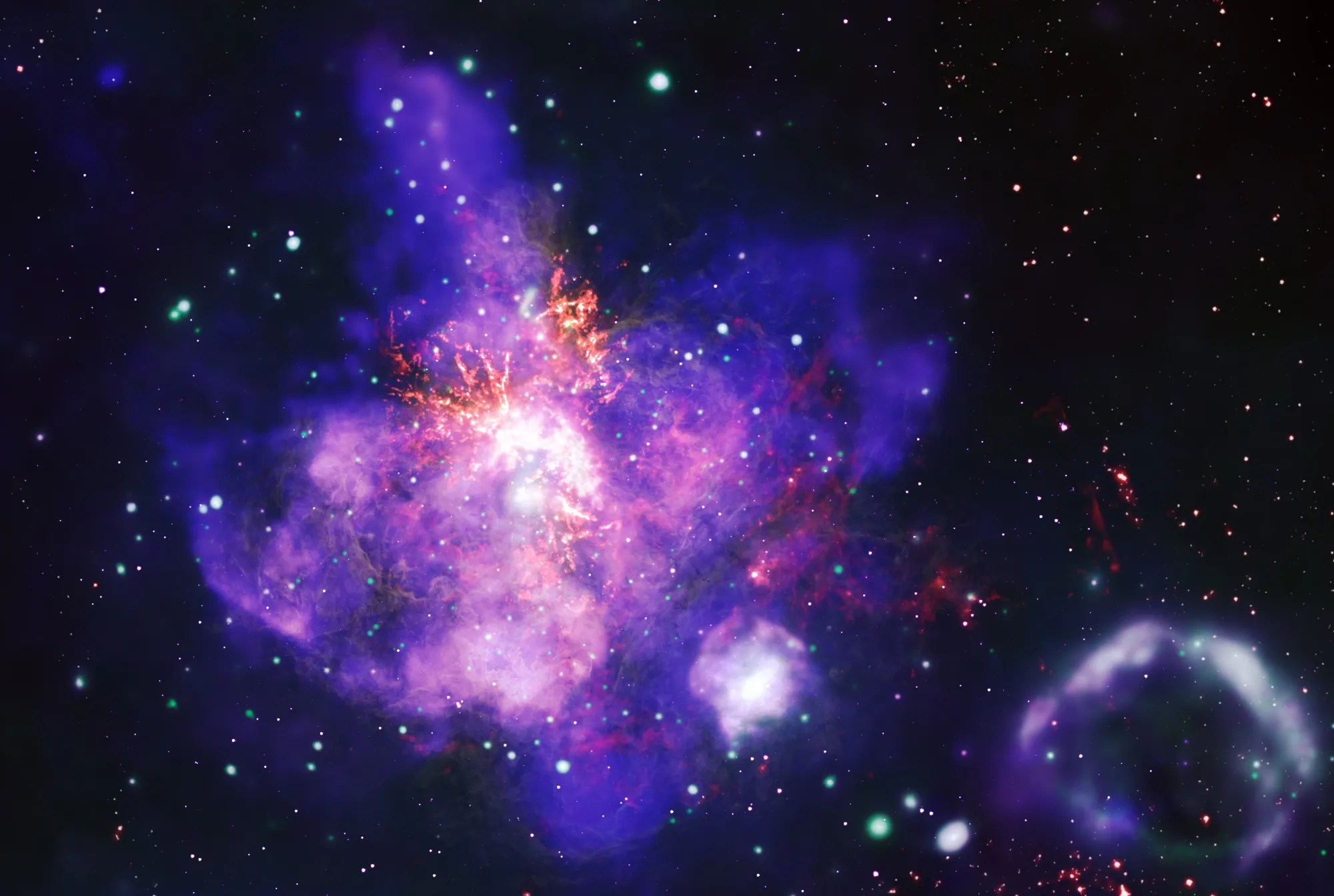
Image (Credit): Composite image of 30 Doradus. (X-ray: NASA/CXC/Penn State Univ./L. Townsley et al.; Infrared: NASA/JPL-CalTech/SST; Optical: NASA/STScI/HST; Radio: ESO/NAOJ/NRAO/ALMA; Image Processing: NASA/CXC/SAO/J. Schmidt, N. Wolk, K. Arcand)
Yes, NASA has an image ready for Valentine’s Day. This image comes from three sources – the Chandra X-ray Observatory, the Hubble Space Telescope, and the Atacama Large Millimeter/submillimeter Array.
Here is more from NASA (and even more can be found at the linked site):
Otherwise known as the Tarantula Nebula, 30 Dor is located about 160,000 light-years away in a small neighboring galaxy to the Milky Way known as the Large Magellanic Cloud (LMC). Because it one of the brightest and populated star-forming regions to Earth, 30 Dor is a frequent target for scientists trying to learn more about how stars are born.
With enough fuel to have powered the manufacturing of stars for at least 25 million years, 30 Dor is the most powerful stellar nursery in the local group of galaxies that includes the Milky Way, the LMC, and the Andromeda galaxy.
The massive young stars in 30 Dor send cosmically strong winds out into space. Along with the matter and energy ejected by stars that have previously exploded, these winds have carved out an eye-catching display of arcs, pillars, and bubbles.
A dense cluster in the center of 30 Dor contains the most massive stars astronomers have ever found, each only about one to two million years old. (Our Sun is over a thousand times older with an age of about 5 billion years.)
Br Guy Consolmagno, the director of the Vatican Observatory, has published a new book entitled A Jesuit’s Guide to the Stars. Published on the 4th February, the book charts the long history of Jesuit engagement with astronomy. As Consolmagno notes in the book’s introduction, this is a story which has its origin in the very earliest days of the Society of Jesus. The founder of the Jesuit order, St Ignatius of Loyola, says in his autobiography (which, somewhat confusingly, is written in the third person) that “the greatest consolation that he received . . . was from gazing at the sky and stars, and this he did often, and for quite a long time.”
Astronomers have discovered what may be the largest-scale structure in the known universe — a group of galaxy clusters and clusters of galaxy clusters that spans roughly 1.3 billion light-years across and contains a mind-boggling 200 quadrillion solar masses. The newfound structure is dubbed Quipu after an Incan system of counting and storing numbers using knots on cords.
CfA astronomers and its Submillimeter Array were critical for identifying a cache of belts where comets may reside outside our Solar System. For the first time, astronomers have imaged dozens of belts around nearby stars where comets and tiny pebbles within them are orbiting. This result reveals regions around 74 stars spanning a wide range of ages – from those recently formed to others billions of years old – showing how comets play a role in the formation of stars and planetary systems.
Astronomers are calling on nations to ban advertising in space that can be seen from the ground, calling it the latest threat to the dark and quiet sky. At a briefing during the 245th Meeting of the American Astronomical Society earlier this month, the organization rolled out a statement calling for bans on “obtrusive space advertising” because of the interference it could cause for groundbased astronomy. Obtrusive space advertising is defined in U.S. federal law as “advertising in outer space that is capable of being recognized by a human being on the surface of the Earth without the aid of a telescope or other technological device.” Such advertising is banned in federal law through prohibitions on granting launch licenses for missions carrying payloads to carry out space advertising.
Israel has reached an agreement with NASA to send the first Israeli woman astronaut into space, Minister of Innovation, Science and Technology Gila Gamliel said on Monday. The remarks come as Israel is expanding cooperation in space technology with longtime allies such as the U.S., Italy and Azerbaijan, as well as with regional parties to the landmark 2020 Abraham Accords such as the United Arab Emirates.
A team of researchers from Australia has made a remarkable discovery by identifying over 20 intriguing signals from deep space. This achievement has been compared to the daunting task of finding a single grain of sand on a vast beach. Utilizing innovative technology pioneered by the Commonwealth Scientific and Industrial Research Organisation (CSIRO), these findings have been documented in the Publications of the Astronomical Society of Australia.
Image (Credit): The four large Unit Telescopes and the four smaller Auxiliary Telescopes that make up the European Southern Observatory’s (USO) Very Large Telescope. (USO)
Here are some recent stories related to astronomy telescopes.
When a study in 2023 crowned Cerro Paranal the darkest observatory site in the world, astronomers must have felt reassured to have chosen the right spot. The 2,635-meter (8,645-foot) mountain in Chile’s Atacama Desert is home to the European Southern Observatory’s (ESO) Very Large Telescope, one of the most advanced and prolific astronomical facilities. But now, if a company named AES Andes (a subsidiary of the U.S. power company AES Corporation) gets its way, Paranal’s observational prowess might soon be history: Light pollution emitted by a proposed industrial “megaproject” could do away with the dark skies over this observatory.
Researchers have finished equipping the Subaru Telescope with a new special “compound eye,” culminating several years of effort. This new eye is an instrument featuring approximately 2,400 prisms scattered across the extremely wide field of view available at the Subaru Telescope’s primary focus, allowing for simultaneous spectroscopic observation of thousands of celestial objects. This unrivaled capability will help researchers precisely understand the formation and evolution of galaxies and the Universe. Among 8-meter-class telescopes, the Subaru Telescope is the most competitive with the largest survey capability in the world. This instrument, the Prime Focus Spectrograph (PFS), will be ready to begin scientific operations in February 2025.
Astronomers have released a set of more than a million simulated images showcasing the cosmos as NASA’s upcoming Nancy Grace Roman Space Telescope will see it. This preview will help scientists explore Roman’s myriad science goals.“We used a supercomputer to create a synthetic universe and simulated billions of years of evolution, tracing every photon’s path all the way from each cosmic object to Roman’s detectors,” said Michael Troxel, an associate professor of physics at Duke University in Durham, North Carolina, who led the simulation campaign. “This is the largest, deepest, most realistic synthetic survey of a mock universe available today.”



 Our Awesome Universe