Image (Credit): Orion’s Belt. (Davide De Martin & the ESA/ESO/NASA Photoshop FITS Liberator)
The ongoing panic related to drones it getting pretty silly. I am just glad we are not shooting down small airplanes or trying to take out a star system.
For example, Maryland’s former Governor Larry Hogan recently claimed to have “personally witnessed” drones outside his house. However, he was actually looking at Orion’s Belt.
Maybe he should check with employees at the University of Maryland’s observatory to learn about upcoming stargazing events for the public. Oh wait, the observatory is currently closed due to budget cuts.
Image (Credit): Wolf-Rayet 124 (WR 124), a hot star just about to go supernova, as captured by the James Webb Space Telescope. (NASA, ESA, CSA, STScI, Webb ERO Production Team)
Fast forward to now, and Zwicky’s namesake, the Zwicky Transient Facility (ZTF)—a National Science Foundation-funded sky survey that began operations in 2017 using the 48-inch telescope—has detected about a hundred thousand supernovae. These detections, in turn, have led to the spectroscopic classification and confirmation of more than 10,000 supernovae, making ZTF the largest supernova survey to date. “There are trillions of stars in the universe, and about every second, one of them explodes. Reaching 10,000 classifications is amazing, but what we truly should celebrate is the incredible progress we have made in our ability to browse the universe for transients, or objects that change in the sky, and the science our rich data will enable,” says Christoffer Fremling, a staff astronomer at Caltech. Fremling leads the Bright Transient Survey (BTS), ZTF project that discovers and classifies new supernovae.
Dry river channels and lake beds on Mars point to the long-ago presence of a liquid on the planet’s surface, and the minerals observed from orbit and from landers seem to many to prove that the liquid was ordinary water. Not so fast, the authors of a new Perspectives article in Nature Geoscience suggest. Water is only one of two possible liquids under what are thought to be the conditions present on ancient Mars. The other is liquid carbon dioxide (CO2), and it may actually have been easier for CO2 in the atmosphere to condense into a liquid under those conditions than for water ice to melt.
In the next decade, researchers will start probing the atmosphere of planets as small as Earth and Venus orbiting nearby stars. But although these two solar system planets are similar in size and bulk density—so that some call them “twins”—their atmospheres are nothing alike. Would scientists be able to set them apart if seen from light-years away?A team led by the Institute of Astrophysics and Space Sciences (IA) pretended Venus was faraway in another planetary system—an exoplanet—and asked what kind of information they could extract. The results were published in an article in the journal Atmosphere and prove that techniques being used to study large hot exoplanets can be effectively applied to those with a diameter 10 times smaller.
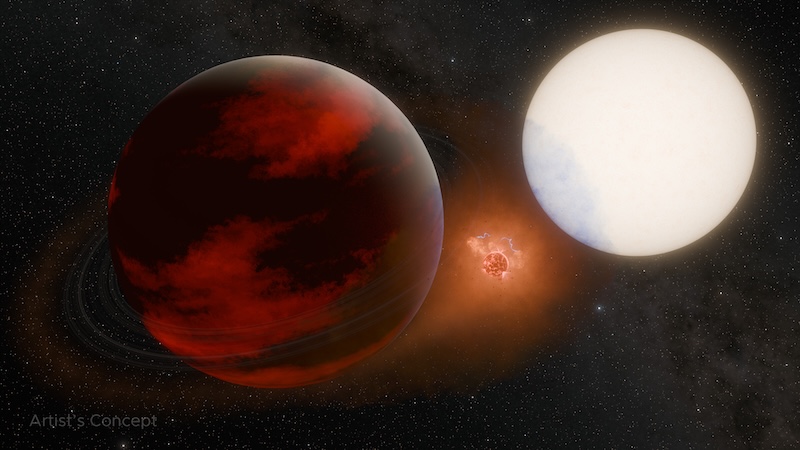
Image (Credit): An artist’s rendering of a volcanic moon orbiting WASP-49 b. (NASA/ JPL-Caltech)
The search for new exoplanets in our galaxy continues, but now it may include the first exomoon. This was something that was expected to occur at some point as the detection methods became better over time.
The exomoon in question is believed to be a volcanic moon orbiting a giant planet about 635 light-years away. Detected using the European Southern Observatory’s Very Large Telescope in Chile, the exomoon is discussed in a paper written by researchers with NASA’s Jet Propulsion Laboratory and Caltech in California. The clue was a cloud of sodium that did not appear to come from the host exoplanet.
The new discovery is being compared to Jupiter’s volcanic moon Io, which is the most volcanically active world in the solar system.
If you want to learn more about exomoons, I recommend a Cool Worlds video narrated by Assistant Professor of Astronomy David Kipping who provides five reasons that the study of exomoons is so important.
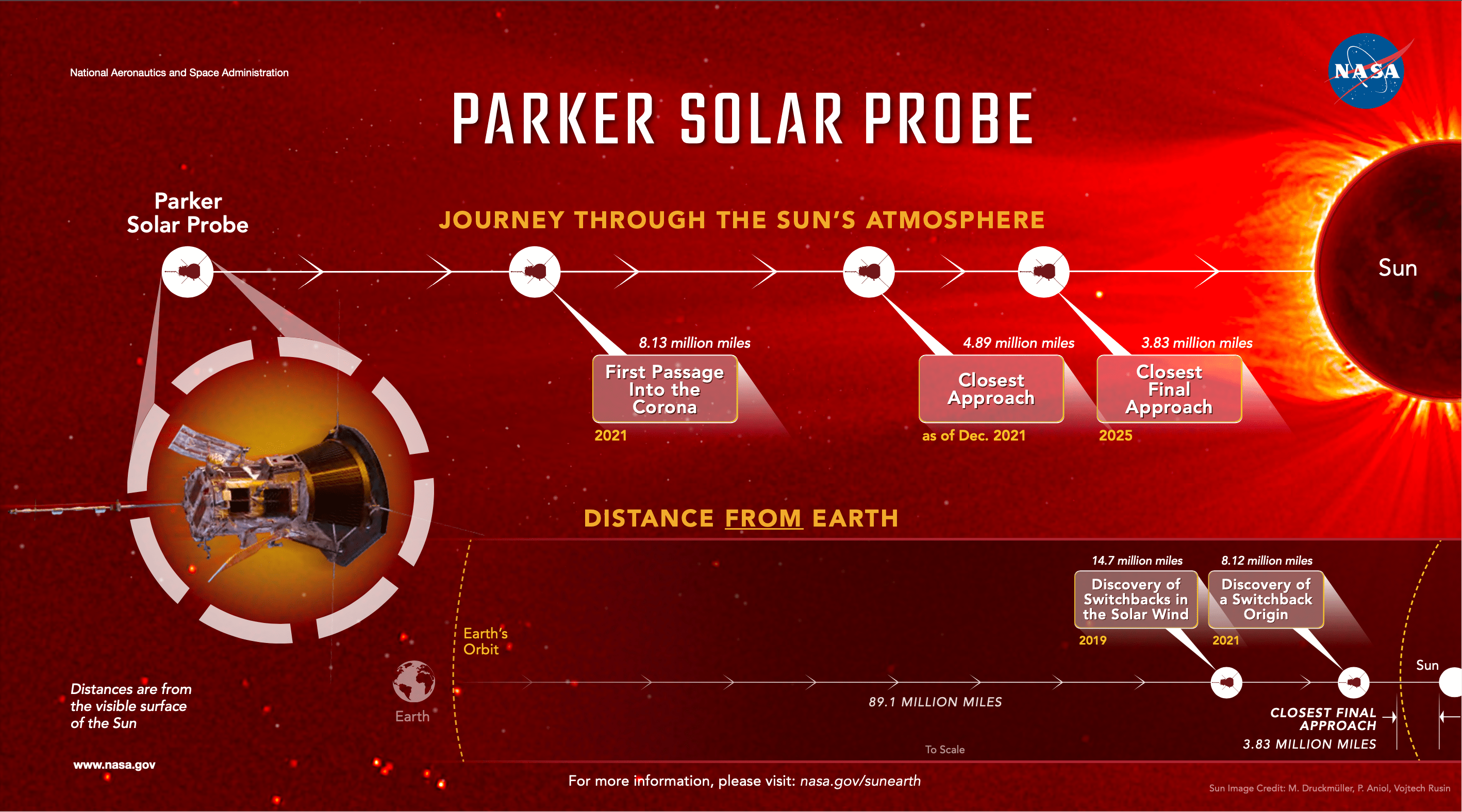
NASA has sent a whole host of spacecraft across the Solar System and even beyond. They range from crewed ships to orbit and to the Moon to robotic explorers. Among them are a range of mission classes from Flagships to Discovery Class programs. Now a new category has been announced: Probe Explorers. This new category will fill the gap between Flagship and smaller missions. Among them are two proposed missions; the Advanced X-ray Imaging Satellite and the Probe Far-Infrared Mission for Astrophysics.
It is a major goal of astronomical research to find planets other than Earth that might be suitable for sustaining life. There are a number of factors which many scientists agree are essential to a planet being habitable, but an important one is whether or not a planet has an atmosphere. Scientists have found other rocky, Earth-like exoplanets, but none that we can definitively say have atmospheres. Finding these planets will reveal insights into how such atmospheres are formed and retained, so that we can better predict which planets could be habitable. A study conducted by University of Chicago PhD student Qiao Xue with Prof. Jacob Bean’s group has demonstrated a new way to determine if faraway exoplanets have an atmosphere—and showed that it was simpler and more efficient than previous methods. The new technique, when applied to more planets, has the potential to help us learn more about patterns in atmosphere formation.
A giant wakes as the Sun sets in Western Australia. The workers can finally rest easy after more than a day spent using an enormous crane to lift the colossal 122-tonne, 35-metre diameter reflector dish and crown ESA’s newest deep space communication antenna. With the dish and its quadrupole now installed, ESA is on track to inaugurate its fourth deep-space antenna, and second at the New Norcia site in Australia, by the end of 2025. Referred to as NNO3, the New Norcia 3 antenna will allow spacecraft to send and receive more valuable data collected from onboard scientific instruments and vital flight instructions for mission operations.
The canonical theory for planet formation in circumstellar disks proposes that planets are grown from initially much smaller seeds. The long-considered alternative theory proposes that giant protoplanets can be formed directly from collapsing fragments of vast spiral arms induced by gravitational instability—if the disk is gravitationally unstable. For this to be possible, the disk must be massive compared with the central star: a disk-to-star mass ratio of 1:10 is widely held as the rough threshold for triggering gravitational instability, inciting substantial non-Keplerian dynamics and generating prominent spiral arms. Although estimating disk masses has historically been challenging, the motion of the gas can reveal the presence of gravitational instability through its effect on the disk-velocity structure. Here we present kinematic evidence of gravitational instability in the disk around AB Aurigae, using deep observations of 13CO and C18O line emission with the Atacama Large Millimeter/submillimeter Array (ALMA). The observed kinematic signals strongly resemble predictions from simulations and analytic modelling. From quantitative comparisons, we infer a disk mass of up to a third of the stellar mass enclosed within 1″ to 5″ on the sky.
Citation: Speedie, J., Dong, R., Hall, C. et al. Gravitational instability in a planet-forming disk. Nature 633, 58–62 (2024). https://doi.org/10.1038/s41586-024-07877-0