MAVEN Communication Issues

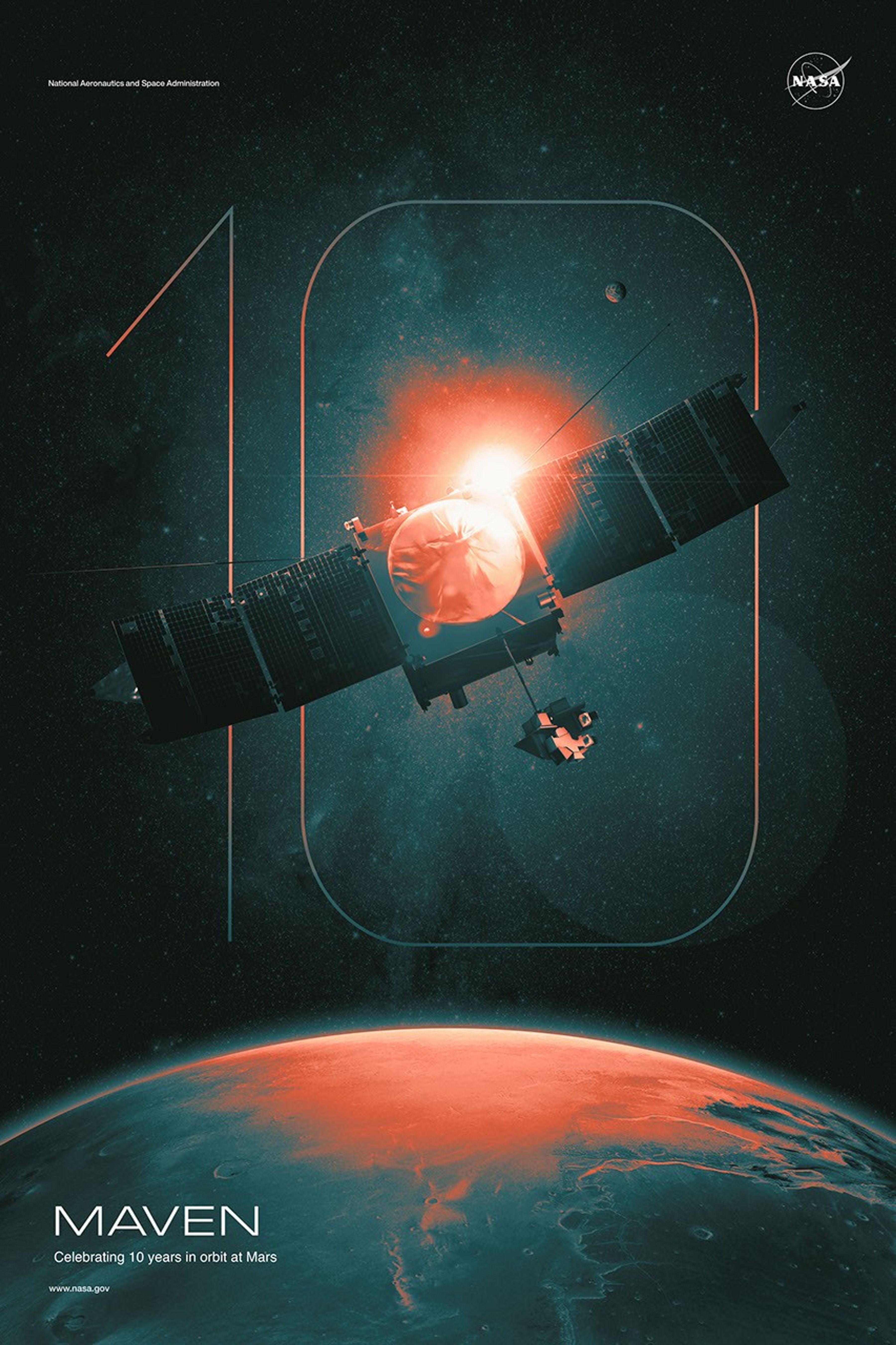
Image (Credit): Tenth anniversary poster for the MAVEN spacecraft from 2024. (NASA)

This time last year we were celebrating the 10th anniversary of NASA’s Mars Atmosphere and Volatile EvolutioN (MAVEN) spacecraft entering orbit around Mars. Today we are wondering about the future of that spacecraft after NASA lost contact with it.

As of earlier today, all NASA would say is the following:

The spacecraft and operations teams are investigating the anomaly to address the situation. More information will be shared once it becomes available.

MAVEN is part of the Mars Relay Network (MRN), which is used to transmit data from the Martian surface back to Earth. For instance, NASA’s two remaining rovers – Curiosity and Perseverance – utilize this network. Five NASA and European Space Agency spacecraft orbiting Mars are part of the MRN: MAVEN, Mars Odyssey, Mars Express, Mars Reconnaissance Orbiter, and ExoMars Trace Gas Orbiter.

The last thing we need now under this administration is a weak link to Mars since finding funds to further bolster the MRN will not be easy. So let’s hope for an easy fix.

Pic of the Week: Pismis 24

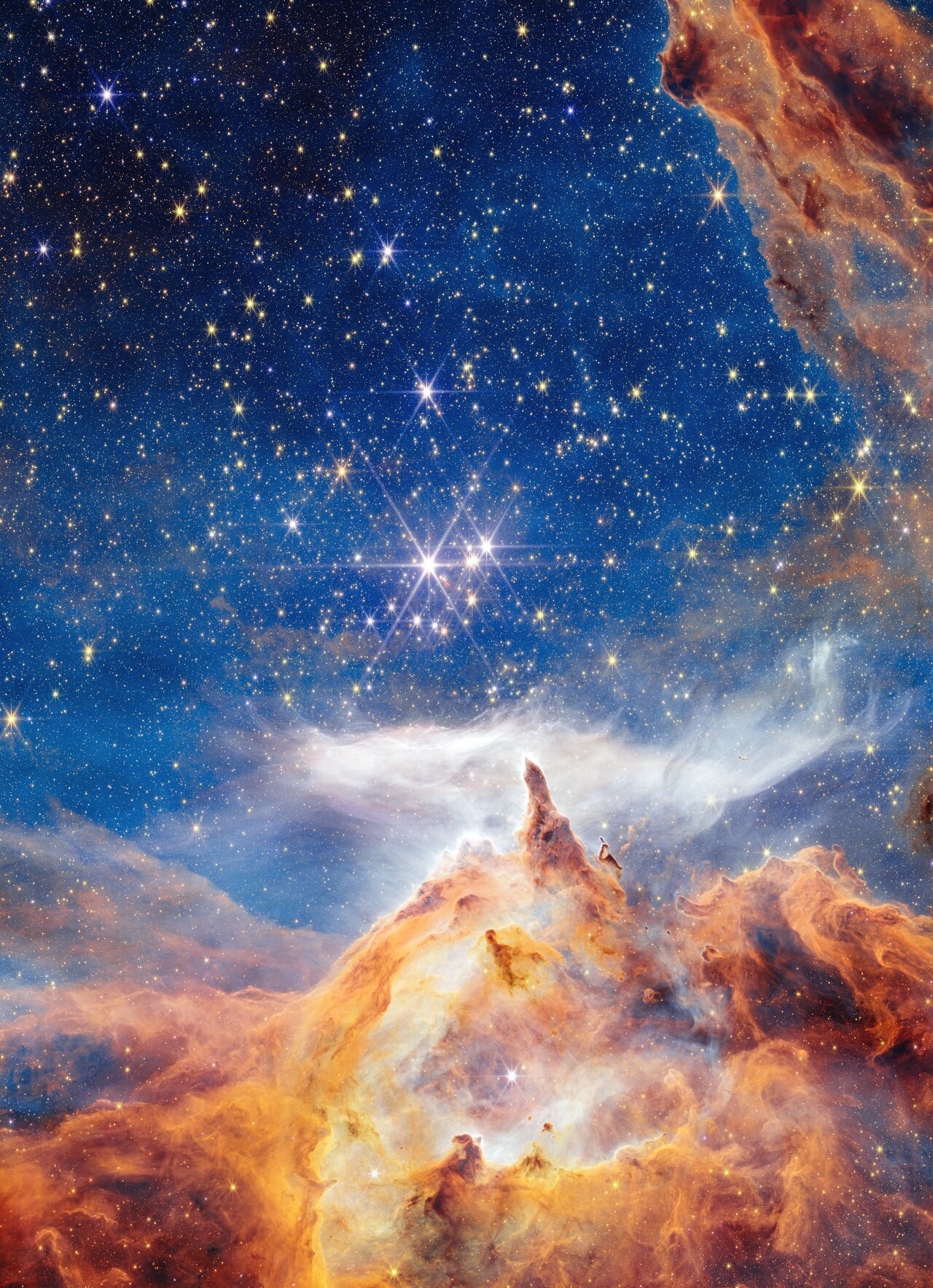
Image (Credit): The Pismis 24 star cluster as captured by the JWST. (NASA, ESA, CSA, and STScI, A. Pagan (STScI))

This week’s amazingly vibrant image was captured by the James Webb Space Telescope (JWST). It shows a young star cluster, called Pismis 24, which is approximately 5,500 light-years away.

Here is the rest of the story from the European Space Agency (ESA):

What appears to be a craggy, starlit mountaintop kissed by wispy clouds is actually a cosmic dust-scape being eaten away by the blistering winds and radiation of nearby, massive, infant stars. Home to a vibrant stellar nursery and one of the closest sites of massive star birth, Pismis 24 provides rare insight into large and massive stars. This region is one of the best places to explore the properties of hot young stars and how they evolve.

A Day in Astronomy: The Arrival of the Expedition 1 Crew at the ISS

Image (Credit): The Expedition 1 crew of Yuri P. Gidzenko (left), William M. Shepherd, and Sergei K. Krikalev in the ISS’s Zvezda Service Module. (NASA)

It was 25 years ago on this day that the Expedition 1 crew arrived at the International Space Station (ISS), which marked the beginning of very successful space collaboration between five space agencies from the United States, Russia, the European Union, Japan, and Canada.

The Expedition 1 crew, arriving at the ISS aboard a Russian Soyuz capsule, consisted of NASA astronaut William M. Shepherd and Russian cosmonauts Yuri P. Gidzenko and Sergei K. Krikalev. This first mission of four months focused on the continued assembly of the station, with the Expedition 2 crew arriving in March 2001 aboard Space Shuttle Discovery.

Some of the key facts related to the ISS include:

  • In 24 hours, the space station makes 16 orbits of Earth, traveling through 16 sunrises and sunsets.
  • The living and working space in the station is larger than a six-bedroom house (and has six sleeping quarters, two bathrooms, a gym, and a 360-degree view bay window).
  • A spacecraft can arrive at the space station as soon as four hours after launching from Earth.
  • The space station travels an equivalent distance to the Moon and back in about a day.
Image (Credit): Drawing of the International Space Station with all of the elements labeled. (NASA)

Space Stories: Questionable Move of Space Shuttle Discovery, the Problem with Red Dwarf Exoplanets, and a Rare Sight from Mars

Image (Credit): Space shuttle Discovery landing at Edwards Air Force Base in California. (NASA)

Here are some recent space-related stories of interest.

Chron: Historic Space Shuttle Could Be Compromised for Trip to Texas

Within the next 18 months, the space shuttle Discovery may be disassembled in Washington D.C., transported more than 1,000 miles to Houston and reassembled. But not if grassroots group Keep The Shuttle has anything to say about it. The plan to move a shuttle, notably an unnamed shuttle, was part of President Donald Trump’s “Big Beautiful Bill” passed this summer. The Smithsonian and others have dug in against the move, saying the research institute actually owns the Discovery in a trust for the American people, nothing that it’s unclear if Congress even has the authority to order the Smithsonian transfer an artifact.

Universe Today New Research Suggests Red Dwarf Systems are Unlikely to Have Advanced Civilizations

Thanks to the huge spate of exoplanet discoveries, multiple rocky planets have been found orbiting within the habitable zones (HZs) of red dwarf stars. For decades, there has been an ongoing debate as to whether these systems could be our best bet for finding evidence of life beyond Earth. In a recent study, Professor David Kipping addresses two key facts that could mean humanity is an outlier. Based on the age of the Universe and the relatively rare nature of our Sun, he concludes that astrobiologists examining red dwarf planets may be looking in the wrong place.

CBS News: “Interstellar Comet Passing by Mars Seen in Rare Images

A rare interstellar comet — only the third ever confirmed to enter our solar system — was photographed last week, closely approaching Mars, the European Space Agency said Tuesday. The images taken on Friday by two Mars orbiters show a bright, fuzzy white dot of the comet, also known as 3I/ATLAS, appearing to move against a backdrop of distant stars as it was about 18,641,135 miles away from Mars. The comet poses no threat to Earth, NASA has previously said.

Pic of the Week: The Indescribable NGC 2775

Image (Credit): NGC 2775, which is 67 million light-years away, as captured by the NASA/ESA Hubble Space Telescope. (ESA/Hubble & NASA, F. Belfiore, J. Lee and the PHANGS-HST Team)

This week’s image is from the NASA/European Space Agency (ESA) Hubble Space Telescope. It shows the odd galaxy NGC 2275 that is hard to describe. Is it an elliptical galaxy, a spiral galaxy, or something else?

The ESA weighs in on the issue below:

NGC 2775 sports a smooth, featureless centre that is devoid of gas, resembling an elliptical galaxy. It also has a dusty ring with patchy star clusters, like a spiral galaxy. Which is it, then: spiral or elliptical — or neither?

Because we can only view NGC 2775 from one angle, it’s difficult to say for sure. Some researchers have classified NGC 2775 as a spiral galaxy because of its feathery ring of stars and dust, while others have classified it as a lenticular galaxy. Lenticular galaxies have features common to both spiral and elliptical galaxies.

It’s not yet known exactly how lenticular galaxies come to be, and they might form in a variety of ways. Lenticular galaxies might be spiral galaxies that have merged with other galaxies, or that have mostly run out of star-forming gas and lost their prominent spiral arms. They also might have started out more similar to elliptical galaxies, then collected gas into a disk around them.

Some evidence suggests that NGC 2775 has merged with other galaxies in the past. Invisible in this Hubble image, NGC 2775 has a tail of hydrogen gas that stretches almost 100 000 light-years around the galaxy. This faint tail could be the remnant of one or more galaxies that wandered too close to NGC 2775 before being stretched apart and absorbed. If NGC 2775 merged with other galaxies in the past, it could explain the galaxy’s strange appearance today.