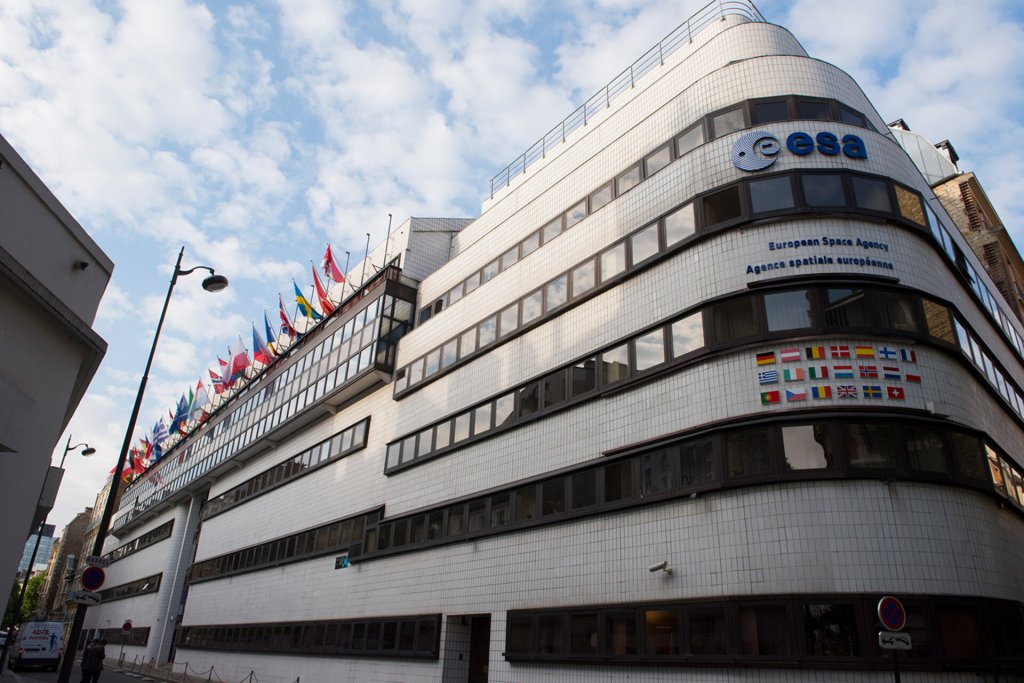
Image (Credit): European Space Agency (ESA) headquarters in Paris. (ESA)
“From understanding our changing planet to exploring Mars, I hugely value the cooperation we have with NASA…By contributing key European hardware and services to exciting programmes such as Artemis and Mars Sample Return, we are building Europe’s autonomy while also being a reliable partner.”
The image this week is from the NASA/ESA Hubble Space Telescope. It shows a cluster of old and young stars in the globular cluster Liller 1 located within the bulge of the Milky Way Galaxy. Here is a full explanation from NASA:
The muted red tones of the globular cluster Liller 1 are partially obscured in this image by a dense scattering of piercingly blue stars. In fact, it is thanks to Hubble’s Wide Field Camera 3 (WFC3) that we are able to see Liller 1 so clearly in this image, because the WFC3 is sensitive to wavelengths of light that the human eye cannot detect. Liller 1 is only 30 000 light-years from Earth — relatively neighbourly in astronomical terms — but it lies within the Milky Way’s ‘bulge’, the dense and dusty region at our galaxy’s centre. Because of that, Liller 1 is heavily obscured from view by interstellar dust, which scatters visible light (particularly blue light) very effectively. Fortunately, some infrared and red visible light are able to pass through these dusty regions. WFC3 is sensitive to both visible and near-infrared (infrared that is close to the visible) wavelengths, allowing us to see through the obscuring clouds of dust, and providing this spectacular view of Liller 1.
Liller 1 is a particularly interesting globular cluster, because unlike most of its kind, it contains a mix of very young and very old stars. Globular clusters typically house only old stars, some nearly as old as the Universe itself. Liller1 instead contains at least two distinct stellar populations with remarkably different ages: the oldest one is 12 billion years old and the youngest component is just 1-2 billion years old. This led astronomers to conclude that this stellar system was able to form stars over an extraordinary long period of time.
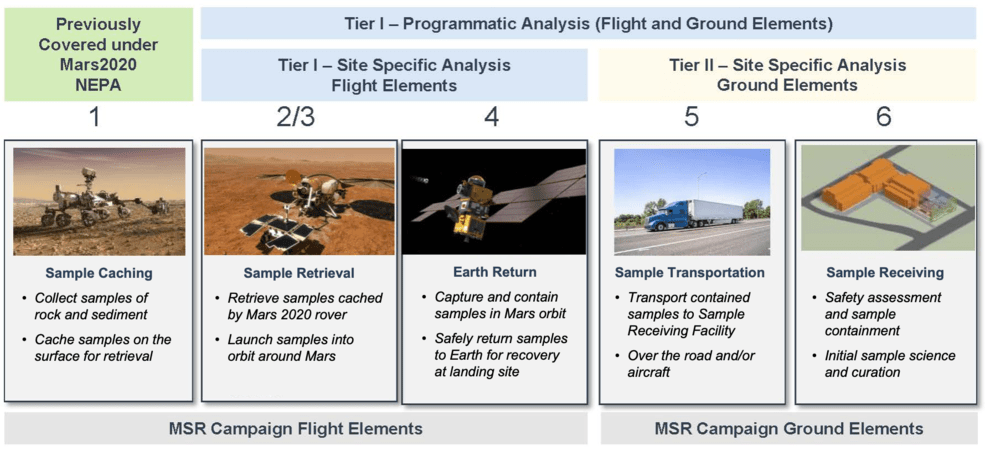
Image (Credit): Mars Sample Return campaign poster. (NASA)
NASA and the European Space Agency are still looking for comments on the process to return Martian rock samples to Earth. Of the six steps needed to collect and return the samples (see graphic above), only the first step is currently underway with the Perseverance Rover exploring Mars. Now we need to get those samples home. You have until May 15th to get comments back to NASA on this.
And what is the time frame for getting these samples back to Earth? The current goal is 2033, assuming all goes well. You may recall that China also wants to collect and return Martian samples by 2030. I expect more delays on both sides. When you add this to the race back to the Moon, the space race is getting more interesting every day.
Image (Credit): This Hubble image is a mosaic of many exposures where some asteroids appear multiple times. (NASA, ESA, and B. Sunnquist and J. Mack/STScI)
The Hubble Space Telescope’s old data still holds some secrets. The European Space Agency (ESA) has reported that astronomers have found 1,031 unidentified asteroid trails in earlier data from the NASA/ESA Hubble Space Telescope. The asteroids were located by the Hubble Asteroid Hunter project, which defines the project in this way:
…we use archival images made by the Hubble Space Telescope to find asteroids observed by chance. The ESASky team compared the observation epoch and field of view of these images with the computed orbits of asteroids, to identify possible observations. The positions predicted by the algorithm, nevertheless, have some associated uncertainty because the ephemerides are not always known to great precision. This uncertainty increases with the amount of time between the last observation date and the date we predict the position for. Identifying the asteroids in the images (if present) and marking the exact position of their trail allows us to update the ephemerides and help us better characterise these objects.
More than 11,000 volunteers studied about 37,000 composite images taken by the Hubble between April 2002 and March 2021. The volunteers found about 1,000 asteroid trails, which when combined with other images spotted using artificial intelligence added to 1,701 asteroid trails. Of these, 1,031 are unidentified trails most likely associated with smaller asteroids. The analysis of these unidentified trails will continue.
This is a great example of the public assisting with astronomy and allowing for more timely results. It’s a helpful model for future astronomy endeavors.
Image (Credit): The nebula surrounding the star AG Carinae (ESA/Hubble and NASA, A. Nota, C. Britt)
This week’s photo is from the Hubble Space Telescope. It shows the “puffing dust bubbles and an erupting gas shell,” or nebula, surrounding the monster star AG Carinae. Here is the rest of the story from the European Space Agency (ESA) Hubble site:
This giant star is waging a tug-of-war between gravity and radiation to avoid self-destruction. The star is surrounded by an expanding shell of gas and dust — a nebula — that is shaped by the powerful winds emanating from the star. The nebula is about five light-years wide, equal to the distance from here to our nearest star, Alpha Centauri.
AG Carinae is formally classified as a Luminous Blue Variable because it is hot (blue), very luminous, and variable. Such stars are quite rare because there are not many stars that are so massive. Luminous Blue Variable stars continuously lose mass in the final stages of their life, during which a significant amount of stellar material is ejected into the surrounding interstellar space, until enough mass has been lost that the star has reached a stable state.
AG Carinae is surrounded by a spectacular nebula, formed by material ejected by the star during several of its past outbursts. The nebula is approximately 10 000 years old, and the observed velocity of the gas is approximately 70 kilometres per second. While this nebula looks like a ring, it is in fact a hollow shell rich in gas and dust, the centre of which has been cleared by the powerful stellar wind travelling at roughly 200 kilometres per second. The gas (composed mostly of ionised hydrogen and nitrogen) is visible to us in these images as a thick bright red ring, which appears doubled in places — possibly the result of several outbursts colliding into each other. The dust, here visible in blue, has formed in clumps, bubbles and filaments that are shaped by the stellar wind.




 Our Awesome Universe