NASA 2025 Calendar and More

Credit: NASA

If you are looking for a colorful calendar or simply some amazing images and art, you cannot go wrong downloading NASA’s 2025 calendar. For example, the graphics shown above and below are just two examples of the pages you can find in this 32-page calendar. It shows the number of NASA-led or supported space missions throughout our solar system. It is a numbing number of missions.

Have you heard of ESCAPADE mission, which stands for the Escape and Plasma Acceleration and Dynamics Explorers? Checking the NASA site, I learned that this mission was a dual-spacecraft mission to study ion and sputtered escape from Mars, and it was supposed to be launched this week but it was put back on the shelf. Here is more on the mission:

The planned launch on the Blue Origin New Glenn booster from Cape Canaveral, originally scheduled for October 13, 2024, has been delayed indefinitely. The science goals of the mission are to: understand the processes controlling the structure of Mars’ hybrid magnetosphere and how it guides ion flows; understand how energy and momentum are transported from the solar wind through Mars’ magnetosphere; and understand the processes controlling the flow of energy and matter into and out of the collisional atmosphere. EscaPADE is part of the NASA Small Innovative Missions for Planetary Exploration (SIMPLEx) program.

I am learning about it just in time to find out it is going nowhere for the moment.

Of course, there are many more on the list that you can look up for yourself. For instance, Google the European Space Agency’s BepiColombo.

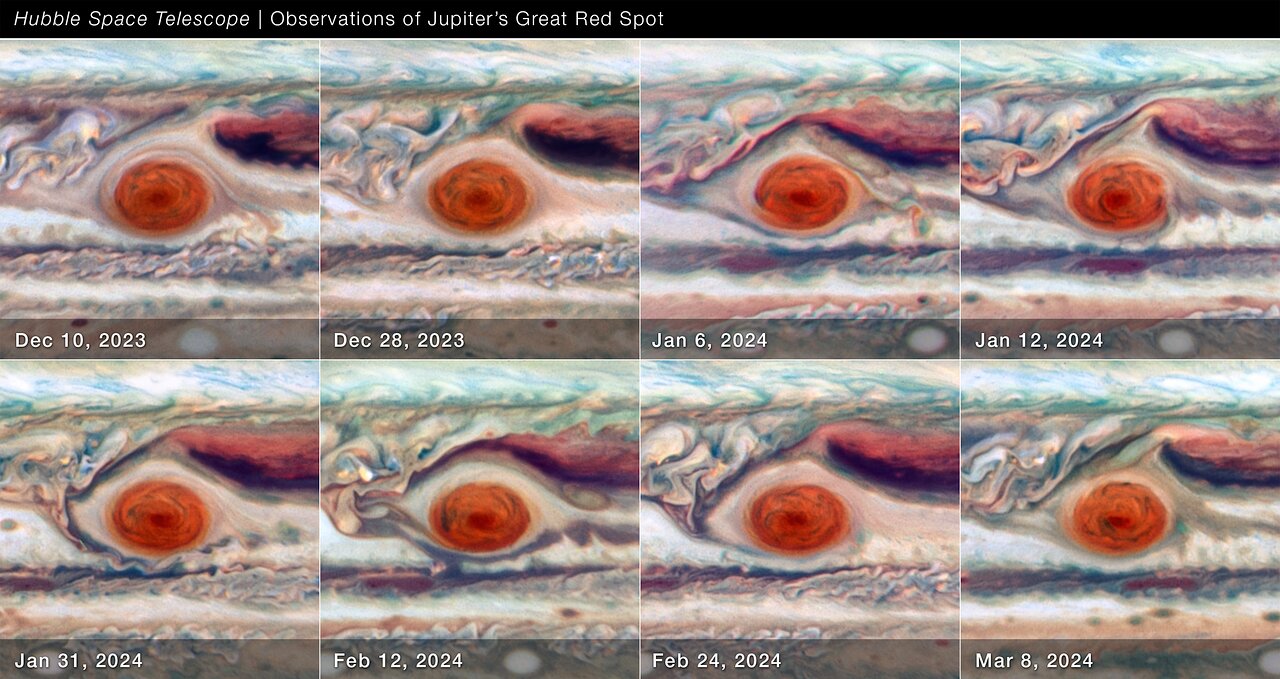
Image (Credit): Second part of the Science Fleet – Operating & Future Missions. (NASA)

Pic of the Week: Jupiter’s Changing Spot

Image (Credit): Jupiter’s Great Red Spot captured by the Hubble Space Telescope over a 90 day period. (NASA, ESA, A. Simon (GSFC))

This week’s image is from the NASA/European Space Agency (ESA) Hubble Space Telescope. It captures one of the most identifiable objects in our solar system – Jupiter’s Great Red Spot.

Here is a little more from the ESA Hubble site:

Using Hubble Space Telescope data spanning approximately 90 days (between December 2023 and March 2024) when the giant planet Jupiter was approximately 630 million to 820 million kilometres from the Sun, astronomers measured the Great Red Spot’s size, shape, brightness, colour, and vorticity over one full oscillation cycle. The data reveal that the Great Red Spot is not as stable as it might look. It was observed going through an oscillation in its elliptical shape, jiggling like a bowl of gelatin. The cause of the 90-day oscillation is unknown.

Good News: Hurricane Milton Had Little Impact on NASA Facilities

Image (Credit): View of the Kennedy Space Center following Hurricane Milton. (NASA)

NASA has reported that it has so far detected little damage from Hurricane Milton at the Kennedy Space Center.

Here is what NASA shared today via Twitter/X:

Kennedy is now OPEN!

The Damage Assessment and Recovery Team has completed their assessment of the center and its facilities, and determined that employees can safely return on-site to resume working.

The damage identified is manageable and in-line with the items the Ride Out Teams previously identified, including minor impacts such as ripped awning, and damage to doors and traffic lights.

It is interesting that NASA is using DART in a whole way here compared to yesterday’s story about the European Space Agency’s Hera mission. I just hope that the DART mission never leads to a DART event here on Earth.

Pic of the Week: The Launch of Hera

Image (Credit): Visitors at ESA’s control center in Germany watching the Hera launch. (ESA / J.Mai)

This week’s image shows a crowd in Germany watching the launch of the European Space Agency’s (ESA) Hera mission on October 7, 2024. The launch itself took place from Cape Canaveral Space Force Station in Florida via a SpaceX Falcon 9.

Hera’s goal is to study how binary asteroid systems like Didymos form and function to learn more about to defend the Earth from approaching asteroids. You may remember Didymos from the earlier NASA Double Asteroid Redirection Test (DART) mission.

Here is more from the ESA on the mission:

Hera’s first deep space manoeuvre will begin in late October and put the spacecraft on course for its next major milestone, a flyby of Mars in March 2025. During this flyby, Hera will use its instruments to study Deimos, the smaller and more enigmatic of Mars’s two moons. This will serve as an important test for many of the spacecraft’s instruments, ensuring they are fully operational before the spacecraft arrives at its final destination, Didymos.

Hera will perform a second deep space manoeuvre in February 2026. An ‘impulsive rendezvous’ in October 2026 will bring Hera into the vicinity of the Didymos asteroid system. The spacecraft will begin its detailed survey of the moonlet Dimorphos in 2027, which will turn the 151 m asteroid into one of the most studied objects in the Solar System.

Space Stories: NASA’s Probe Explorers, Finding Exoplanet Atmospheres, and an Australian Space Antenna

Here are some recent stories of interest.

Universe TodayNASA Announces a New Class of Space Missions: Probe Explorers

NASA has sent a whole host of spacecraft across the Solar System and even beyond. They range from crewed ships to orbit and to the Moon to robotic explorers. Among them are a range of mission classes from Flagships to Discovery Class programs. Now a new category has been announced: Probe Explorers. This new category will fill the gap between Flagship and smaller missions. Among them are two proposed missions; the Advanced X-ray Imaging Satellite and the Probe Far-Infrared Mission for Astrophysics.

uChicago News: “UChicago Researchers Use New Method of Finding Atmospheres in Distant Planets

It is a major goal of astronomical research to find planets other than Earth that might be suitable for sustaining life. There are a number of factors which many scientists agree are essential to a planet being habitable, but an important one is whether or not a planet has an atmosphere. Scientists have found other rocky, Earth-like exoplanets, but none that we can definitively say have atmospheres. Finding these planets will reveal insights into how such atmospheres are formed and retained, so that we can better predict which planets could be habitable. A study conducted by University of Chicago PhD student Qiao Xue with Prof. Jacob Bean’s group has demonstrated a new way to determine if faraway exoplanets have an atmosphere—and showed that it was simpler and more efficient than previous methods. The new technique, when applied to more planets, has the potential to help us learn more about patterns in atmosphere formation.

European Space Agency: “ESA Crowns New Deep Space Antenna in Australia

A giant wakes as the Sun sets in Western Australia. The workers can finally rest easy after more than a day spent using an enormous crane to lift the colossal 122-tonne, 35-metre diameter reflector dish and crown ESA’s newest deep space communication antenna. With the dish and its quadrupole now installed, ESA is on track to inaugurate its fourth deep-space antenna, and second at the New Norcia site in Australia, by the end of 2025. Referred to as NNO3, the New Norcia 3 antenna will allow spacecraft to send and receive more valuable data collected from onboard scientific instruments and vital flight instructions for mission operations.