Space Stories: Redefining Planets, Second Thoughts About Crashing the ISS, and NASA Preparing for Artemis II

Credit: AdisResic at Pixabay

Here are some recent stories of interest.

Space.com: What Exactly is a Planet?’ Astronomers Want to Amend the Definition

Three astronomers last week proposed expanding the official definition of a planet to encompass worlds orbiting stars other than our own, a nuance not currently included in the formal definition of the term established in 2006 by the International Astronomical Union, or IAU. If the trio’s new definition pans out, thousands of celestial bodies across the universe could be confirmed as formal planets.

Forbes: U.S. Plan To Crash Space Station Is Condemned By Space Agency Leaders

An American plan to destroy the International Space Station by propelling it to burn through the atmosphere, and then crashing it into the Pacific Ocean, would rob citizens of the future of one of civilization’s greatest technological masterworks, and should be halted, say one-time leaders of NASA and of the European Space Agency. NASA’s draft blueprints to send the ISS on a peacetime kamikaze mission, to explode on impact with Antarctic waters, would obliterate a pole star of human ingenuity, says Jean-Jacques Dordain, Director General of the European Space Agency when the ISS was being built and expanded.

NASA: NASA Barge Preparations Underway for Artemis II Rocket Stage Delivery

Team members are installing pedestals aboard NASA’s Pegasus barge to hold and secure the massive core stage of NASA’s SLS (Space Launch System) rocket, indicating NASA barge crews are nearly ready for its first delivery to support the Artemis II test flight around the Moon. The barge will ferry the core stage on a 900-mile journey from the agency’s Michoud Assembly Facility in New Orleans to its Kennedy Space Center in Florida…Measuring 212 feet in length and 27.6 feet in diameter, the core stage is the largest rocket stage NASA has ever built and the longest item ever shipped by a NASA barge.
Pic of the Week: Omega Centauri

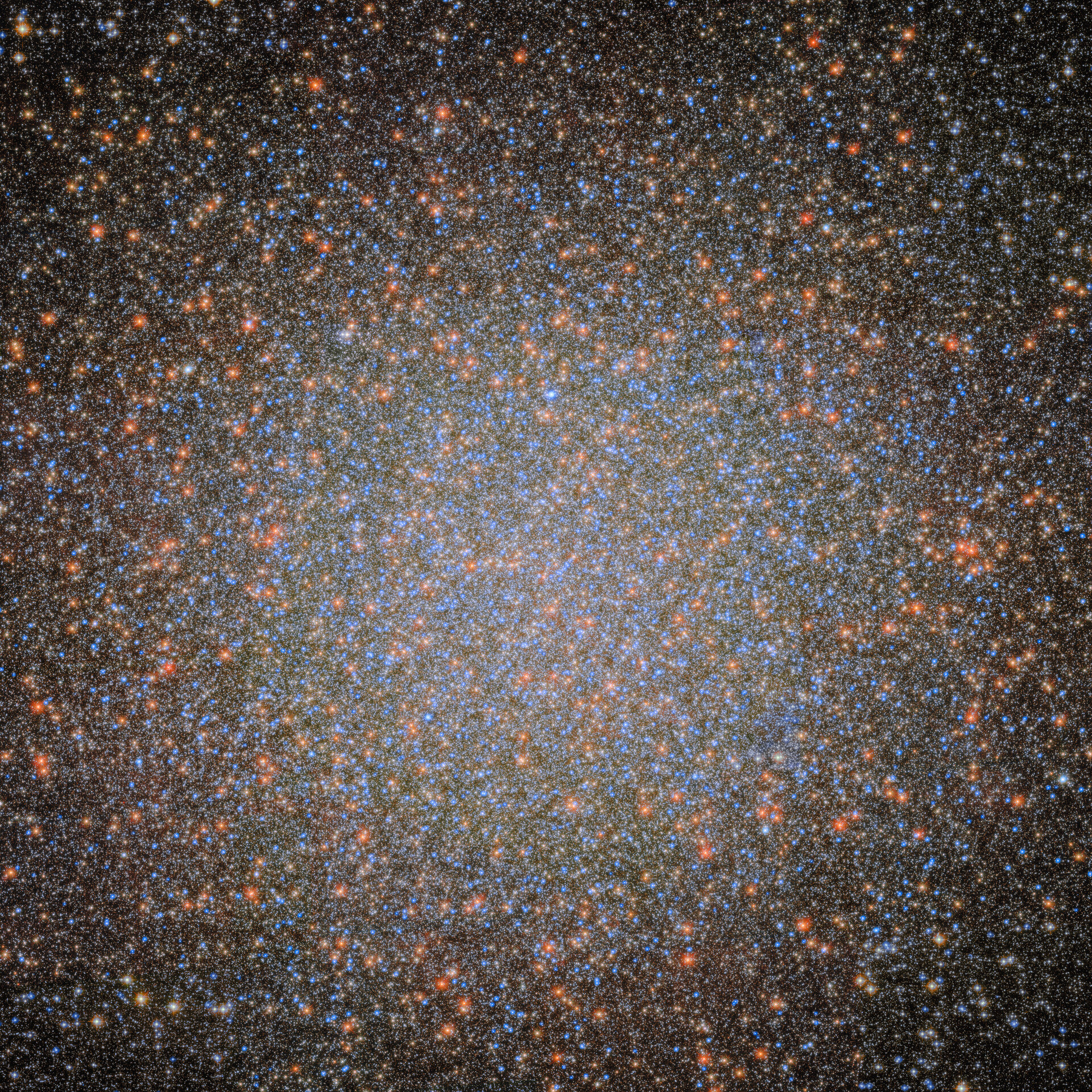
Image (Credit): Hubble Space Telescope’s view of Omega Centauri. (ESA/Hubble & NASA, M. Häberle)

The colorful image this week is from the Hubble Space Telescope. It shows the stars that make up Omega Centauri, a globular cluster one can view with the naked eye.

Here’s a little more about this image from the European Space Agency (ESA):

Omega Centauri is visible from Earth with the naked eye and is one of the favourite celestial objects for stargazers in the southern hemisphere. Although the cluster is 17 000 light-years away, lying just above the plane of the Milky Way, it appears almost as large as the full Moon when seen from a dark rural area. The exact classification of Omega Centauri has evolved through time, as our ability to study it has improved. It was first listed in Ptolemy’s catalogue nearly two thousand years ago as a single star. Edmond Halley reported it as a nebula in 1677, and in the 1830s the English astronomer John Herschel was the first to recognise it as a globular cluster. Omega Centauri consists of roughly 10 million stars that are gravitationally bound.

Europe is Back in the Space Race

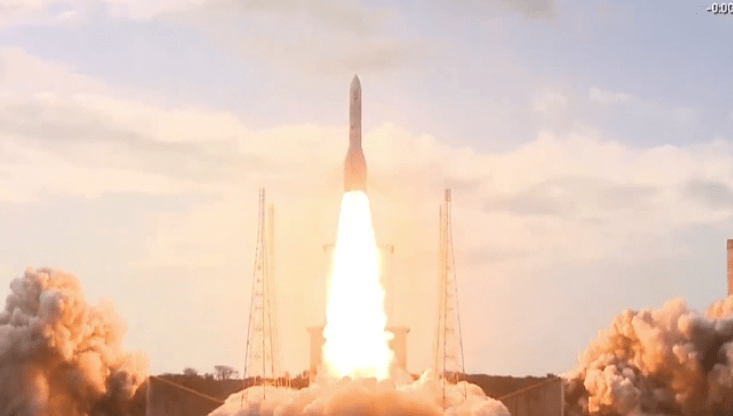
Image (Credit): Today’s launch of the Ariane 6 rocket from the Guiana Space Centre in Kourou, French Guiana. (ESA)

Earlier today, the European Space Agency (ESA) successfully launched an Ariane 6 rocket, the next generation of European space rockets. The launch was from the ESA’s Guiana Space Centre in French Guiana.

Europe is once again moving away from it dependence on US and Russian rockets to get its space program into space. The launch of the new rocket has been delayed for years while the Ariane 5 flew its last mission about a year ago.

On it’s Twitter page, the ESA stated:

We have now entered into a new era of spaceflight for Europe, powering us into space and allowing us to realise our ambitions on the world stage.

The inaugural flight did experience a problem when part of its test payload failed to deploy. This will need to be investigated and corrected before more critical payloads are placed on a rocket.

That said, all in all it was a good day for the Europeans and space enthusiasts everywhere.

Posted in ESA

When Will the Boeing Astronauts Return?

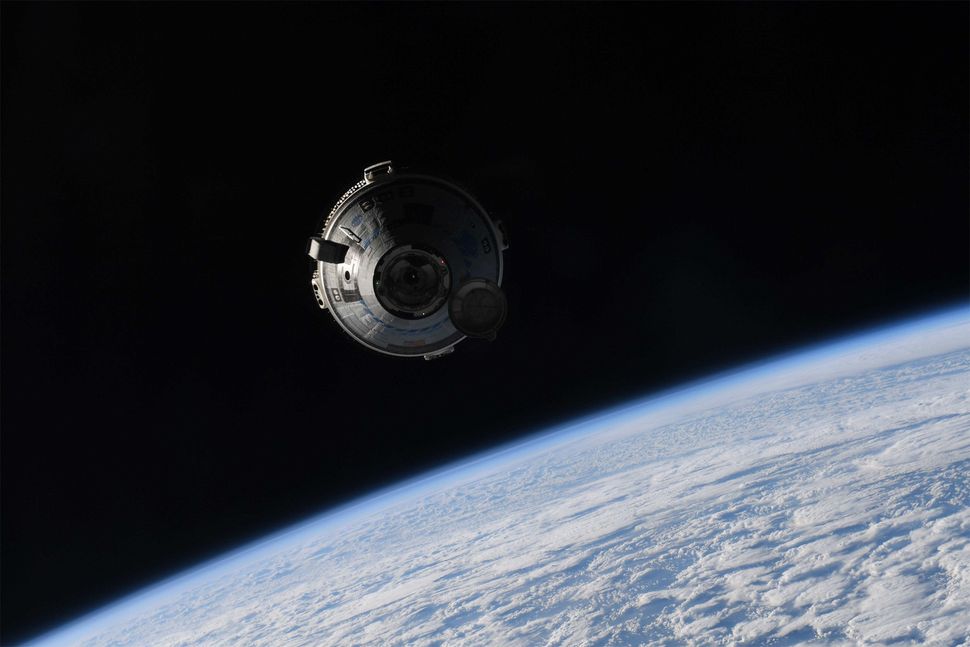
Image (Credit): Boeing’s Starliner approaching the ISS. (Samantha Cristoforetti/European Space Agency)

The return of the two astronauts from the earlier Starliner mission has been bumped a few times now, with the latest return scheduled for this Saturday (June 22).

The Boeing Starliner arrived at the International Space Station with thruster problems, and then encountered further helium leaks after that, so the need for additional time to study the issue makes some sense. NASA will address the status of the mission requirements and weather conditions at a press conference tomorrow (June 18).

It took long enough to get the two astronauts to the ISS after many delays, so maybe should not surprise anyone that we have a few delays on the return.

Boeing needs good press these days, so a quick and simple mission would have been nice. Yet this would be a bad time to throw caution into the wind when they are so close to the finish line.

Pic of the Week: Frost on Olympus Mons

Image (Credit): Frosty summit of Mar’s Olympus Mons. (ESA/DLR/FU Berlin)

This week’s image is from the European Space Agency (ESA) and shows Olympus Mons on Mars, the tallest volcano in the solar system. Captured by ESA’s Mars Express, it shows water frost close to the planet’s equator, which was unexpected.

Colin Wilson, ESA project scientist for both ExoMars Trace Gas Orbiter and Mars Express, stated:

Finding water on the surface of Mars is always exciting, both for scientific interest and for its implications for human and robotic exploration…Even so, this discovery is particularly fascinating. Mars’s low atmospheric pressure creates an unfamiliar situation where the planet’s mountaintops aren’t usually colder than its plains – but it seems that moist air blowing up mountain slopes can still condense into frost, a decidedly Earth-like phenomenon.