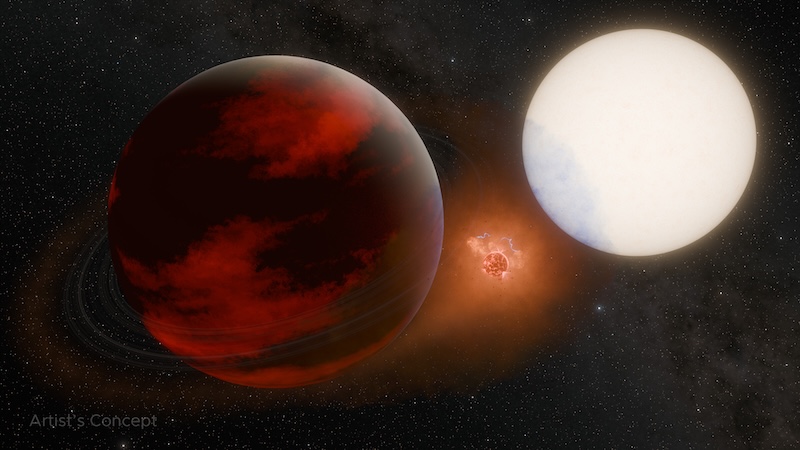
Potential Exomoon Being Studied by JWST

Image (Credit): Artist’s rendering of WASP-39b. (NASA, ESA, CSA, Joseph Olmsted (STScI))

We hear plenty about all the exoplanets being studies at the moment, but we hear very little about exomoons, though several astronomers are eager to find them and learn more about them.

This time last year I highlighted a paper that discussed a possible exomoon circling an exoplanet called WASP-49Ab located about 635 light-years away . It was spotted by the European Southern Observatory’s Very Large Telescope in Chile.

Well, now the James Webb Space Telescope (JWST) has provided data related to another possible exomoon orbiting a hot Jupiter-like exoplanet called WASP-39b. It is located about 700 million light-years away.

In a Scientific American article titled “Have Astronomers Finally Found an Exomoon?” we learn that a paper is being released shortly outlining the argument for this potential “hypervolcanic exomoon.” This presumed IO-like exomoon is being cooked by the parent sun.

The paper accepted for publication, Volcanic Satellites Tidally Venting Na, K, SO2 in Optical & Infrared Light, states the following:

Recent infrared spectroscopy from the James Webb Space Telescope (JWST) has spurred analyses of common volcanic gases such as carbon dioxide (CO2), sulfur dioxide (SO2), alongside alkali metals sodium (Na I) and potassium (K I) surrounding the hot Saturn WASP-39 b. We report more than an order-of-magnitude of variability in the density of neutral Na, K, and SO2 between ground-based measurements and JWST, at distinct epochs, hinting at exogenic physical processes similar to those sourcing Io’s extended atmosphere and torus. Tidally-heated volcanic satellite simulations sputtering gas into a cloud or toroid orbiting the planet, are able to reproduce the probed line-of-sight column density variations. The estimated SO2 flux is consistent with tidal gravitation predictions, with a Na/SO2 ratio far smaller than Io’s. Although stable satellite orbits at this system are known to be < 15.3 hours, several high-resolution alkali Doppler shift observations are required to constrain a putative orbit. Due to the Roche limit interior to the planetary photosphere at ~ 8 hours, atmosphere-exosphere interactions are expected to be especially important at this system.

It is a dense summary, but also a hopeful finding that may lead to more focused searches for exomoons.

The addition of exomoons to the list of new discoveries will only increase the chances that some form of life can be found among he many solar systems we can study. Interestingly enough, we are still probing our own solar system’s moons with the same hope.
We Have Moved from Exoplanet to Exomoon

Image (Credit): An artist’s rendering of a volcanic moon orbiting WASP-49 b. (NASA/ JPL-Caltech)

The search for new exoplanets in our galaxy continues, but now it may include the first exomoon. This was something that was expected to occur at some point as the detection methods became better over time.

The exomoon in question is believed to be a volcanic moon orbiting a giant planet about 635 light-years away. Detected using the European Southern Observatory’s Very Large Telescope in Chile, the exomoon is discussed in a paper written by researchers with NASA’s Jet Propulsion Laboratory and Caltech in California. The clue was a cloud of sodium that did not appear to come from the host exoplanet.

The new discovery is being compared to Jupiter’s volcanic moon Io, which is the most volcanically active world in the solar system.

If you want to learn more about exomoons, I recommend a Cool Worlds video narrated by Assistant Professor of Astronomy David Kipping who provides five reasons that the study of exomoons is so important.

Space Stories: Old Stars Harboring Exoplanets, a Hot “Earth” Located, and the Role of Exomoons

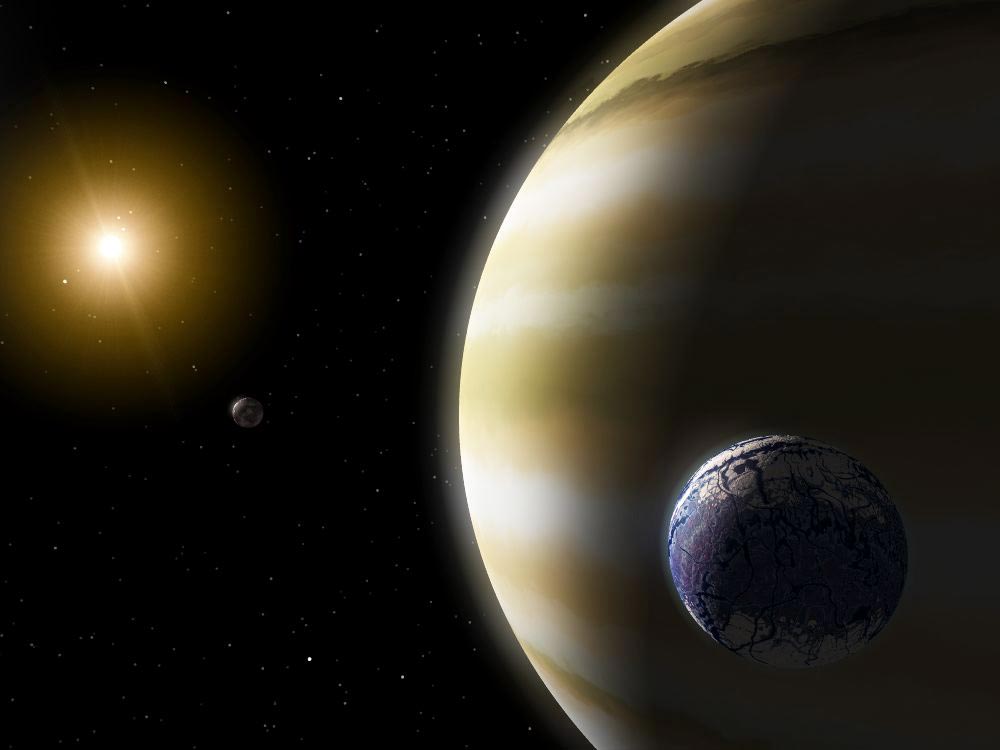
Image (Credit): Artist’s rendering of an Earth-like exomoon orbiting a gas giant planet in a star’s habitable zone. (NASA/JPL-Caltech)

Here are some recent stories of interest related to exoplanets.

Phys.org: “Old Stars May Be the Best Places to Search for Life

Once upon a cosmic time, scientists assumed that stars apply an eternal magnetic brake, causing an endless slowdown of their rotation. With new observations and sophisticated methods, they have now peeked into a star’s magnetic secrets and found that they are not what they expected. The cosmic hotspots for finding alien neighbors might be around stars hitting their midlife crisis and beyond. This groundbreaking study, shedding light on magnetic phenomena and habitable environments, has been published in The Astrophysical Journal Letters.

NASA: “Earth-sized Planet Has a ‘Lava Hemisphere’

In a system with two known planets, astronomers spotted something new: a small object transiting across the Sun-sized star. This turned out to be another planet: extra hot and Earth-sized…The newly-spotted planet, called HD 63433 d, is tidally locked, meaning there is a dayside which always faces its star and a side that is constantly in darkness. This exoplanet, or planet outside of our solar system, orbits around the star HD 63433 (TOI 1726) in the HD 63433 planetary system. This scorching world is the smallest confirmed exoplanet younger than 500 million years old. It’s also the closest discovered Earth-sized planet this young, at about 400 million years old.

UniverseToday: “Big Planets Don’t Necessarily Mean Big Moons’”

Does the size of an exomoon help determine if life could form on an exoplanet it’s orbiting? This is something a February 2022 study published in Nature Communications hopes to address as a team of researchers investigated the potential for large exomoons to form around large exoplanets (Earth-sized and larger) like how our Moon was formed around the Earth. Despite this study being published almost two years ago, its findings still hold strong regarding the search for exomoons, as astronomers have yet to confirm the existence of any exomoons anywhere in the cosmos. But why is it so important to better understand the potential for large exomoons orbiting large exoplanets?

Space Stories: Tom Hanks Returns to the Moon, Exomoons are Questioned, and Our Moon Enters a New Phase

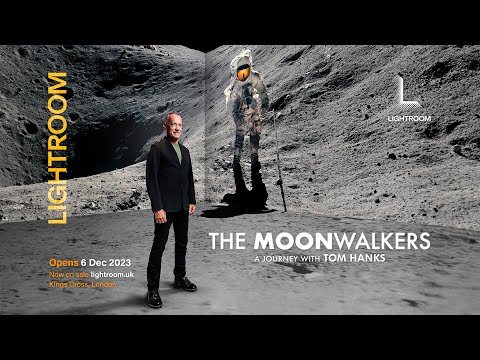
Image (Credit): Tom Hanks at the opening of his new show in London. (Apollo Remastered)

Here are some recent stories of interest.

Reuters: “Tom Hanks Brings Love of Space to New Immersive London Show

Archive footage of space rockets taking off beam across giant walls in a new immersive show in London, as Hollywood actor Tom Hanks narrates the story of human voyages to the moon. “The Moonwalkers: A Journey With Tom Hanks” looks at the first moon landings of the Apollo missions from 1969 to 1972 and their successor, NASA’s human spaceflight program, Artemis. The next mission – the Artemis II lunar flyby – is planned for next year and interviews with the four-member team are also projected on the walls at the Lightroom gallery space in London’s King Cross area.

Max Planck Institute for Solar System Research: “Giant Doubts About Giant Exomoons

Just as it can be assumed that the stars in our Milky Way are orbited by planets, moons around these exoplanets should not be uncommon. This makes it all the more difficult to detect them. So far, only two of the more than 5300 known exoplanets have been found to have moons. A new data analysis now demonstrates that scientific statements are rarely black or white, that behind every result there is a greater or lesser degree of uncertainty and that the path to a statement often resembles a thriller. In observations of the planets Kepler-1625b and Kepler-1708b from the Kepler and Hubble space telescopes, researchers had discovered traces of such moons for the first time. A new study now raises doubts about these previous claims. As scientists from the Max Planck Institute for Solar System Research and the Sonnenberg Observatory, both in Germany, report in the journal Nature Astronomy, “planet-only” interpretations of the observations are more conclusive.

The University of Kansas: “Scholars Say it’s Time to Declare a New Epoch on the Moon, The ‘Lunar Anthropocene’

Human beings first disturbed moon dust Sept. 13, 1959, when the USSR’s unmanned spacecraft Luna 2 alighted on the lunar surface. In the following decades, more than a hundred other spacecraft have touched the moon — both crewed and uncrewed, sometimes landing and sometimes crashing. The most famous of these were NASA’s Apollo Lunar Modules, which transported humans to the moon’s surface to the astonishment of humankind. In the coming years, missions and projects already planned will change the face of the moon in more extreme ways. Now, according to anthropologists and geologists at the University of Kansas, it’s time to acknowledge humans have become the dominant force shaping the moon’s environment by declaring a new geological epoch for the moon: the Lunar Anthropocene.

Video: More on the Importance of Exomoons

Image (Credit): Artist’s rendering of an exomoon. (Cool Worlds Lab)

If you watched my earlier post on Cool Worlds Lab’s missed opportunity on an exomoon proposal with the James Webb Space Telescope, then you will enjoy this updated video where Assistant Professor of Astronomy David Kipping provides five reasons that the study of exomoons is so important.

I do not want to give too much away, but one of the reasons is that the search for life on exoplanets needs to consider not only the chemical composition of the exoplanet, but the orbiting exmoon as well. If we assume everything we are seeing in the light from the observed exoplanet comes from only the exoplanet, we may experience a number of false positives because the life-affirming chemicals may not be combined in one object but instead come from two dead objects that only appear as one.

This makes sense, but it also throws a wrench into things. If we are struggling to build telescopes large enough to truly understand an exoplanet’s composition, we are now much farther away from a useful telescope because of the impact of exomoons. Of course, this is not the fault of the exomoons, but rather a reality that must be added to the equation.

Check out the video as Dr. Kipping makes his argument. It is pretty convincing.