Image (Credit): Assistant Professor of Astronomy David Kipping sharing his story of rejection. By the way, the image behind him is the exomoon Pandora from the movie Avatar. (Cool Worlds Lab)
A few months back, Assistant Professor of Astronomy David Kipping shared a short video regarding his organization’s failure to secure James Webb Space Telescope (JWST) time to search for exomoons that he knows are there. His organization, Cool Worlds Lab, has done some amazing work studying and publicizing issues related to astronomy. You should visit his site for some challenging topics.
What is unique about his video is that it was recorded only one hour after he learned that his organization would not be able to use JWST for his exomoon search and he wanted to share what rejection felt like “in real time.” He goes on to say that such rejection is part of science, as brutal as it may feel at the moment, noting that for every seven JWST proposals, only one will be approved.
Fortunately, we have scientists out there with very thick skin sharing new ideas and proposals. And Dr. Kipping will not be giving up on his exomoon push anytime soon. That is good news for all of us.
Astronomers peering into the night sky always talk about exoplanets located in the “Goldilocks Zone,” or “Habitable Zone,” similar to the Earth’s location from the sun. But what if that is too limited? What if we should also be focusing on colder regions as well as exomoons?
The new study released this week based on data from NASA’s spacecraft Cassini has found that Saturn’s moon Enceladus contains the ingredients for life as we know it. The study states:
Saturn’s moon Enceladus harbours a global ice-covered water ocean. The Cassini spacecraft investigated the composition of the ocean by analysis of material ejected into space by the moon’s cryovolcanic plume. The analysis of salt-rich ice grains by Cassini’s Cosmic Dust Analyzer enabled inference of major solutes in the ocean water (Na+, K+, Cl–, HCO3–, CO32–) and its alkaline pH. Phosphorus, the least abundant of the bio-essential elements, has not yet been detected in an ocean beyond Earth. Earlier geochemical modelling studies suggest that phosphate might be scarce in the ocean of Enceladus and other icy ocean worlds. However, more recent modelling of mineral solubilities in Enceladus’s ocean indicates that phosphate could be relatively abundant.
Again, this represents the building blocks of life and it is the first time all these ingredients have been discovered in our solar system outside of Earth. We did not find it on Venus or Mars, two other planets in the Goldilocks Zone. No, it was found in a much colder part of the solar system on a tiny moon.
This discovery certainly mixes up the situation and provides a much broader region for life to appear in other solar systems. It’s not a new idea, but it has more credibility now that we know a little more about our own neighborhood.
Maybe Goldilock’s concerns about something being too cold was not such a problem after all.
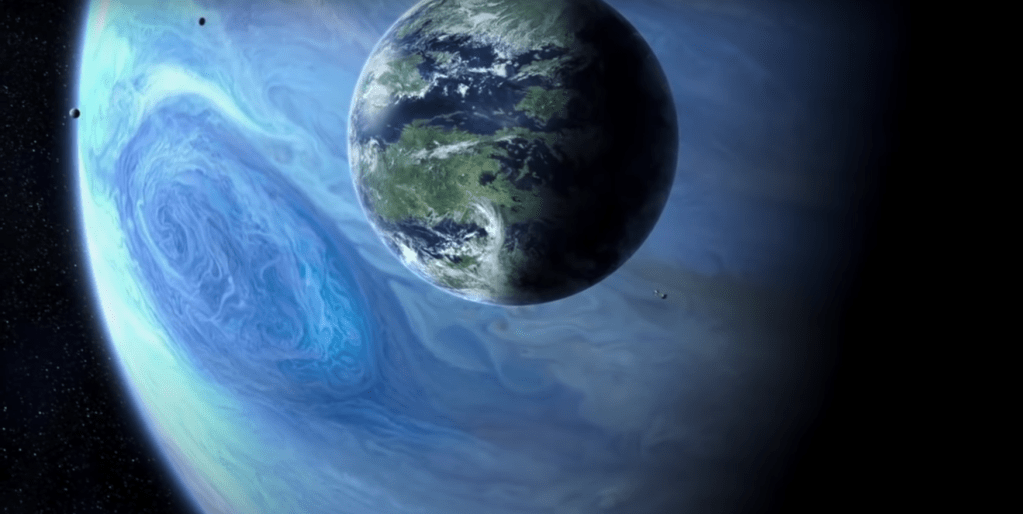
Note: It seems James Cameron figured this out years ago. The planet visited in the Avatar movies, Pandora, is portrayed as a moon (or exomoon) in the Alpha Centauri System.
Image (Credit): Pandora and its host gas giant Polyphemus from the movie Avatar. (20th Century Fox)
Source/Credit: A NASA composite image of Uranus taken from Voyager 2 and the Hubble Space Telescope.
In an earlier posting, I highlighted some scientific papers calling for a return to Neptune rather than Uranus, in part because of Neptune’s moon Triton. But what is the argument for a mission to Uranus? Below I highlight one of the papers submitted to the Planetary Science and Astrobiology Decadal Survey 2023-2032 arguing the merits of a NASA mission to Uranus.
The large moons of Uranus are possible ocean worlds that exhibit a variety of surface features, hinting at endogenic geologic activity in the recent past. These moons are rich in water ice, as well as carbon-bearing and likely nitrogen-bearing constituents, which represent some of the key components for life as we know it. However, our understanding of Uranus and its moons is severely limited by the absence of data collected by an orbiting spacecraft…
An orbiter would vastly improve our understanding of these possible ocean worlds and allow us to assess the nature of water and organics in the Uranian system, thereby improving our knowledge of these moons’ astrobiological potential. A Flagship mission to Uranus can be carried out with existing chemical propulsion technology by making use of a Jupiter gravity assist in the 2030 – 2034 timeframe, leading to a flight time of only ~11 years, arriving in the early to mid 2040’s (outlined in the Ice Giants Pre-Decadal Survey Mission Study Report: https://www.lpi.usra.edu/icegiants/mission_study/Full-Report.pdf).
The five large moons discussed in the paper are Miranda, Ariel, Umbriel, Titania, and Oberon. Titania and Oberon where the first to be discovered back in 1787, followed by the later discoveries of Ariel, Umbriel, and Miranda (in that order). Unlike the moons of other planets, the moons of Uranus are named after magical spirits in English literature.
All of these ocean worlds have gained greater interest as we learn about the dynamics of life on of our own planet. As noted in an article in the MIT Technology Review:
It was once thought the solar system was probably a barren wasteland apart from Earth. Rocky neighbors were too dry and cold like Mars, or too hot and hellish like Venus. The other planets were gas giants, and life on those worlds or their satellite moons was basically inconceivable. Earth seemed to be a miracle of a miracle.
But life isn’t that simple. We now know that life on Earth is able to thrive in even the harshest, most brutal environments, in super cold and super dry conditions, depths of unimaginable pressures, and without the need to use sunlight as a source of energy. At the same time, our cursory understanding of these obscure worlds has expanded tremendously.
We have plenty of worlds to explore in our own solar system as other scientists continue their search for exoplanets and exomoons. The only question now is which local worlds will we visit in our next round of space missions.
We have located exoplanets (planets around other suns) and even free-floating planets (planets without a sun), but what about exoplanet moons? A recent video from the YouTube channel Cool Worlds titled “We Discovered a New Exomoon Candidate! A Survey of 70 Cool Gas Giants,” discusses efforts by the Cool Worlds Lab to find these new moons. The Cool Worlds Lab, based at the Department of Astronomy, Columbia University, is a team of astronomers seeking to discover and understand alien worlds, particularly those where temperatures are cool enough for life, led by Professor David Kipping.
In this video, Professor Kipping discusses his lab’s discovery of exomoon Kepler-1625b-I in 2018. This is a Neptune-sized moon orbiting a Jupiter-sized planet that orbits about the same distant from its star as Earth orbits from our Sun. The video goes into the lab’s “Cool Giant Exomoon Survey” to locate additional exomoons orbiting Jupiter-sized cool giants further out from the host star. I do not want to give away the findings since you can see this for yourself, but it can be safely stated that a new exomoon candidate has been located (and shared in Nature). The exomoon’s designation is given away in the article’s title, so the secret is out.
Check out the Cool Worlds YouTube page for other fascinating videos.


 Our Awesome Universe
