Space Stories: Volcanoes on Venus, Exoplanet Radio Signals, and Bright Baby Jupiter

Image (Credit): Map of volcanoes located on Venus. (Washington University in St. Louis)

Here are some recent stories of interest.

Washington University in St. Louis: “Scientists Share ‘Comprehensive’ Map of Volcanoes on Venus — all 85,000 of Them

Byrne and Hahn’s new study includes detailed analyses of where volcanoes are, where and how they’re clustered, and how their spatial distributions compare with geophysical properties of the planet such as crustal thickness. Taken together, this work provides the most comprehensive understanding of Venus’ volcanic properties — and perhaps of any world’s volcanism so far. That’s because, although we know a great deal about the volcanoes on Earth that are on land, there are still likely a great many yet to be discovered under the oceans. Lacking oceans of its own, Venus’ entire surface can be viewed with Magellan radar imagery.

CNN: “Repeating Radio Signal Leads Astronomers to an Earth-Size Exoplanet

Astronomers have detected a repeating radio signal from an exoplanet and the star that it orbits, both located 12 light-years away from Earth. The signal suggests that the Earth-size planet may have a magnetic field and perhaps even an atmosphere…Scientists noticed strong radio waves coming from the star YZ Ceti and the rocky exoplanet that orbits it, called YZ Ceti b, during observations using the Karl G. Jansky Very Large Array of telescopes in New Mexico. The researchers believe the radio signal was created by interactions between the planet’s magnetic field and the star.

ScienceNews: “Baby Jupiter Glowed so Brightly it Might have Desiccated its Moon

A young, ultrabright Jupiter may have desiccated its now hellish moon Io. The planet’s bygone brilliance could have also vaporized water on Europa and Ganymede, planetary scientist Carver Bierson reported March 17 at the Lunar and Planetary Science Conference. If true, the findings could help researchers narrow the search for icy exomoons by eliminating unlikely orbits. Jupiter is among the brightest specks in our night sky. But past studies have indicated that during its infancy, Jupiter was far more luminous. “About 10 thousand times more luminous,” said Bierson, of Arizona State University in Tempe.

Space Stories: An Exoplanet’s Atmosphere, A Cosmic Explosion, and Stars Halfway to the Andromeda Galaxy

Here are some recent stories of interest.

WebbTelescope.org: “Weather Report: Expect Scattered, Patchy Clouds Made Up of Silicates on Planet VHS 1256 b

Ever had hot sand whip across your face? That’s a soothing experience compared to the volatile conditions discovered high in the atmosphere of planet VHS 1256 b. Researchers using NASA’s James Webb Space Telescope proved that its clouds are made up of silicate particles, ranging from fine specks to small grains. Plus, its near-constant cloud cover is on the move! The team projects that the silicates swirling in these clouds periodically get too heavy and rain into the depths of the planet’s atmosphere. Webb’s observations also show clear signatures of water, methane and carbon monoxide, and provide evidence for carbon dioxide. This is only the beginning of the team’s research – many more findings are expected as they continue to dig in to Webb’s “downpour” of data.

The Guardian: “Cosmic Explosion Last Year May be ‘Brightest Ever Seen’”

A cosmic explosion that blinded space instruments last year may be the brightest ever seen, according to astronomers. The blast took place 2bn light years from Earth, producing a pulse of intense radiation that swept through the solar system in October last year. The cosmic event, known as a gamma-ray burst (GRB), produced some of the strongest and brightest explosions in the universe, triggering detectors on multiple spacecraft. The October blast was deemed so exceptional that astronomers said it was the brightest of all time since the beginning of human civilisation.

Astronomy.com: “Milky Way Stars Found Nearly Halfway to Andromeda Galaxy

Astronomers have discovered a slew of stars lingering in the far fringes of our galaxy. And when we say far, we mean far. The most distant of these stars is located more than 1 million light-years away. That’s almost halfway to our largest galactic neighbor, the Andromeda Galaxy, which is located some 2.5 million light-years away. “This study is redefining what constitutes the outer limits of our galaxy,” said Raja GuhaThakurta, professor and chair of astronomy and astrophysics at UC Santa Cruz, in a news release. “Our galaxy and Andromeda are both so big, there’s hardly any space between the two galaxies.”

Study Findings: Framework for the Architecture of Exoplanetary Systems

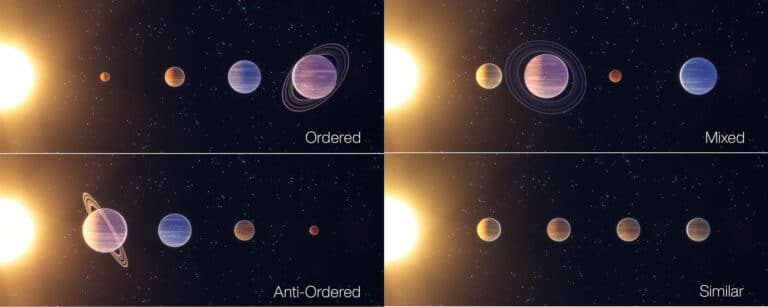
Image (Credit): Artist’s rendering of the four classes of planetary system architecture discussed in the paper below. (© NCCR PlanetS, / Tobias Stierli)

Astronomy and Astrophysics abstract:

We present a novel, model-independent framework for studying the architecture of an exoplanetary system at the system level. This framework allows us to characterise, quantify, and classify the architecture of an individual planetary system. Our aim in this endeavour is to generate a systematic method to study the arrangement and distribution of various planetary quantities within a single planetary system. We propose that the space of planetary system architectures be partitioned into four classes: similar, mixed, anti-ordered, and ordered. We applied our framework to observed and synthetic multi-planetary systems, thereby studying their architectures of mass, radius, density, core mass, and the core water mass fraction. We explored the relationships between a system’s (mass) architecture and other properties. Our work suggests that: (a) similar architectures are the most common outcome of planet formation; (b) internal structure and composition of planets shows a strong link with their system architecture; (c) most systems inherit their mass architecture from their core mass architecture; (d) most planets that started inside the ice line and formed in-situ are found in systems with a similar architecture; and (e) most anti-ordered systems are expected to be rich in wet planets, while most observed mass ordered systems are expected to have many dry planets. We find, in good agreement with theory, that observations are generally biased towards the discovery of systems whose density architectures are similar, mixed, or anti-ordered. This study probes novel questions and new parameter spaces for understanding theory and observations. Future studies may utilise our framework to not only constrain the knowledge of individual planets, but also the multi-faceted architecture of an entire planetary system. We also speculate on the role of system architectures in hosting habitable worlds.

Citation: L. Mishra, Y. Alibert, S. Udry, C. Mordasini, A framework for the architecture of exoplanetary systems. I. Four classes of planetary system architecture, Astronomy and Astrophysics (Accepted December 2022).
https://doi.org/10.1126/sciadv.abn2103

Study-related stories:

Space Quote: Google’s Expensive Mistake Regarding the JWST

Image (Credit): Actual image of the exoplanet 2M1207b (red) around its star 2M1207A. (European Southern Observatory)

“What new discoveries from the James Webb space telescope (JWST) can I tell my nine-year old about?”

-The one question put to Google’s Bard AI program, which was designed to rival Microsoft’s ChatGPT. In response, Bard stated the JWST took the very first pictures of an exoplanet, which was incorrect. The first image of an exoplanet can be seen above, taken by the European Southern Observatory’s Very Large Telescope back in 2004. The exoplanet, called 2M1207 b, is a gas giant about five times the mass of Jupiter. Following the erroneous feedback, the stock of Google’s parent Alphabet dropped about $100 billion in value. Below is an image from another exoplanet spotted by the JWST last year, called HIP 65426 b, which is about six to eight times the mass of Jupiter.

Image (Credit): First direct image of an exoplanet by the JWST. The exoplanet, called HIP 65426 b, is about 6 to 8 times the mass of Jupiter and only 15 to 20 million years old. The Earth is about 4.5-billion-year-old Earth. (NASA/ESA/CSA, A Carter (UCSC), the ERS 1386 team, and A. Pagan (STScI))

Space Stories: Jovian Moons, Charon’s Canyons, and a New Space Telescope

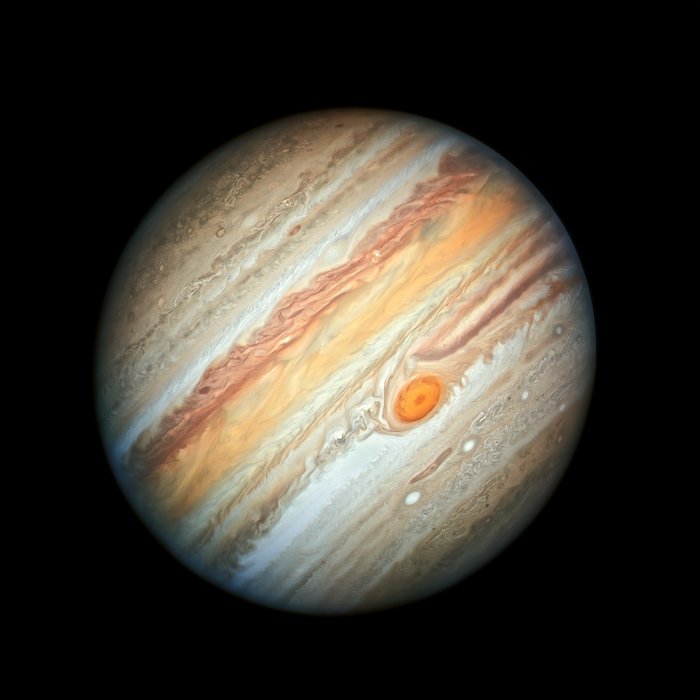
Image (Credit): Jupiter as seen by the NASA/ESA Hubble Space Telescope. (NASA, ESA, A. Simon (Goddard Space Flight Center), and M.H. Wong (University of California, Berkeley)

Here are some recent stories of interest.

Live Science: “Jupiter Officially has the Most Moons in the Solar System, Discovery of 12 New Satellites Confirms

Jupiter was already the king of the solar system, and new discoveries give the massive planet another way to reign supreme: It now has the most moons. Twelve new moons discovered orbiting Jupiter have been confirmed, bumping the count from 80 to 92, and knocking Saturn — which has 83 moons — down a peg. 

Phys.org: “Models Explain Canyons on Pluto’s Large Moon Charon

In 2015, when NASA’s New Horizons spacecraft encountered the Pluto-Charon system, the Southwest Research Institute-led science team discovered interesting, geologically active objects instead of the inert icy orbs previously envisioned. An SwRI scientist has revisited the data to explore the source of cryovolcanic flows and an obvious belt of fractures on Pluto’s large moon Charon. These new models suggest that when the moon’s internal ocean froze, it may have formed the deep, elongated depressions along its girth but was less likely to lead to cryovolcanoes erupting with ice, water and other materials in its northern hemisphere.

Big Think: “NASA’s Habitable Worlds Observatory to Finally Answer the Epic Question: “Are we Alone?”

…perhaps the biggest question of all — that of “Are we alone in the Universe?” — remains a mystery. While the current generation of ground-based and space-based telescopes can take us far into the Universe, this is a question that’s currently beyond our reach. To get there, we’ll need to directly image Earth-like exoplanets: planets with sizes and temperatures similar to Earth, but that orbit Sun-like stars, not the more common red dwarf stars like Proxima Centauri or TRAPPIST-1. Those capabilities are precisely what NASA is aiming for with its newly announced flagship mission: the Habitable Worlds Observatory. It’s an ambitious project but one that’s well worth it. After all, finding out we’re not alone in the Universe would quite possibly be the biggest revolution in all of science history.