Podcast: Capturing Life Off Planet and Here on Earth

Image (Credit): Venus as captured by NASA’s Mariner 10 spacecraft in February 1974. (NASA)

I recommend checking out Alan Alda’s interview with astronomer Sara Seager in a recent Clear + Vivid podcast episode. MIT Professor Seager has focused her work on exoplanet atmospheres as well as another planet nearby – Venus. In the interview, she discusses her early work as well as her theories about the existence of life in the atmosphere of Venus. She also discusses her involvement with MIT’s Transiting Exoplanet Survey Telescope (TESS). 

And while I do not remember it coming up during the interview, Professor Seager is also known for the Seager equation (shown below), which is less demanding than the Drake equation and focuses on any form of life on another planet (without reference to technology).

  • N = the number of planets with detectable signs of life
  • N* = the number of stars observed
  • FQ = the fraction of stars that are quiet
  • FHZ = the fraction of stars with rocky planets in the habitable zone
  • FO = the fraction of stars with observable planets
  • FL = the fraction of planets that have life
  • FS = the fraction of life forms that produce planetary atmospheres with one or more detectable signature gases

But in addition to the science, it was a fascinating discussion about Professor Seager’s life covering the early death of her husband from cancer, her attempts to get her life back on track, and her discovery later in life that she has autism. Most science stories focus on the work, but Mr. Alda has a unique way of drawing out the person in these interviews. It is a great episode, and you can read more about Professor Seager’s life and work in her book The Smallest Lights in the Universe.

Credit: Crown Publishing

Exoplanet TOI-700e Could Sustain Life

Image (Credit): Artist’s rendering of exoplanet TOI-700e. (NASA/JPL-Caltech/Robert Hurt)

The search for another Earth continues, and a professor from Michigan State may have found a perfect candidate. Joey Rodriguez, an assistant professor in MSU’s Department of Physics and Astronomy, was working with researchers involved with NASA’s Transiting Exoplanet Survey Satellite (TESS) when the discovery was made. Since being launched in 2018, the TESS spacecraft is surveying 200,000 stars looking for exoplanets that transit in front of their parent star and thereby periodically block part of the star’s light.

Back in 2020, the TESS team spotted the 100 light-year distant solar system and three exoplanets, but the latest finding includes Earth-size TOI-700e, which orbits in the habitable zone around parent star TOI-700. Its orbit is closer to that of Venus than Earth, yet still within the habitable zone.

In the Lansing State Journal article reporting the finding, Emily Gilbert, a postdoctoral fellow at NASA’s Jet Propulsion Laboratory in Southern California leading the project, stated:

This is one of only a few systems with multiple, small, habitable-zone planets that we know of,…That makes the TOI-700 system an exciting prospect for additional follow-up.

A closer look at the planet’s atmosphere will tell scientists more about the likelihood of life on the surface. Maybe this will be another candidate for the James Webb Space Telescope (JWST). The JWST has already probed other exoplanets to learn more about their atmosphere.

You can learn more about the new exoplanet at this NASA link.

Space Stories: JWST Confirms Earth-Size Exoplanet, Russia Sending Rescue Mission to ISS, and IO Erupts

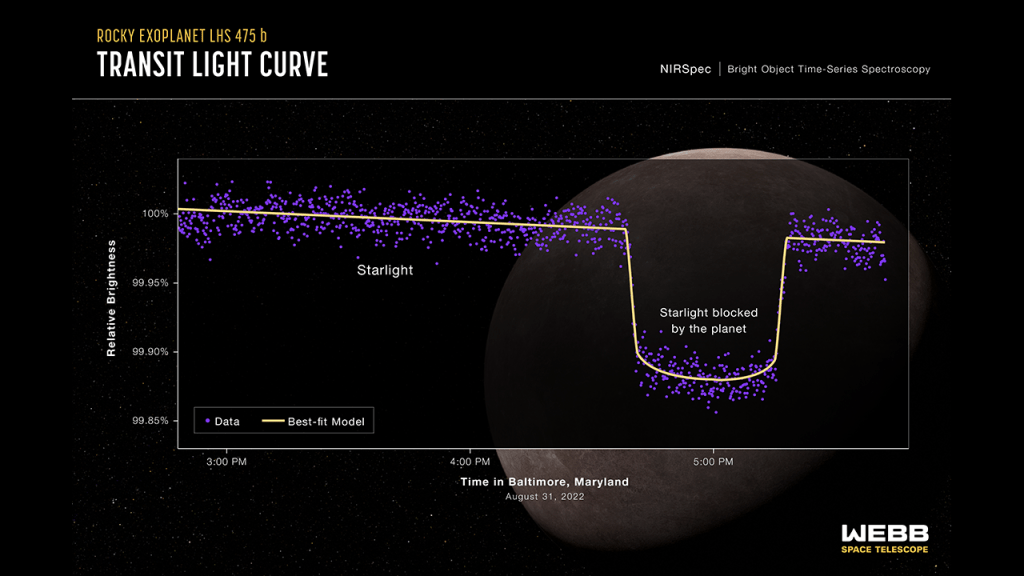
Image (Credit): James Webb Space Telescope (JWST) data associated with exoplanet LHS 475 b. (NASA, ESA, CSA, Leah Hustak (STScI))

Here are some recent stories of interest.

Webb Space Telescope: “NASA’s Webb Confirms Its First Exoplanet

Researchers confirmed an exoplanet, a planet that orbits another star, using NASA’s James Webb Space Telescope for the first time. Formally classified as LHS 475 b, the planet is almost exactly the same size as our own, clocking in at 99% of Earth’s diameter. The research team is led by Kevin Stevenson and Jacob Lustig-Yaeger, both of the Johns Hopkins University Applied Physics Laboratory in Laurel, Maryland.

ABC News: “Russia Will Launch New Capsule to Return Space Station Crew

Russia will send up a new capsule next month to bring back three space station crew members whose original ride home was damaged, officials said Wednesday. The two Russians and one American will stay several extra months at the International Space Station as a result of the capsule switch, possibly pushing their mission to close to a year, NASA and Russian space officials told reporters.

MSN Science Alert: “Massive Volcanic Outburst Detected on Jupiter’s Hellish Moon Io

In the space around Jupiter, a torus of plasma created and fed by Io’s volcanic emissions grew significantly richer between July and September of last year and persisted until December, showing the moon underwent a spate of volcanic activity that released a huge amount of material. For something that’s just a little bit bigger than Earth’s Moon, Io is an absolute beast of volcanism. It’s bristling with volcanoes, with around 150 of the 400 known volcanoes erupting at any given time, creating vast lakes of molten lava.

A Day in Astronomy: Birth of Astronomer Johannes Kepler

Credit: NASA

It was on December 27, 1571 that German astronomer, mathematician, and astrologer Johannes Kepler was born in the Free Imperial City of Weil der Stadt. He is best remembered for his laws of planetary motion, though he had many discoveries, including:

  • The first to formulate eyeglass designing for nearsightedness and farsightedness;
  • The first to explain the principles of how a telescope works;
  • The first to develop integral calculus;
  • The first to explain that the tides are caused by the Moon; and
  • The first to derive the birth year of Christ (a date that is now universally accepted).

Kepler’s name is also attached to a NASA space telescope launched into space in 2009 that was designed to detect exoplanets, which it did with great success. Thanks to the Kepler Space Telescope, we now know that planets are common throughout the galaxy, including Earth-sized planets. As of today, NASA reports there are 5,235 confirmed exoplanets, and more than 9,000 are still being reviewed. However, using the small patch of sky studied by the Kepler telescope as a start, scientists now estimate the Milky Way may contain over 100 billion exoplanets.

Credit: NASA Exoplanet Exploration

Space Stories: Chinese Lunar Nuclear Station, Helium Exoplanets, and the UAE Lunar Rover

Image (Credit): Artist’s rendering of a lunar exploration base. (NASA/Dennis Davidson)

Here are some recent stories of interest.

Republic World: “China Plans Development Of New Nuclear System To Power Its Bases On Moon By 2028

China is developing a nuclear system that will be used to power its lunar station planned to be developed on the Moon’s South Pole. Wu Weiren, chief designer of the Chinese lunar exploration programme, told Chinese broadcaster CCTV that this new system will fulfill the ‘high-power energy demands’ of the station, the South China Morning Post (SCMP) reported. Notably, the station is being developed by the China National Space Administration (CNSA) and the Russian space agency Roscosmos and is expected to complete by 2028.

University of Chicago: “Many Planets Could Have Atmospheres Rich in Helium, Study Finds

For centuries, no one knew if we were alone in the universe—or if there were even other planets like ours. But thanks to new telescopes and methods in the past decades, we now know there are thousands and thousands of planets out there circling faraway stars, and they come in all sorts of shapes and sizes—large and small, rocky and gaseous, cloudy or icy or wet. A study by scientists with the University of Chicago, the University of Michigan and the University of Maryland suggests another for the list: planets with helium atmospheres. Moreover, the discovery may suggest a new step in our understanding of planet evolution. Their simulations found that it’s likely that helium would build up in the atmospheres of certain types of exoplanets over time. If confirmed, this would explain a decades-long puzzle about the sizes of these exoplanets.

Astronomy.com: “China and United Arab Emirates Plan Lunar Rover Mission

The United Arab Emirates’ fledgling space program took another step forward last month, securing an agreement to collaborate on China’s planned Chang’e 7 lunar mission, set to land near the Moon’s south pole in 2026. The Mohammed bin Rashid Space Center (MBRSC) in Dubai will build a small robotic rover, which will hitch a ride on the Chang’e 7 lander, according to the agreement signed Sept. 16 between MBRSC and the China National Space Administration (CNSA).