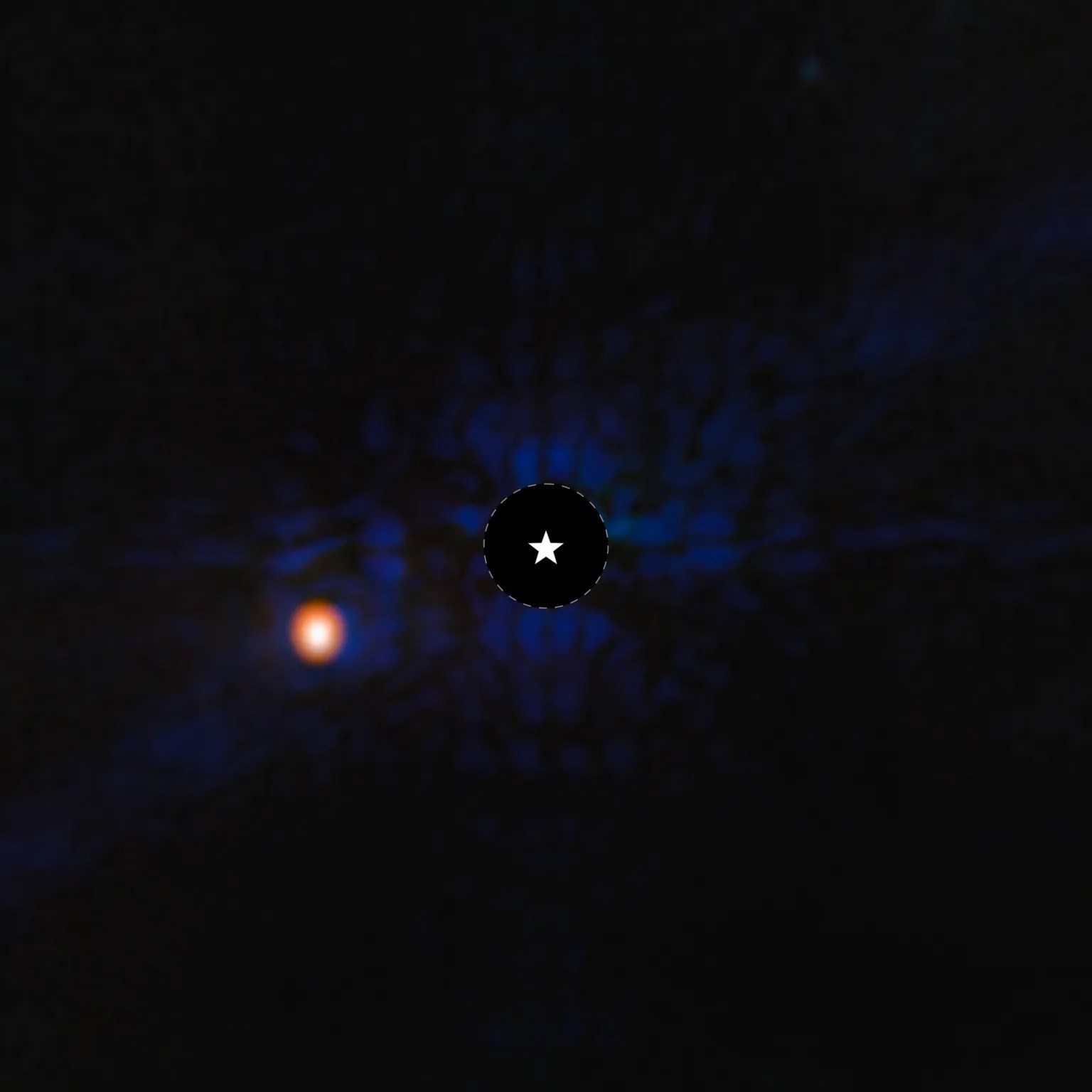
Image (Credit): JWST’s view of exoplanet Epsilon Indi Ab. (NASA, ESA, CSA, STScI, E. Matthews (Max Planck Institute for Astronomy))
This week’s image looks dark and simple, and yet it is an amazing sight provided by NASA’s James Webb Space Telescope (JWST). It shows a directly imaged exoplanets that resides about 12 light-years from us. It is called Epsilon Indi Ab and is several times the mass of Jupiter.
Here is an explanation from NASA about what you are seeing in the image:
This image of the gas-giant exoplanet Epsilon Indi Ab was taken with the on NASA’s James Webb Space Telescope’s MIRI (Mid-Infrared Instrument). A star symbol marks the location of the host star Epsilon Indi A, whose light has been blocked by the coronagraph, resulting in the dark circle marked with a dashed white line. Epsilon Indi Ab is one of the coldest exoplanets ever directly imaged. Light at 10.6 microns was assigned the color blue, while light at 15.5 microns was assigned the color orange. MIRI did not resolve the planet, which is a point source.
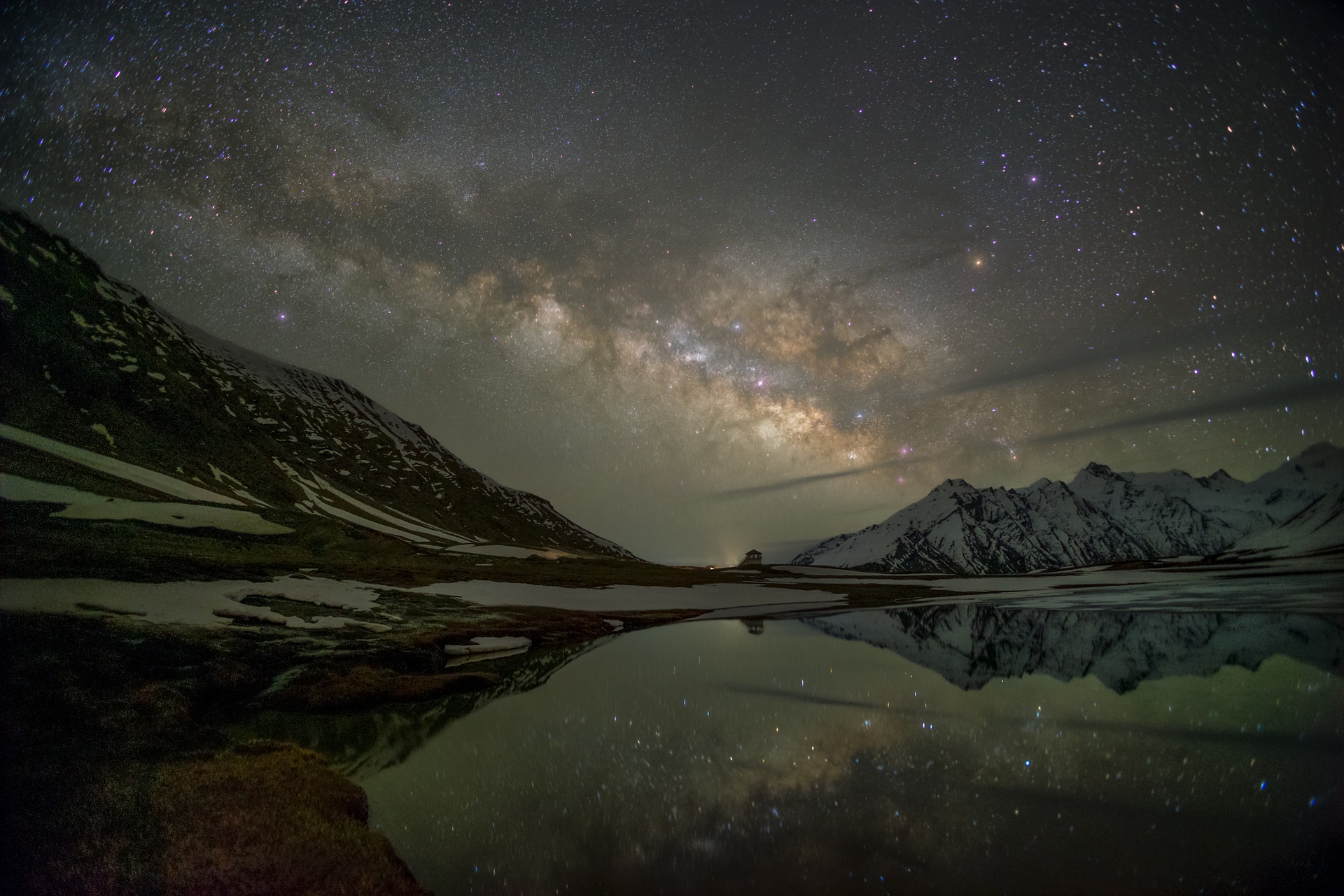
The arrival of August means two things for stargazers — “shooting stars” and the Milky Way. In 2024, you can see both at the same time if you know exactly where and when to look…This month, there’s a new moon on Aug. 4, which will keep the post-sunset sky dark until about Aug. 8. That makes the first week of August ideal for spotting “shooting stars” — while you also look for the Milky Way. True darkness won’t come until midnight for most of the Northern Hemisphere, but look to the southeast after dark, and you’ll have a chance of seeing the Sagittarius arm of the Milky Way arching across the night sky.
Using the James Webb Space Telescope (JWST), an MPIA-led team of astronomers imaged a new exoplanet that orbits a star in the nearby triple system Epsilon Indi. The planet is a cold super-Jupiter exhibiting a temperature of around 0 degrees Celsius and a wide orbit comparable to that of Neptune around the Sun. This measurement was only possible thanks to JWST’s unprecedented imaging capabilities in the thermal infrared. It exemplifies the potential of finding many more such planets similar to Jupiter in mass, temperature, and orbit. Studying them will improve our knowledge of how gas giants form and evolve in time.
Researchers are turning to techniques from astronomy to help spot computer-generated ‘deepfake’ images — which can look identical to genuine photographs at first glance. By analysing images of faces using methods that are usually used to survey distant galaxies, astronomers can measure how a person’s eyes reflect light, which can reveal telltale signs of image manipulation.
A JuMBO means Jupiter-mass binary objects, which is just part of the story in this video. The presentation starts with a finding from astronomers using the James Webb Space Telescope, who identify 520 rogue planet candidates. This is interesting in itself, but the intriguing part is that a number of these planets are found in pairs. This would not make a lot of sense if we believed these planets were once within a solar system before being pushing into space.
The video discusses the various theories explaining these JuMBOs and rogue planets in general. It also discusses the potential impact on our own solar system, such as whether we lost one of our own planets in the past and/or a nearby rogue planet (and its moons) is out there today waiting to be discovered.
As always, Cool Worlds Lab keeps astronomy even more interesting.
Three astronomers last week proposed expanding the official definition of a planet to encompass worlds orbiting stars other than our own, a nuance not currently included in the formal definition of the term established in 2006 by the International Astronomical Union, or IAU. If the trio’s new definition pans out, thousands of celestial bodies across the universe could be confirmed as formal planets.
An American plan to destroy the International Space Station by propelling it to burn through the atmosphere, and then crashing it into the Pacific Ocean, would rob citizens of the future of one of civilization’s greatest technological masterworks, and should be halted, say one-time leaders of NASA and of the European Space Agency. NASA’s draft blueprints to send the ISS on a peacetime kamikaze mission, to explode on impact with Antarctic waters, would obliterate a pole star of human ingenuity, says Jean-Jacques Dordain, Director General of the European Space Agency when the ISS was being built and expanded.
Team members are installing pedestals aboard NASA’s Pegasus barge to hold and secure the massive core stage of NASA’s SLS (Space Launch System) rocket, indicating NASA barge crews are nearly ready for its first delivery to support the Artemis II test flight around the Moon. The barge will ferry the core stage on a 900-mile journey from the agency’s Michoud Assembly Facility in New Orleans to its Kennedy Space Center in Florida…Measuring 212 feet in length and 27.6 feet in diameter, the core stage is the largest rocket stage NASA has ever built and the longest item ever shipped by a NASA barge.
NASA and SpaceX are planning for the possibility of modifying the Artemis III mission. Instead of landing on the Moon, a crew would launch in the Orion spacecraft and rendezvous with Starship in low-Earth orbit. This would essentially be a repeat of the Apollo 9 mission, buying down risk and providing a meaningful stepping stone between Artemis missions. Officially, NASA maintains that the agency will fly a crewed lunar landing, the Artemis III mission, in September 2026. But almost no one in the space community regards that launch date as more than aspirational. Some of my best sources have put the most likely range of dates for such a mission from 2028 to 2032. A modified Artemis III mission, in low-Earth orbit, would therefore bridge a gap between Artemis II and an eventual landing.
The satellite galaxy Crater II (or Crater 2) of the Milky Way is located approximately 380,000 light-years away from Earth in the constellation of Crater. This galaxy is extremely cold and exceptionally diffuse, and has low surface brightness. According to new research, Crater II exists thanks to a self-interacting dark matter.
Using NASA’s Chandra X-ray Observatory and ESA’s (European Space Agency’s) XMM-Newton, astronomers are exploring whether nearby stars could host habitable exoplanets, based on whether they emit radiation that could destroy potential conditions for life as we know it. This type of research will help guide observations with the next generation of telescopes aiming to make the first images of planets like Earth. A team of researchers examined stars that are close enough to Earth that future telescopes could take images of planets in their so-called habitable zones, defined as orbits where the planets could have liquid water on their surfaces. Any images of planets will be single points of light and will not directly show surface features like clouds, continents, and oceans. However, their spectra — the amount of light at different wavelengths — will reveal information about the planet’s surface composition and atmosphere.



 Our Awesome Universe