The Europa Clipper Mission Has Begun

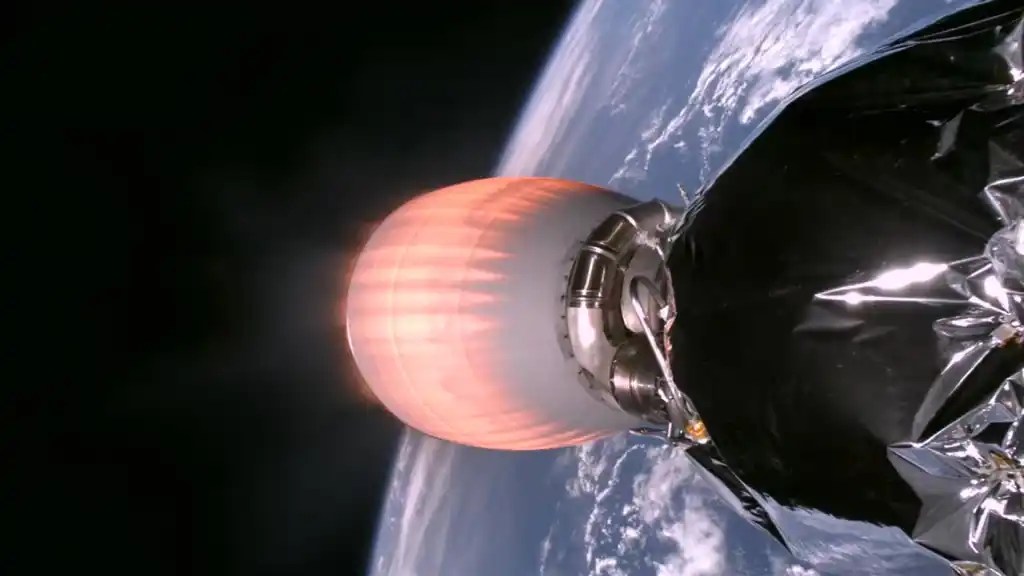
Image (Credit): View of SpaceX’s Falcon Heavy second stage engine as it completes its burn after launching the Europa Clipper spacecraft. (NASA)

Earlier today, the Europa Clipper spacecraft was launched from Kennedy Space Center for its 2030 rendezvous with the Jovian moon Europa. It can then begin to analyze the moon’s salt water ocean and look for any signs of life.

The mission is expected to last for three years, maybe longer should the spacecraft prove to be durable and ready for more scientific work. After that, it will plummet down into the Jovian moon Ganymede.

Scientists believe Europa may contain more water than is found here on Earth. That is interesting in terms of what may lie below the surface in terms of potential life. It also offers mankind a priceless resource should we ever find ourselves living in that region.

Europa Clipper Project Scientist Robert Pappalardo stated:

We know of our Earth as an ocean world, but Europa is representative of a new class of ocean worlds, icy worlds in the distant outer solar system where saltwater oceans might exist under their icy surfaces…In fact, icy ocean worlds could be the most common habitat for life, not just in our solar system, but throughout the universe.

You can follow the status of the mission here.

An Interesting Message for Europa

Image (Credit): One side of the panel attached to the Europa Clipper showing “water” ” in 103 languages (explained below). (NASA/JPL-Caltech)

In past NASA missions to the outer planets of our solar system, we attached messages for any distant civilization that might be out there. Both the Pioneer and Voyager missions contained such messages.

So what about NASA’s Europa Clipper mission to Jupiter’s moon set to launch in October? It too will have some messages, but these appear to be for the inhabitants of the moon rather than some distant civilization.

A triangular 7″ x 11″ metal plate attached to the spacecraft destined for Europa will carry messages on both sides. The image above shows one of these sides containing features waveforms that are visual representations of the sound waves formed by the word “water” in 103 languages.

The other side of the plate (shown below) contains a variety of messages:

  • the Drake Equation, which estimate the possibility of finding advanced civilizations beyond Earth;
  • U.S. Poet Laureate Ada Limón’s handwritten “In Praise of Mystery: A Poem for Europa”;
  • a reference to the radio frequencies considered plausible for interstellar communication; and
  • a portrait Ron Greeley, whose early efforts laid the foundation for Europa Clipper.

The spacecraft will also carry a silicon microchip containing more than 2.6 million names that were submitted by the public as part of NASA’s “Message in a Bottle” campaign.

This is all interesting in itself, but not really a message to others. I expect it is not intended for anyone else but ourselves because the Europa Clipper is not expected to leave the solar system but instead crash into another of Jupiter’s moons – Ganymede.

Note: You may wonder about the message on the New Horizons spacecraft that is also travelling to the edges of our solar system. That message is somewhat controversial. I will let you read about that one in this Slate article, “Ashes and Small Change.”

Image (Credit): One side of the panel attached to the Europa Clipper showing a poem, portrait, and more (explained above). (NASA/JPL-Caltech)

Space Stories: Volcanoes on Venus, Exoplanet Radio Signals, and Bright Baby Jupiter

Image (Credit): Map of volcanoes located on Venus. (Washington University in St. Louis)

Here are some recent stories of interest.

Washington University in St. Louis: “Scientists Share ‘Comprehensive’ Map of Volcanoes on Venus — all 85,000 of Them

Byrne and Hahn’s new study includes detailed analyses of where volcanoes are, where and how they’re clustered, and how their spatial distributions compare with geophysical properties of the planet such as crustal thickness. Taken together, this work provides the most comprehensive understanding of Venus’ volcanic properties — and perhaps of any world’s volcanism so far. That’s because, although we know a great deal about the volcanoes on Earth that are on land, there are still likely a great many yet to be discovered under the oceans. Lacking oceans of its own, Venus’ entire surface can be viewed with Magellan radar imagery.

CNN: “Repeating Radio Signal Leads Astronomers to an Earth-Size Exoplanet

Astronomers have detected a repeating radio signal from an exoplanet and the star that it orbits, both located 12 light-years away from Earth. The signal suggests that the Earth-size planet may have a magnetic field and perhaps even an atmosphere…Scientists noticed strong radio waves coming from the star YZ Ceti and the rocky exoplanet that orbits it, called YZ Ceti b, during observations using the Karl G. Jansky Very Large Array of telescopes in New Mexico. The researchers believe the radio signal was created by interactions between the planet’s magnetic field and the star.

ScienceNews: “Baby Jupiter Glowed so Brightly it Might have Desiccated its Moon

A young, ultrabright Jupiter may have desiccated its now hellish moon Io. The planet’s bygone brilliance could have also vaporized water on Europa and Ganymede, planetary scientist Carver Bierson reported March 17 at the Lunar and Planetary Science Conference. If true, the findings could help researchers narrow the search for icy exomoons by eliminating unlikely orbits. Jupiter is among the brightest specks in our night sky. But past studies have indicated that during its infancy, Jupiter was far more luminous. “About 10 thousand times more luminous,” said Bierson, of Arizona State University in Tempe.

Space Mission: ESA’s Juice Mission

Image (Credit): Upper stage of the Ariane 5 rocket that will launch ESA’s Juice mission. (ESA)

On April 13th, the European Space Agency (ESA) will launch its Jupiter Icy Moons Explorer (Juice) mission from French Guiana. The purpose of the mission is to conduct a detailed study of Jupiter as well as three of its moons (and their oceans) – Ganymede, Callisto and Europa. The spacecraft will eventually go into orbit around Ganymede, which will be the first orbit of a moon in our solar system other than Earth’s Moon.

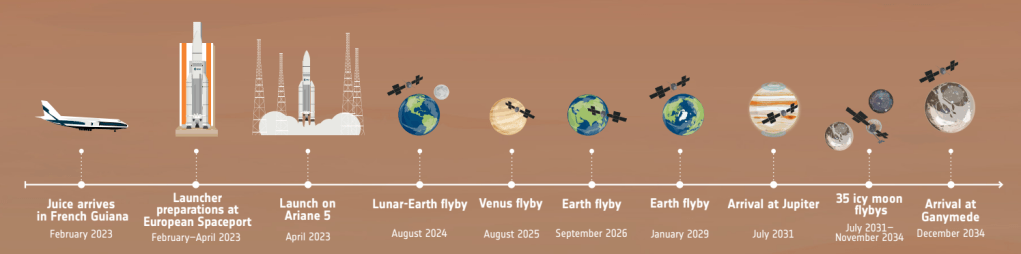
The key milestones for the mission are listed below and shown in greater detail within the graphic as well:

February 2023: Juice arrives in French Guiana

April 13, 2023: Launch on Ariane-5 rocket

July 2031: Arrival at Jupiter

-July 2031 – November 2034: 35 icy moon flybys

December 2034: Arrival at Ganymede

Image (Credit): Juice mission milestones. (ESA JUICE Launch Kit)

In addition to ESA/European scientific instruments and equipment, the spacecraft will also carry items from NASA, the Japan Aerospace Exploration Agency, and the Israel Space Agency.

The delayed arrival at Jupiter relates to the need for multiple flybys cover this great distance. In The Financial Times, Justin Byrne, head of science for lead contractor Airbus, stated, “Ariane-5 is a very powerful rocket but it can only give us about half the energy we need to get to Jupiter…We get the rest by doing planetary fly-bys, each one giving us a gravitational assist through a slingshot manoeuvre.”

The ESA put together a useful Launch Kit that answers any question you may have about the Juice mission, as well as related missions.

Pic of the Week: Jupiter and the Juno Spacecraft

Source: Jupiter image from NASA.

The image above was taken by NASA’s Juno spacecraft on June 8, 2021. You can watch the full flyby video here that starts with the Juno spacecraft going past Jupiter’s moon Ganymede on June 7, 2021 before moving onto Jupiter. The violence of the storms in Jupiter’s atmosphere are smoothed into the beautiful giant marble we see from a great distance.

Launched by NASA in 2011, Juno’s goal is to improve our understanding of the solar system’s beginnings by revealing the origin and evolution of Jupiter. With its primary mission completed last July, the spacecraft will continue to operate through at least 2025 by continuing to observe Jupiter, its rings, and its moons.