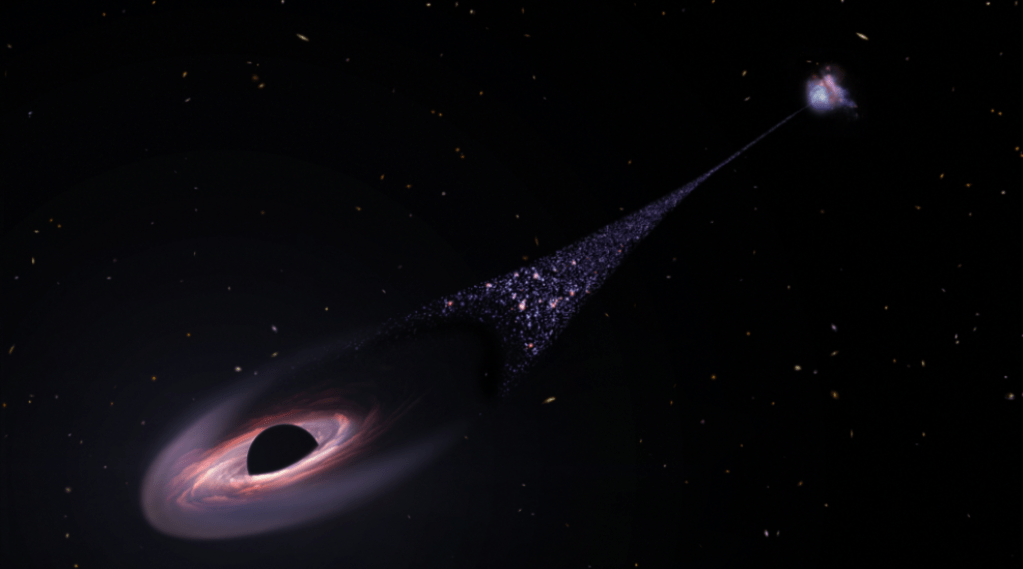
Image (Credit): Artist’s rendering of a black hole with a trail of stars behind it. (NASA, ESA, Leah Hustak, STScI)
This week’s image is an illustration showing what scientists believe the NASA/ESA Hubble Space Telescope has detected, though it initially showed as only a smudge. The dramatic illustration tells a fascinating story, as described by NASA’s Hubblesite
There’s an invisible monster on the loose, barreling through intergalactic space so fast that if it were in our solar system, it could travel from Earth to the Moon in 14 minutes. This supermassive black hole, weighing as much as 20 million Suns, has left behind a never-before-seen 200,000-light-year-long “contrail” of newborn stars, twice the diameter of our Milky Way galaxy. It’s likely the result of a rare, bizarre game of galactic billiards among three massive black holes.
Image (Credit): Irregular Spiral Galaxy NGC 5486. (ESA/Hubble & NASA, C. Kilpatrick)
This week’s image is from the Hubble Space Telescope. It shows the irregular spiral galaxy NGC 5486 with pink areas indicating the formation of new stars.
NGC 5486 hangs against a background of dim, distant galaxies in this image from the NASA/ESA Hubble Space Telescope. The tenuous disc of the galaxy is threaded through with pink wisps of star formation, which stand out from the diffuse glow of the galaxy’s bright core. While this particular galaxy has indistinct, meandering spiral arms it lies close to the much larger Pinwheel Galaxy, one of the best known examples of ‘grand design’ spiral galaxies with prominent and well-defined spiral arms. In 2006 Hubble captured an image of the Pinwheel Galaxy which was — at the time — the largest and most detailed photo of a spiral galaxy ever taken with Hubble.
NGC 5486 lies 110 million light-years from Earth in the constellation Ursa Major. This observation comes from a selection of Hubble images exploring debris left behind by Type II supernovae. As massive stars reach the end of their lives, they cast off huge amounts of gas and dust before ending their lives in titanic supernova explosions. NGC 5486 hosted a supernova in 2004, and astronomers used the keen vision of Hubble’s Advanced Camera for Surveys to explore the aftermath in the hopes of learning more about these explosive events.
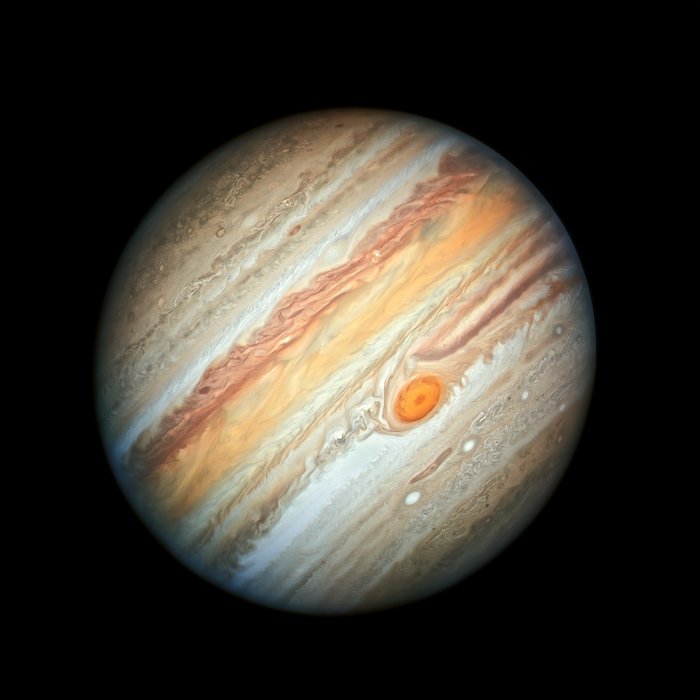
Image (Credit): Jupiter as seen by the NASA/ESA Hubble Space Telescope. (NASA, ESA, A. Simon (Goddard Space Flight Center), and M.H. Wong (University of California, Berkeley)
Jupiter was already the king of the solar system, and new discoveries give the massive planet another way to reign supreme: It now has the most moons. Twelve new moons discovered orbiting Jupiter have been confirmed, bumping the count from 80 to 92, and knocking Saturn — which has 83 moons — down a peg.
In 2015, when NASA’s New Horizons spacecraft encountered the Pluto-Charon system, the Southwest Research Institute-led science team discovered interesting, geologically active objects instead of the inert icy orbs previously envisioned. An SwRI scientist has revisited the data to explore the source of cryovolcanic flows and an obvious belt of fractures on Pluto’s large moon Charon. These new models suggest that when the moon’s internal ocean froze, it may have formed the deep, elongated depressions along its girth but was less likely to lead to cryovolcanoes erupting with ice, water and other materials in its northern hemisphere.
…perhaps the biggest question of all — that of “Are we alone in the Universe?” — remains a mystery. While the current generation of ground-based and space-based telescopes can take us far into the Universe, this is a question that’s currently beyond our reach. To get there, we’ll need to directly image Earth-like exoplanets: planets with sizes and temperatures similar to Earth, but that orbit Sun-like stars, not the more common red dwarf stars like Proxima Centauri or TRAPPIST-1. Those capabilities are precisely what NASA is aiming for with its newly announced flagship mission: the Habitable Worlds Observatory. It’s an ambitious project but one that’s well worth it. After all, finding out we’re not alone in the Universe would quite possibly be the biggest revolution in all of science history.
Image (Credit): NGC 2260 in the constellation Vela. (NASA, ESA, and T. von Hippel (Embry-Riddle Aeronautical University); Processing: Gladys Kober (NASA/Catholic University of America))
This week’s image containing all of the sparkling stellar glitter is from the Hubble Space Telescope. Hubble continues to astound with an ongoing stream of amazing images.
This glittering group of stars, shining through the darkness like sparks left behind by a firework, is NGC 2660 in the constellation Vela, best viewed in the southern sky. NGC 2660 is an open cluster, a type of star cluster that can contain anywhere from tens to a few hundreds of stars loosely bound together by gravity. The stars of open clusters form out of the same region of gas and dust and thus share many characteristics, such as age and chemical composition. Unlike globular clusters – their ancient, denser, and more tightly-packed cousins – open clusters are easier to study since astronomers can more easily distinguish between individual stars. Their stars can be old or young, and they may disperse after a few million years into the spiral or irregular galaxies where they are born.
The spikes surrounding many of the stars in this image are “diffraction spikes,” which occur when the glow from bright points of light reflects off of Hubble’s secondary mirror support. The bright red object to the left with the very prominent diffraction spikes is a foreground star that is not part of the cluster. Hubble observed this open cluster as part of a program to study the ages of white dwarf stars in open clusters.
Image (Credit): Costs and timescales of past, current and future NASA missions. Cost is at launch, i.e. does not include servicing missions. Development timescale indicates time from survey recommendation to launch. For future missions, the estimated cost is a minimum, assuming immediate start and optimum budget profile. (PhysicsWorld using data taken from the NASA Astro2020 decadal survey)
Take a look at the article to learn more about the science and politics surrounding space telescopes and the likelihood we will see other great space telescopes like the James Webb Space Telescope in the near future.




 Our Awesome Universe