Pic of the Week: Hickson Compact Group 40

Image (Credit): The NASA/ESA Hubble Space Telescope view of five galaxies, called the Hickson Compact Group 40. (NASA/ESA Hubble)

This week’s image is from the NASA/ESA Hubble Space Telescope. It shows an amazing collection of five galaxies in close proximity to one another in what is known as the Hickson Compact Group 40. In about one billion years they are expected to coalesce into one large galaxy.

Here is the summary from the Hubble site:

This menagerie includes three spiral-shaped galaxies, an elliptical galaxy and a lenticular (lens-like) galaxy. Somehow, these different galaxies have crossed paths to create an exceptionally crowded and eclectic galaxy sampler.

Caught in a leisurely gravitational dance, the whole group is so crowded that it could fit within a region of space that is less than twice the diameter of our Milky Way’s stellar disc.

Though such galaxy groupings can be found in the heart of huge galaxy clusters, these galaxies are notably isolated in their own small patch of the Universe, in the direction of the constellation Hydra.

One possibility is that there’s a lot of dark matter (a poorly understood and invisible form of matter) associated with these galaxies. If they come close together the dark matter can form a big cloud within which the galaxies orbit. As the galaxies plough through the dark matter they feel a frictional force that results from its gravitational effects. This slows their motion and makes the galaxies lose energy, so they fall together. Therefore, this snapshot catches the galaxies at a very special moment in their lifetimes. In about 1 billion years they will eventually collide and merge to form a single giant elliptical galaxy.

Astronomers have studied this compact galaxy group not only in visible light, but in radio, infrared, and at X-ray wavelengths. Almost every one of the galaxies has a compact radio source at its core, which could be evidence for the presence of a supermassive black hole. X-ray observations show that the galaxies have been gravitationally interacting as witnessed by the presence of a lot of hot gas amongst them. Infrared observations reveal clues to the rate of formation of new stars.

Though over 100 such compact galaxy groups have been catalogued in sky surveys going back several decades, Hickson Compact Group 40 is one of the most densely packed. Observations suggest that such tight groups may have been more abundant in the early Universe and provided fuel for powering black holes, known as quasars, whose light from superheated inflating material blazed across space. Studying the details of galaxies in nearby groups like this helps astronomers sort out when and where galaxies assembled themselves, and what they are assembled from.

Pic of the Week: The Pillars of Creation

Image (Credit): JWSP’s view of The Pillars of Creation. (NASA, ESA, CSA, STScI; Joseph DePasquale (STScI), Anton M. Koekemoer (STScI), Alyssa Pagan (STScI))

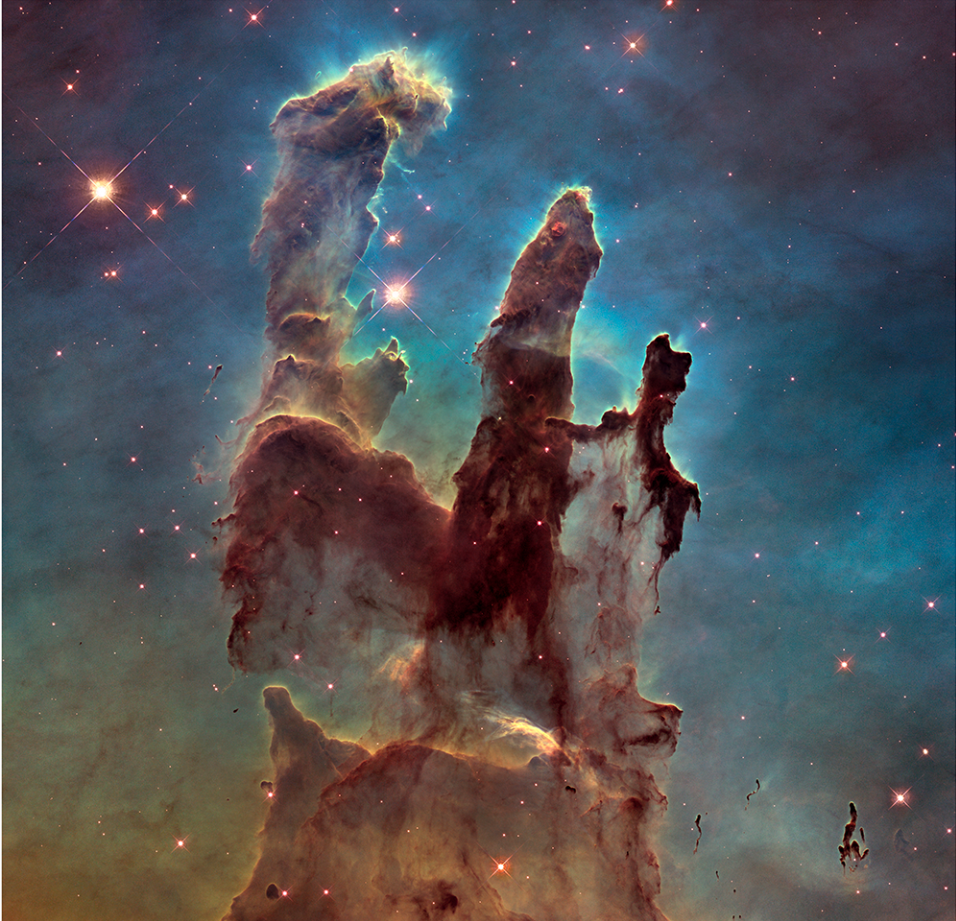
This week’s image is a redo of an earlier Hubble Space Telescope image (shown below), but this time we see the Pillars of Creation through the eyes of the James Webb Space Telescope (JWST). The pillars is part of the Eagle Nebula, which lies 6,500 light-years away.

Here is more from NASA on the JWST image:

Newly formed stars are the scene-stealers in this image from Webb’s Near-Infrared Camera (NIRCam). These are the bright red orbs that typically have diffraction spikes and lie outside one of the dusty pillars. When knots with sufficient mass form within the pillars of gas and dust, they begin to collapse under their own gravity, slowly heat up, and eventually form new stars.

What about those wavy lines that look like lava at the edges of some pillars? These are ejections from stars that are still forming within the gas and dust. Young stars periodically shoot out supersonic jets that collide with clouds of material, like these thick pillars. This sometimes also results in bow shocks, which can form wavy patterns like a boat does as it moves through water. The crimson glow comes from the energetic hydrogen molecules that result from jets and shocks. This is evident in the second and third pillars from the top – the NIRCam image is practically pulsing with their activity. These young stars are estimated to be only a few hundred thousand years old.

Although it may appear that near-infrared light has allowed Webb to “pierce through” the clouds to reveal great cosmic distances beyond the pillars, there are no galaxies in this view. Instead, a mix of translucent gas and dust known as the interstellar medium in the densest part of our Milky Way galaxy’s disk blocks our view of the deeper universe.

Image (Credit): Hubble Space Telescope’s view of The Pillars of Creation in 2014. (NASA, ESA, and the Hubble Heritage Team)

Pic of the Week: Stellar Tantrum

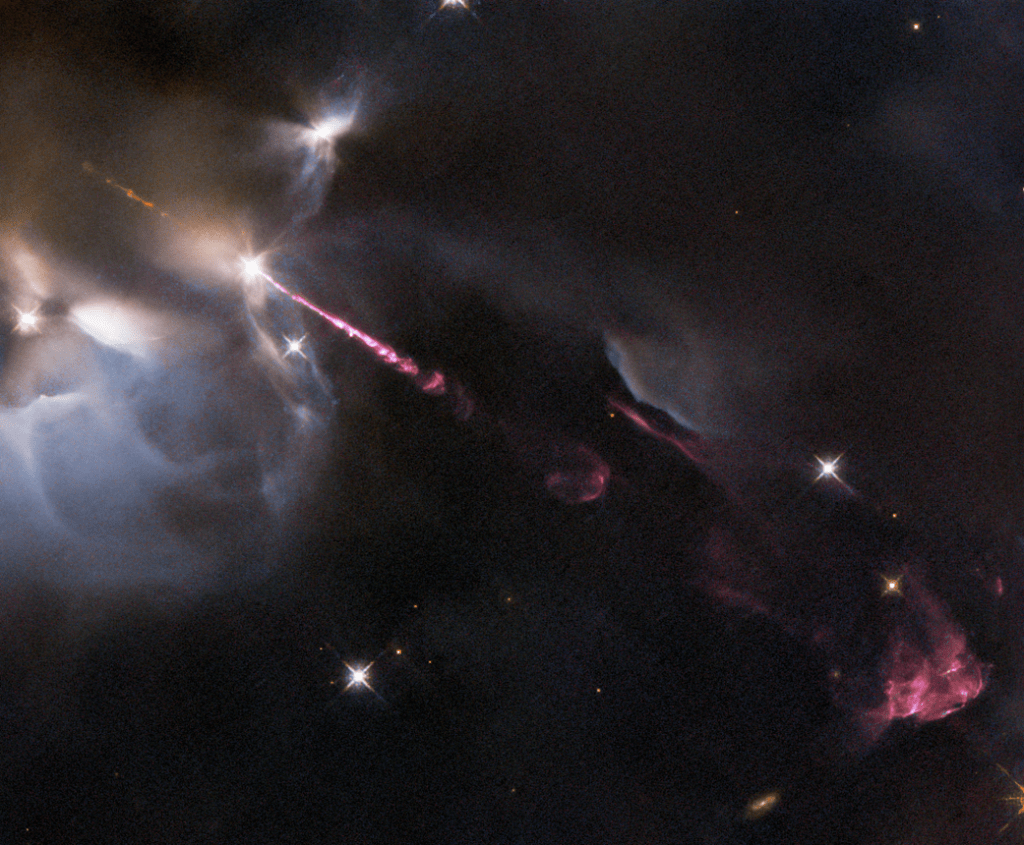
Image (Credit): Hubble image of an outburst from an infant star. (ESA/Hubble & NASA, B. Nisini)

This week’s image is from the NASA/ESA Hubble Space Telescope. While it may look like an enormous interstellar stingray, it actually shows gas streaming from a newly-formed star. Here is the story from the European Space Agency (ESA):

An energetic outburst from an infant star streaks across this image from the NASA/ESA Hubble Space Telescope. This stellar tantrum – produced by an extremely young star in the earliest phase of formation – consists of an incandescent jet of gas travelling at supersonic speeds. As the jet collides with material surrounding the still-forming star, the shock heats this material and causes it to glow. The result is the colorfully wispy structures, which astronomers refer to as Herbig–Haro objects, billowing across the lower right of this image.

Herbig–Haro objects are seen to evolve and change significantly over just a few years. This particular object, called HH34, was previously captured by Hubble between 1994 and 2007, and again in glorious detail in 2015. HH34 resides approximately 1,250 light-years from Earth in the Orion Nebula, a large region of star formation visible to the unaided eye. The Orion Nebula is one of the closest sites of widespread star formation to Earth, and as such has been pored over by astronomers in search of insights into how stars and planetary systems are born. 

NASA Confirms Success of DART Mission

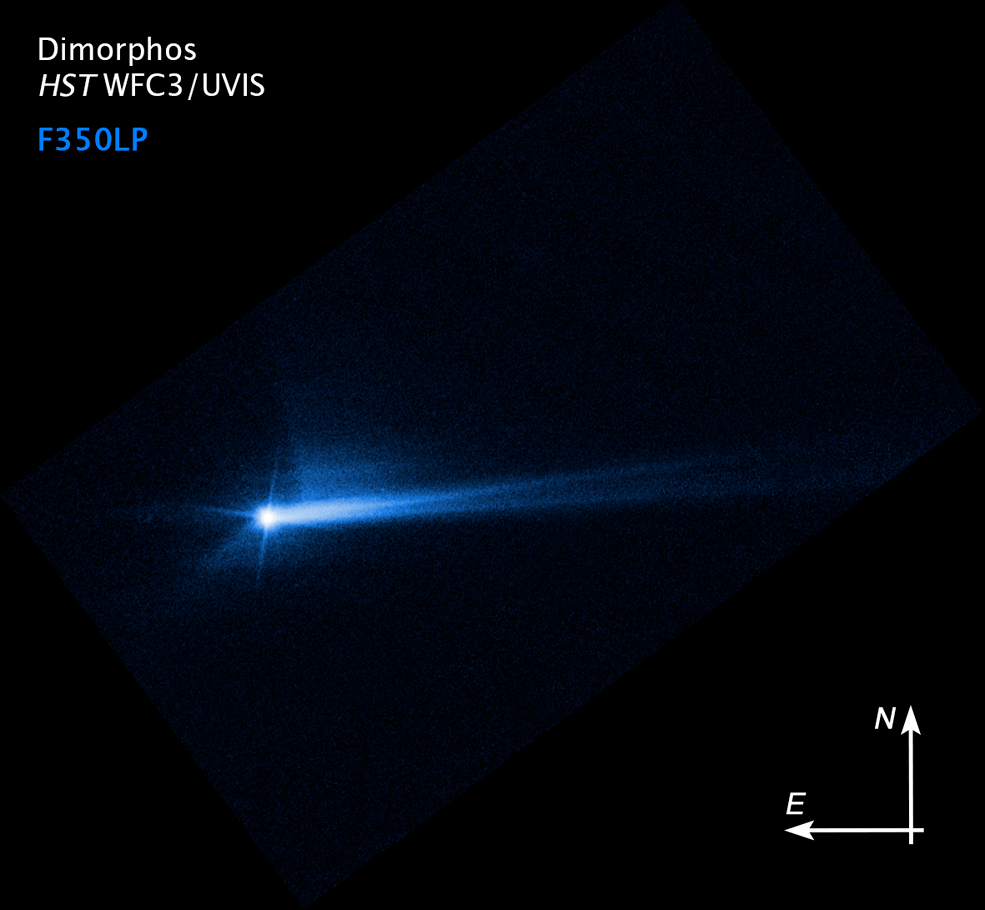
Image (Credit): The image above was taken on October 8, 2022 by NASA’s Hubble Space Telescope. It shows the debris blasted from the surface of Dimorphos 285 hours after the asteroid was intentionally hit by NASA’s DART spacecraft on September 26th. NASA stated that the shape of that tail has changed over time. ( NASA/ESA/STScI/Hubble)

NASA has saved the Earth, or it would have had the asteroid Dimorphos and its partner been heading towards us. That is the news from earlier today from the space agency. NASA’s Administrator Bill Nelson made the following comments regarding the results of the impact by the Double Asteroid Redirection Test (DART) spacecraft:

This mission shows that NASA is trying to be ready for whatever the universe throws at us. NASA has proven we are serious as a defender of the planet. This is a watershed moment for planetary defense and all of humanity, demonstrating commitment from NASA’s exceptional team and partners from around the world.

NASA scientists determined that the orbit of Dimorphos around its parent asteroid, Didymos, was truncated by 32 minutes as a result of the impact. Since minimum success would have been 1 minute 13 seconds, DART was a great success.

Hollywood may prefer a more dramatic method with oil rig astronauts and nuclear bombs, but sometimes a simple nudge will do the job.

Credit: Touchstone Pictures

Hubble: SpaceX to the Rescue

Image (Credit): The Hubble Space Telescope orbiting Earth. (Hubblesite.org)

The Washington Post reports that NASA and SpaceX are looking into the idea of extending the life of the NASA/ESA Hubble Space Telescope, which has already been in service more than 30 years. The space telescope’s orbit has been deteriorating since 2009, when it was last visited for repairs. The current orbit should be okay until the mid-2030s, and then it will fall to Earth.

To keep the Hubble in service for even more years, it would need to be pushed into a higher orbit. This is where SpaceX comes in. It can assist NASA by moving Hubble just 40 miles higher in order to get another 15 to 20 years out of the space telescope.

The article notes that the James Webb Space Telescope (JWST) was not developed to replace Hubble but rather to complement it. Hence, the extra life for Hubble means more and better astronomical observations over additional years in conjunction with the JWST. For instance, we will get more shots like the one below where the Hubble captured the Double Asteroid Redirection Test (DART) mission before and after it struck the asteroid.

Update: I have also included the JWST DART image below just to show the two space telescopes can work in tandem.

Image (Credit): This animated GIF combines three of the images NASA’s Hubble Space Telescope captured after NASA’s DART spacecraft intentionally impacted Dimorphos, a moonlet asteroid in the double asteroid system of Didymos. The animation spans from 22 minutes after impact to 8.2 hours after the collision took place. As a result of the impact, the brightness of the Didymos-Dimorphos system increased by 3 times. The brightness also appears to hold fairly steady, even eight hours after impact. (NASA, ESA, Jian-Yang Li (PSI); animation: Alyssa Pagan (STScI))
Image (Credit): This animation gif is a timelapse of images from NASA’s JWST. It covers the time spanning just before impact at 7:14 p.m. EDT, Sept. 26, through 5 hours post-impact. Plumes of material from a compact core appear as wisps streaming away from where the impact took place. An area of rapid, extreme brightening is also visible in the animation. (NASA, ESA, CSA, Cristina Thomas (Northern Arizona University), Ian Wong (NASA-GSFC); Joseph DePasquale (STScI))