Pic of the Week: Interacting Galaxy Pair

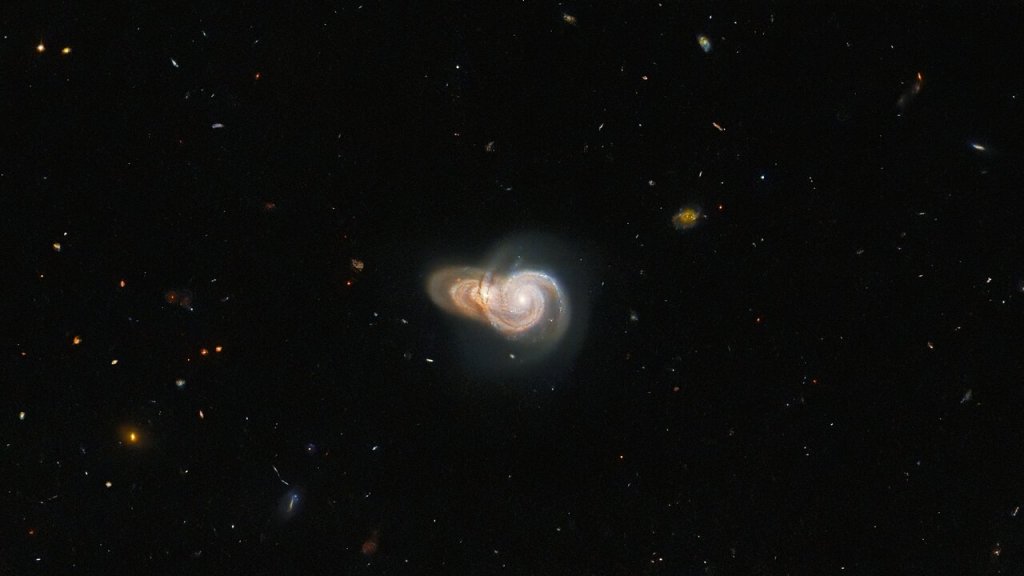
Image (Credit): Hubble image of colliding galaxies – NGC 169 (bottom) and IC 1559 (top). (ESA/Hubble & NASA, J. Dalcanton, Dark Energy Survey, DOE, FNAL/DECam, CTIO/NOIRLab/NSF/AURA, SDSS)

This week’s image comes again from the Hubble Space Telescope, which is keeping us entertained as the James Webb Space Telescope cycles through its required observations and spins off images from time to time.

While an earlier image appeared to show colliding galaxies, though it was believed to be an optical illusion, the collision above is real. Below is more on the image from the European Space Agency’s (ESA) Hubble site:

Galaxies can merge, collide, or brush past one another — each of which has a significant impact on their shapes and structures. As common as these interactions are thought to be in the Universe, it is rare to capture an image of two galaxies interacting in such a visibly dynamic way. This image, from the NASA/ESA Hubble Space Telescope, feels incredibly three-dimensional for a piece of deep-space imagery. 

The subject of this image is named Arp 282, an interacting galaxy pair that is composed of the Seyfert galaxy NGC 169 (bottom) and the galaxy IC 1559 (top). If you’re interested in learning more about Seyfert galaxies, you can read about the Seyfert galaxy NGC 5728 here. Interestingly, both of the galaxies comprising Arp 282 have monumentally energetic cores, known as active galactic nuclei (AGN), although it is difficult to tell that from this image. This is actually rather fortunate, because if the full emission of two AGNs was visible in this image, then it would probably obscure the beautifully detailed tidal interactions occurring between NGC 169 and IC 1559. Tidal forces occur when an object’s gravity causes another object to distort or stretch. The direction of the tidal forces will be away from the lower-mass object and towards the higher mass object. When two galaxies interact, gas, dust and even entire solar systems will be drawn away from one galaxy towards the other by these tidal forces. This process can actually be seen in action in this image — delicate streams of matter have formed, visibly linking the two galaxies.

Pic of the Week: Spiraling Optical Illusion

Image (Credit): Two spiral galaxies about 1 billion light-years away captured by the Hubble. (European Space Agency)

This week’s fascinating image from the NASA/ESA Hubble Space Telescope shows what appears to be two colliding spiral galaxies. A cropped version is shown below to highlight the colors. Here is more from ESA:

The two galaxies, which have the uninspiring names SDSS J115331 and LEDA 2073461, lie more than a billion light-years from Earth. Despite appearing to collide in this image, the alignment of the two galaxies is likely just by chance — the two are not actually interacting. While these two galaxies might simply be ships that pass in the night, Hubble has captured a dazzling array of interacting galaxies in the past.

The JWST’s First Image of an Exoplanet

Image (Credit): Exoplanet HIP 65426 b in different bands of infrared light, as seen from the JWST: purple shows the Near-Infrared Camera (NIRCam) instrument’s view at 3.00 micrometers, blue shows the NIRCam instrument’s view at 4.44 micrometers, yellow shows the Mid-Infrared Instrument (MIRI) instrument’s view at 11.4 micrometers, and red shows the MIRI instrument’s view at 15.5 micrometers. These images look different because of the ways the different Webb instruments capture light. A set of masks within each instrument, called a coronagraph, blocks out the host star’s light so that the planet can be seen. The small white star in each image marks the location of the host star HIP 65426, which has been subtracted using the coronagraphs and image processing. The bar shapes in the NIRCam images are artifacts of the telescope’s optics, not objects in the scene. (NASA/ESA/CSA, A Carter (UCSC), the ERS 1386 team, and A. Pagan (STScI))

It was only a matter of time, but even so it was pretty quick. The James Webb Space Telescope (JWST) has taken a direct image of an exoplanet. HIP 65426 b, a gas giant that lies 355 light-years away, is from 15 to 20 million years old and about 6 to 12 times the mass of Jupiter. This gas giant is also about 100 times farther from its host star than Earth is from the Sun, allowing the JWST to see the exoplanet’s light separate from its sun.

This is not the first direct image of an exoplanet. The Hubble Space Telescope has also captured images of exoplanets. For instance, in 2008 an astronomer using Hubble images reported on Fomalhaut b, a Jupiter-mass exoplanet that is about 25 light-years away and approximately 200 million years old. It takes close to 872 years for the exoplanet to orbit its sun. Fomalhaut b will most likely be another target for JWST in the near future.

Image (Credit): Hubble Space Telescope optical image from 2006 showing the belt of dust and debris (bright oval) surrounding the star Fomalhaut and the planet (inset) that orbits the star every 872 years and sculpts the inner edge of the belt. A coronagraph (center) on the Advanced Camera for Surveys blocks out the light of the star, which is 100 million times brighter than the planet. (Paul Kalas/UC Berkeley, NASA, ESA)

Pic of the Week: A Variety of Galaxies

Image (Credit): Multiple galaxies captured by the NASA/ESA Space Telescope – noted below. (ESA/Hubble & NASA, W. Keel)

With all the excitement about the James Webb Space Telescope, let’s not forget about the ongoing great work being performed by the Hubble Space Telescope. This recently released Hubble image shows multiple galaxies as well as multiple types of galaxies.

Here is a full description from the European Space Agency:

This luminescent image features multiple galaxies, perhaps most noticeably LEDA 58109, the lone galaxy in the upper right. LEDA 58109 is flanked by two further galactic objects to its lower left — an active galactic nucleus (AGN) called SDSS J162558.14+435746.4 that partially obscures the galaxy SDSS J162557.25+435743.5, which appears to poke out to the right behind the AGN. 

Galaxy classification is sometimes presented as something of a dichotomy: spiral and elliptical. However, the diversity of galaxies in this image alone highlights the complex web of galaxy classifications that exist, including galaxies that house extremely luminous AGNs at their cores, and galaxies whose shapes defy the classification of either spiral or elliptical. 

Profile: China’s Xuntian Space Telescope

Image: Artist’s impression of the Xuntian Survey Space Telescope.

Next year China plans to launch the Xuntian (Chinese for “survey to heavens”) Survey Space Telescope that will orbit near China’s space station. Like the Hubble Space Telescope, it will be easier to service from this location. Unlike the Hubble, it will have a greater field of view – about 300-350 times greater. This field of view will allow the telescope to observe about 40 percent of the sky within its 10 year lifespan. If it last 30+ years like the Hubble, it will capture even more of the sky.

In terms of the space telescope’s planned mission, a Chinese news story stated:

It will observe well over one billion galaxies and measure their positions, shapes and brightness which may help explain how those galaxies evolve

The telescope will also be able to help determine the upper limit of neutrino mass and shed light on the mysterious dark matter and dark energy. They’re believed to account for the majority of mass-energy content of the universe.

The versatile telescope can undertake many more intriguing studies such as drawing galactic dust map of the Milky Way, observing how super-massive blackholes are gobbling up surrounding materials, exploring exoplanets and discovering new peculiar celestial bodies.

The Xuntian should be launched later next year and be fully operational in 2024.

As long as scientists around the world can share in these observations, this type of space race benefits everyone. The more eyes on the sky, the better.