In Case You Missed It: Hubble Finds Water on an Exoplanet

Image (Credit): Recent JWST analysis of exoplanet WASP-96 b. (NASA, ESA, CSA, and STScI)

The recent James Webb Space Telescope (JWST) images included hot gas giant exoplanet WASP-96 b, with NASA noting that the space telescope “…has captured the distinct signature of water, along with evidence for clouds and haze, in the atmosphere surrounding a hot, puffy gas giant planet orbiting a distant Sun-like star.”

The same NASA article also noted that the Hubble Space Telescope had found the first evidence of water on a exoplanet back in 2013. So I thought I would dig out that earlier from the European Space Agency, titled “Hubble Finds Water Vapour on Habitable-Zone Exoplanet for the First Time“:

With data from the NASA/ESA Hubble Space Telescope, water vapour has been detected in the atmosphere of a super-Earth within the habitable zone by University College London (UCL) researchers in a world first. K2-18b, which is eight times the mass of Earth, is now the only planet orbiting a star outside the Solar System, or exoplanet, known to have both water and temperatures that could support life.

The parent star, K2-18, is 110 light years from Earth in the constellation of Leo. Maybe we can convince the ESA and others to take another look with the JWST, assuming it is not already on the list of many upcoming projects.

Pic of the Week: The Durable Hubble

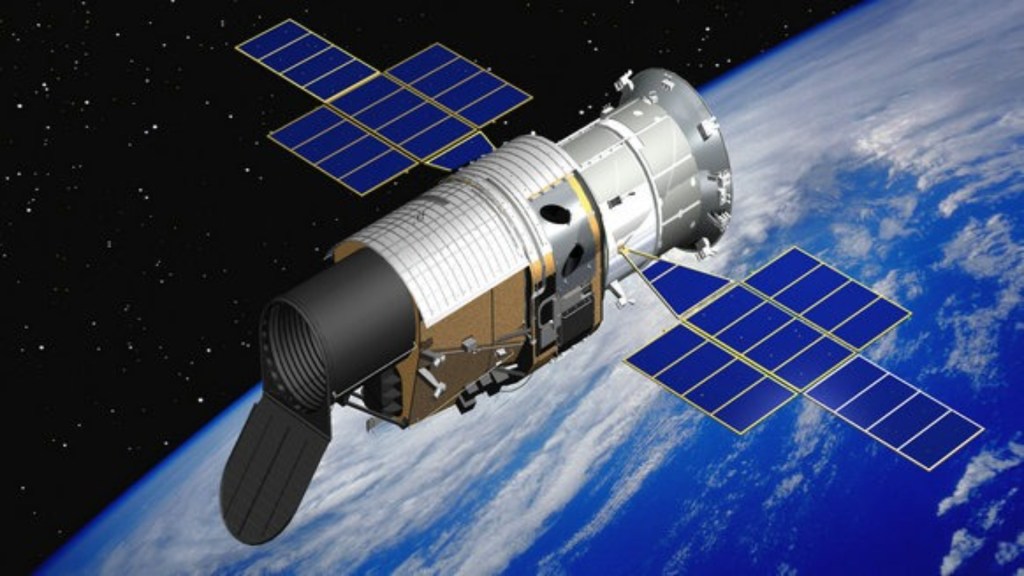
Image (Credit): The Hubble Space Telescope. (NASA/ESA)

This week’s image is the Hubble Space Telescope, still going strong after more than 32 years. It left the Space Shuttle Discovery’s cargo bay on April 25, 1990. With all of the attention on the James Webb Space Telescope (JWST), it’s important to remember this dependable space telescope that brought us so many amazing images over the years, including those shown below.

Given the concern over the recent concerns about a micrometeroid impacting the JWST, let’s not forget that the Hubble had a few growing pains as well. Most importantly, it had to deal with a flawed mirror that required astronauts to visit the space telescope so they could add five pairs of corrective mirrors. More than three years had passed before the astronauts could make this correction. So the current issues with the JWST are pretty minor by comparison.

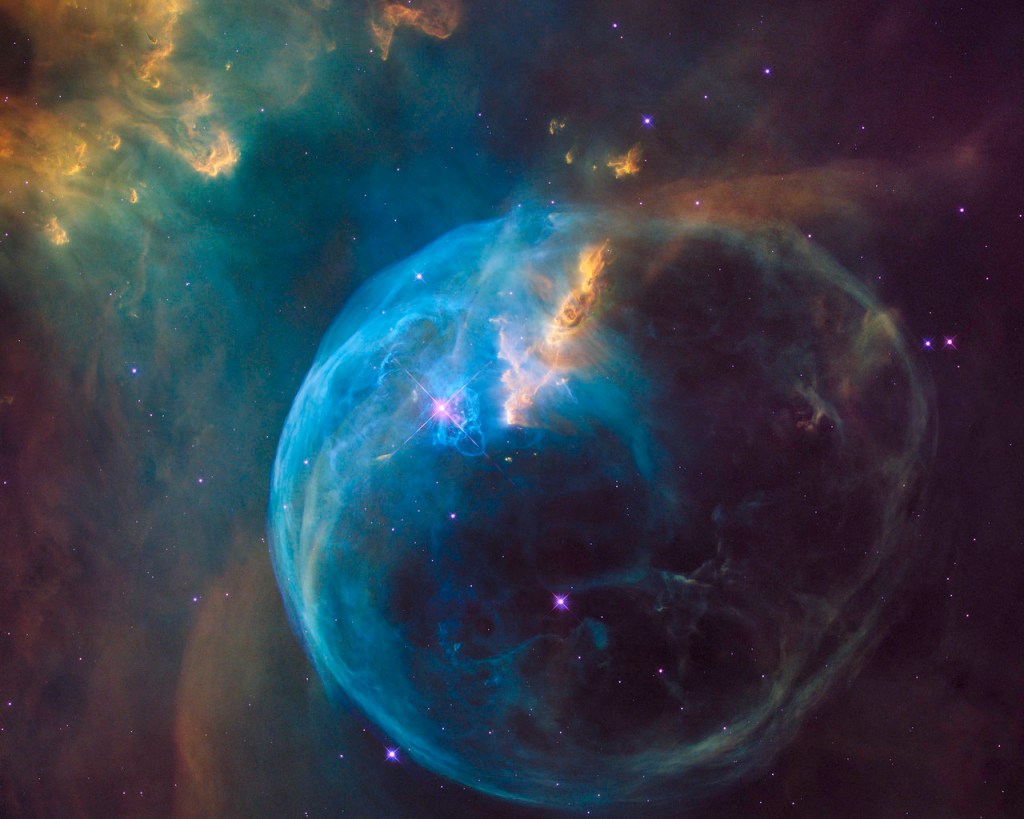
Image (Credit): The Bubble Nebula, also known as NGC 7635, located 8 000 light-years away. (NASA/ESA)
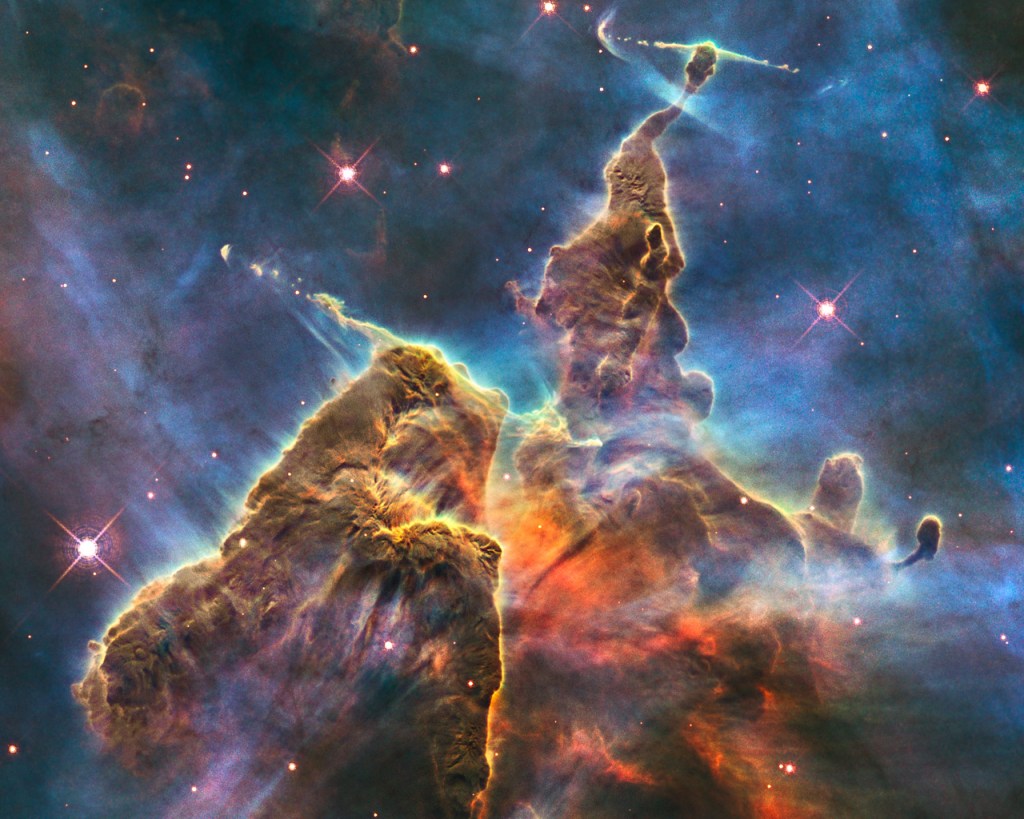
Image (Credit): A pillar of gas and clouds within the stellar nursery called the Carina Nebula, located 7500 light-years away in the southern constellation of Carina. (NASA/ESA).
Image (Credit): The planet Jupiter. (NASA/ESA)

Pic of the Week: Dwarf Starburst Galaxy Henize 2-10

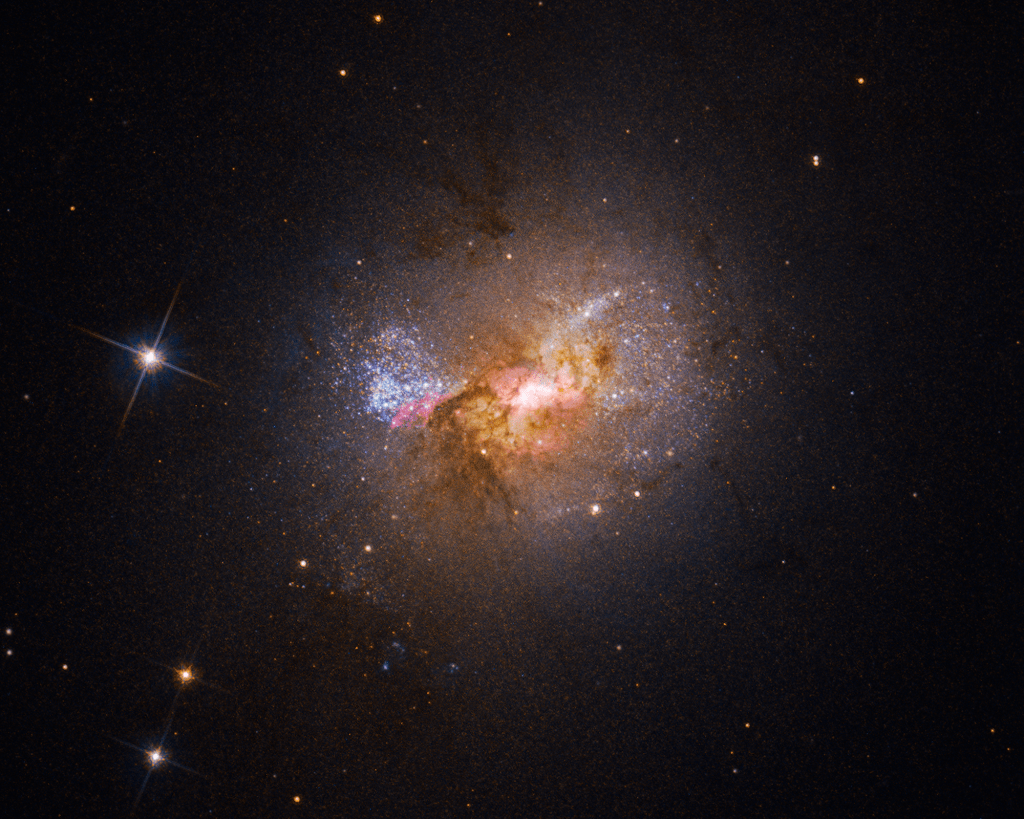
Image (Credit): Dwarf starburst galaxy Henize 2-10. (NASA, ESA, Zachary Schutte (XGI), Amy Reines (XGI), Alyssa Pagan (STScI))

This week’s photo is from the Hubble Space Telescope. It shows the Dwarf starburst galaxy Henize 2-10, which lies 34 million light years away. NASA notes that “The bright region at the center, surrounded by pink clouds and dark dust lanes, indicates the location of the galaxy’s massive black hole and active stellar nurseries.”

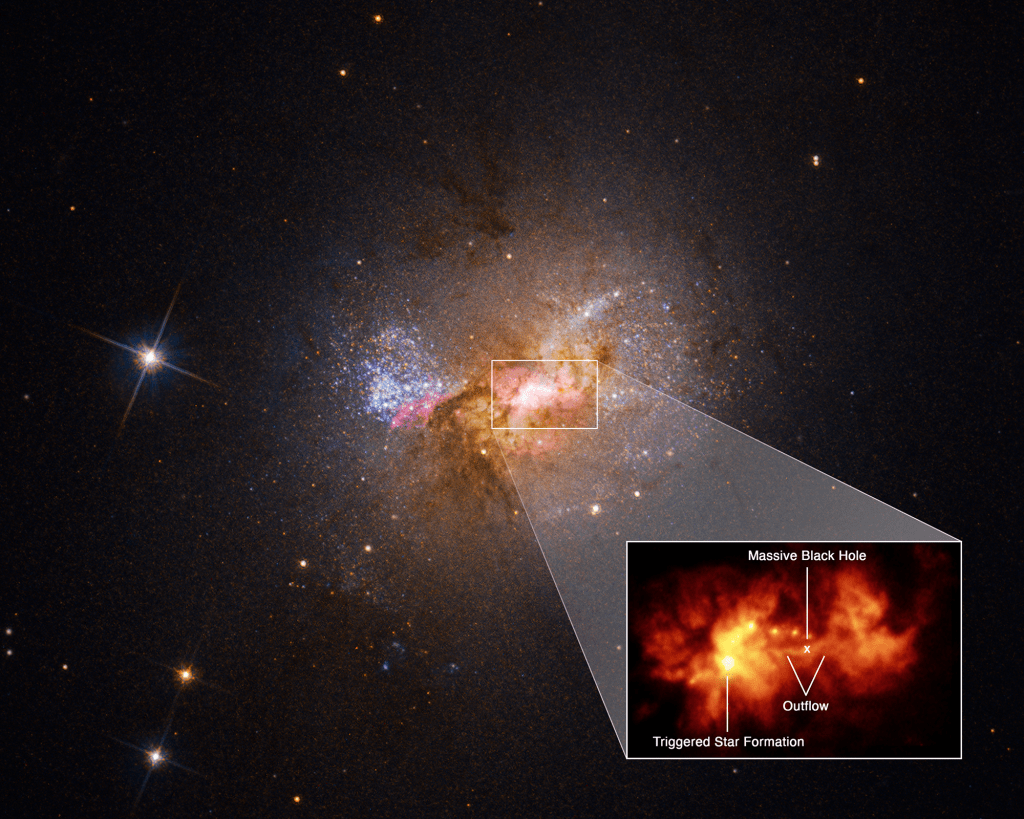
The image below better illustrates the link between the massive black hole and the related star formation. NASA explains:

A pullout of the central region of dwarf starburst galaxy Henize 2-10 traces an outflow, or bridge of hot gas 230 light-years long, connecting the galaxy’s massive black hole and a star-forming region. Hubble data on the velocity of the outflow from the black hole, as well as the age of the young stars, indicates a causal relationship between the two. A few million years ago, the outflow of hot gas slammed into the dense cloud of a stellar nursery and spread out, like water from a hose impacting a mound of dirt. Now clusters of young stars are aligned perpendicular to the outflow, revealing the path of its spread.

Image (Credit): Dwarf starburst galaxy Henize 2-10 with a pullout showing the black hole and related star formation. (NASA, ESA, Zachary Schutte (XGI), Amy Reines (XGI), Alyssa Pagan (STScI))

Pic of the Week: Dazzling Star Cluster

Image (Credit): Globular cluster Liller 1 (ESA/Hubble & NASA, F. Ferraro)

The image this week is from the NASA/ESA Hubble Space Telescope. It shows a cluster of old and young stars in the globular cluster Liller 1 located within the bulge of the Milky Way Galaxy. Here is a full explanation from NASA:

The muted red tones of the globular cluster Liller 1 are partially obscured in this image by a dense scattering of piercingly blue stars. In fact, it is thanks to Hubble’s Wide Field Camera 3 (WFC3) that we are able to see Liller 1 so clearly in this image, because the WFC3 is sensitive to wavelengths of light that the human eye cannot detect. Liller 1 is only 30 000 light-years from Earth — relatively neighbourly in astronomical terms — but it lies within the Milky Way’s ‘bulge’, the dense and dusty region at our galaxy’s centre. Because of that, Liller 1 is heavily obscured from view by interstellar dust, which scatters visible light (particularly blue light) very effectively. Fortunately, some infrared and red visible light are able to pass through these dusty regions. WFC3 is sensitive to both visible and near-infrared (infrared that is close to the visible) wavelengths, allowing us to see through the obscuring clouds of dust, and providing this spectacular view of Liller 1. 

Liller 1 is a particularly interesting globular cluster, because unlike most of its kind, it contains a mix of very young and very old stars. Globular clusters typically house only old stars, some nearly as old as the Universe itself. Liller1 instead contains at least two distinct stellar populations with remarkably different ages: the oldest one is 12 billion years old and the youngest component is just 1-2 billion years old. This led astronomers to conclude that this stellar system was able to form stars over an extraordinary long period of time. 

JWST: It Can Be Dangerous in Space

Image (Credit): Artist’s image of the James Webb Space Telescope. (NASA)

NASA reports that the James Webb Space Telescope (JWST) was hit by a micrometeroid last month. The tweet from NASAWebb stated:

In late May, Webb sustained a dust-sized micrometeroid impact to a primary mirror segment. Not to worry: Webb is still performing at a level that exceeds all mission requirements.

A second story explained how NASA tested the JWST for just such instances, though the final sentence was a little more worrisome:

Webb’s mirror was engineered to withstand bombardment from the micrometeoroid environment at its orbit around Sun-Earth L2 of dust-sized particles flying at extreme velocities. While the telescope was being built, engineers used a mixture of simulations and actual test impacts on mirror samples to get a clearer idea of how to fortify the observatory for operation in orbit. This most recent impact was larger than was modeled, and beyond what the team could have tested on the ground.

And this sentence is also worrisome:

Since launch, we have had four smaller measurable micrometeoroid strikes that were consistent with expectations and this one more recently that is larger than our degradation predictions assumed. 

The $10 billion space telescope, which is still working to become operational, is not expected to share images until mid-July. Unlike the Hubble Space Telescope, NASA cannot send astronauts out to the JWST to make periodic repairs. The JWST currently sits in the L2 Lagrange point about 1 million miles away. All NASA can do now is try to compensate for the damage as best it can.