Hubble: Galaxies Are Moving Away Even Faster Than Expected

Credit: Hubblesite.org.

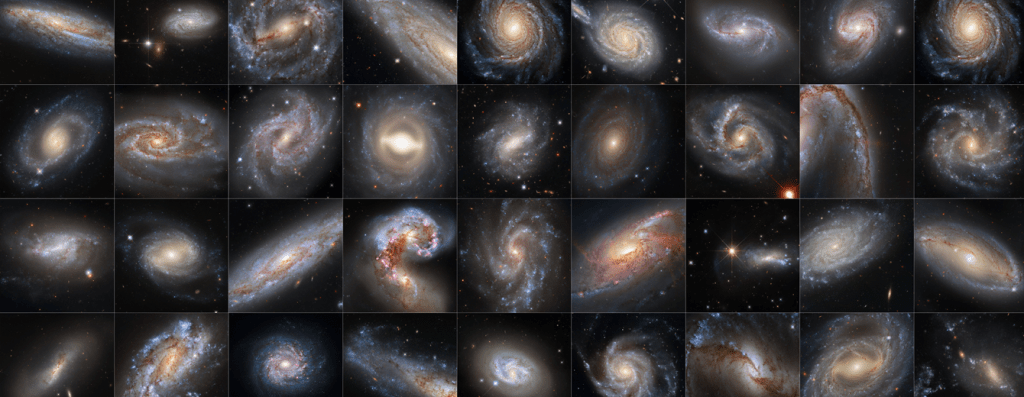
Astronomers using data from the Hubble Space Telescope have determined that the universe is expanding at a faster rate than estimated earlier. Using the Hubble data, the press release stated:

After 30 years of meticulous work using the Hubble telescope’s extraordinary observing power, numerous teams of astronomers have narrowed the expansion rate to a precision of just over 1%. This can be used to predict that the universe will double in size in 10 billion years.

I like another line in the Hubble press release following the discussion of another discovery showing that “the present expansion rate is different than it is expected to be as the universe appeared shortly after the big bang.” The press release noted:

You think this would frustrate astronomers, but instead it opens the door to discovering new physics, and confronting unanticipated questions about the underlying workings of the universe. And, finally, reminding us that we have a lot more to learn among the stars.

That’s the spirit. And yes, that galaxy far, far away is just getting ever further away every day.

Hubble and the Unexpected Asteroids

Image (Credit): This Hubble image is a mosaic of many exposures where some asteroids appear multiple times. (NASA, ESA, and B. Sunnquist and J. Mack/STScI)

The Hubble Space Telescope’s old data still holds some secrets. The European Space Agency (ESA) has reported that astronomers have found 1,031 unidentified asteroid trails in earlier data from the NASA/ESA Hubble Space Telescope. The asteroids were located by the Hubble Asteroid Hunter project, which defines the project in this way:

…we use archival images made by the Hubble Space Telescope to find asteroids observed by chance. The ESASky team compared the observation epoch and field of view of these images with the computed orbits of asteroids, to identify possible observations. The positions predicted by the algorithm, nevertheless, have some associated uncertainty because the ephemerides are not always known to great precision. This uncertainty increases with the amount of time between the last observation date and the date we predict the position for. Identifying the asteroids in the images (if present) and marking the exact position of their trail allows us to update the ephemerides and help us better characterise these objects.

More than 11,000 volunteers studied about 37,000 composite images taken by the Hubble between April 2002 and March 2021. The volunteers found about 1,000 asteroid trails, which when combined with other images spotted using artificial intelligence added to 1,701 asteroid trails. Of these, 1,031 are unidentified trails most likely associated with smaller asteroids. The analysis of these unidentified trails will continue.

This is a great example of the public assisting with astronomy and allowing for more timely results. It’s a helpful model for future astronomy endeavors.

Pic of the Week: Europa in All its Glory

Image (Credit): Hubble images of Jupiter’s moon Europa. (NASA, NASA-JPL, University of Arizona)

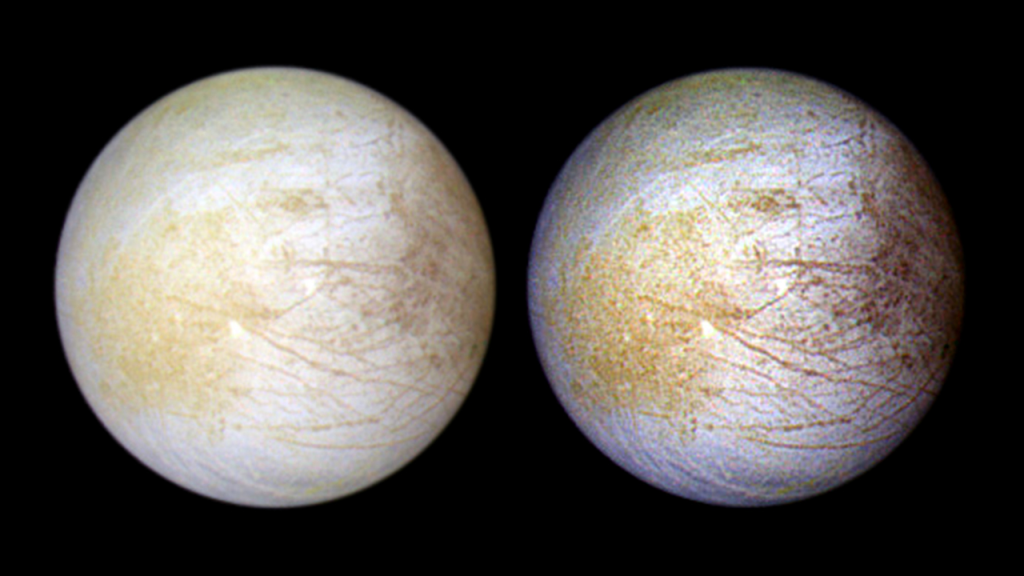
This week’s photo of Jupiter’s moon Europa was taken by the Hubble Space Telescope in June 1997 (and released by NASA on October 14, 2021). Here is the story about these two images (the left one in natural color and the right one enhanced) from the Hubble site:

This photograph of the Jovian moon Europa was taken in June 1997 at a range of 776,700 miles by NASA’s Galileo spacecraft.

Slightly smaller than Earth’s moon, Europa has a very smooth surface and the solid ice crust has the appearance of a cracked eggshell. The interior has a global ocean with more water than found on Earth. It could possibly harbor life as we know it.

Hubble Space Telescope observations of Europa have revealed the presence of persistent water vapor in its very tenuous atmosphere. Hubble observations, spanning 1999 to 2015, find that water vapor is constantly being replenished throughout one hemisphere of the moon. This is a different finding from Hubble’s 2013 observations that found localized water vapor from geysers venting from its subsurface ocean. This water vapor comes from a different process entirely. Sunlight causes the surface ice to sublimate, transitioning directly into gas.

This color composite Galileo view combines violet, green, and infrared images. The view of the moon is shown in natural color (left) and in enhanced color designed to bring out subtle color differences in the surface (right). The bright white and bluish part of Europa’s surface is composed mostly of water ice, with very few non-ice materials. Long, dark lines are fractures in the crust, some of which are more than 1,850 miles long.

Largest Comet to Date Approaching the Sun

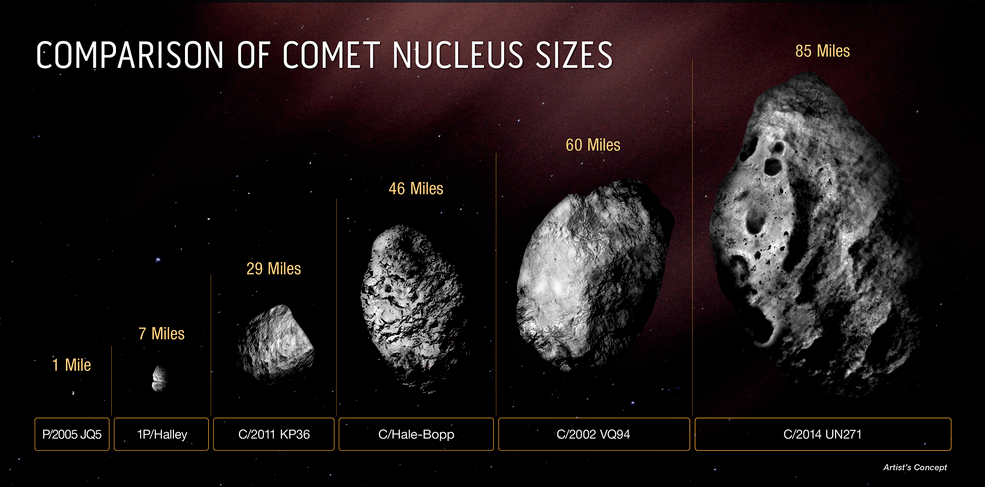
Image (Credit): Comparison of comet C/2014 UN271 (Bernardinelli-Bernstein) to several other comets. (NASA, ESA, Zena Levy (STScI))

A monster comet that takes 3 million years to circle the Sun is being closely analyzed by astronomers. The comet, C/2014 UN271 (Bernardinelli-Bernstein), will come closest to the Sun in 2031, but even then it will be about 1 billion miles away. At the most distant point in its orbit, the comet is about half a light year away from the Sun.

As shown in the graphic above, this is a large comet that could fully cover the state of Rhode Island. It was first detected by astronomers back in November 2010, when it was still 3 billion miles from the Sun. With the help of the Hubble Space Telescope, the astronomers were able to learn more about it this year.

The comet is believed to be a product of the Oort Cloud circling far outside our solar system. Of course, the Oort Cloud itself is a theory that has never been directly observed. But what about the Voyager spacecraft that left our solar system? Well, if you are willing to wait another 300 years, and the spacecraft are still working, you may have an answer.

You can read more about the comet at this NASA site.

Pic of the Week: Final Acts of a Monster Star

Image (Credit): The nebula surrounding the star AG Carinae (ESA/Hubble and NASA, A. Nota, C. Britt)

This week’s photo is from the Hubble Space Telescope. It shows the “puffing dust bubbles and an erupting gas shell,” or nebula, surrounding the monster star AG Carinae. Here is the rest of the story from the European Space Agency (ESA) Hubble site:

This giant star is waging a tug-of-war between gravity and radiation to avoid self-destruction. The star is surrounded by an expanding shell of gas and dust — a nebula — that is shaped by the powerful winds emanating from the star. The nebula is about five light-years wide, equal to the distance from here to our nearest star, Alpha Centauri.

AG Carinae is formally classified as a Luminous Blue Variable because it is hot (blue), very luminous, and variable. Such stars are quite rare because there are not many stars that are so massive. Luminous Blue Variable stars continuously lose mass in the final stages of their life, during which a significant amount of stellar material is ejected into the surrounding interstellar space, until enough mass has been lost that the star has reached a stable state. 

AG Carinae is surrounded by a spectacular nebula, formed by material ejected by the star during several of its past outbursts. The nebula is approximately 10 000 years old, and the observed velocity of the gas is approximately 70 kilometres per second. While this nebula looks like a ring, it is in fact a  hollow shell rich in gas and dust, the centre of which has been cleared by the powerful stellar wind travelling at roughly 200 kilometres per second. The gas (composed mostly of ionised hydrogen and nitrogen) is visible to us in these images as a thick bright red ring, which appears doubled in places — possibly the result of several outbursts colliding into each other. The dust, here visible in blue, has formed in clumps, bubbles and filaments that are shaped by the stellar wind.

This image was selected by the ESA for the month of April in its 2022 ESA/Hubble Calendar.