Pic of the Week: The Morning Star

Image (Credit): View of the Earendel star from the Hubble Space Telescope. (NASA)

This week’s image is the most distant star ever detected. It is from light that traveled 12.9 billion years to get to us, representing a star that existed about 1 billion years after the formation of the universe. It has been named Earendel, or “morning star” in Old English. You can learn more about this image from NASA’s Hubble site:

The find is a huge leap further back in time from the previous single-star record holder; detected by Hubble in 2018…The newly detected star is so far away that its light has taken 12.9 billion years to reach Earth, appearing to us as it did when the universe was only 7 percent of its current age, at redshift 6.2. The smallest objects previously seen at such a great distance are clusters of stars, embedded inside early galaxies…The research team estimates that Earendel is at least 50 times the mass of our Sun and millions of times as bright, rivaling the most massive stars known. But even such a brilliant, very high-mass star would be impossible to see at such a great distance without the aid of natural magnification by a huge galaxy cluster, WHL0137-08, sitting between us and Earendel. The mass of the galaxy cluster warps the fabric of space, creating a powerful natural magnifying glass that distorts and greatly amplifies the light from distant objects behind it…Astronomers expect that Earendel will remain highly magnified for years to come. It will be observed by NASA’s James Webb Space Telescope. Webb’s high sensitivity to infrared light is needed to learn more about Earendel, because its light is stretched (redshifted) to longer infrared wavelengths due to the universe’s expansion.

Image (Credit): Detailed view pinpointing the Earendel star from the Hubble Space Telescope. (NASA)

Pic of the Week: Space Triangle

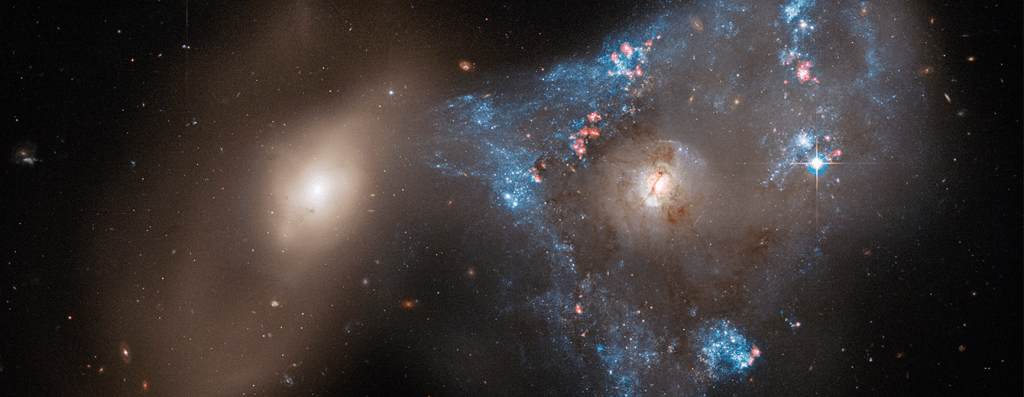
Image (Credit): Space Triangle image from the Hubble Space Telescope. (NASA, ESA, STScI, Julianne Dalcanton with the Center for Computational Astrophysics/Flatiron Inst., UWashington)

This week’s image is from the Hubble Space Telescope. It shows the collision of spiral galaxy NGC 2445 on the right and NGC 2444 on the left, creating what appears to be a triangle of new stars. Here is a little more on the pair from NASA’s Hubblesite:

A spectacular head-on collision between two galaxies fueled the unusual triangular-shaped star-birthing frenzy, as captured in a new image from NASA’s Hubble Space Telescope…

Astronomers suggest that the galaxies passed through each other, igniting the uniquely shaped star-formation firestorm in NGC 2445, where thousands of stars are bursting to life on the right-hand side of the image. This galaxy is awash in starbirth because it is rich in gas, the fuel that makes stars. However, it hasn’t yet escaped the gravitational clutches of its partner NGC 2444, shown on the left side of the image. The pair is waging a cosmic tug-of-war, which NGC 2444 appears to be winning. The galaxy has pulled gas from NGC 2445, forming the oddball triangle of newly minted stars.

Another Space Telescope is Coming: The Nancy Grace Roman Space Telescope

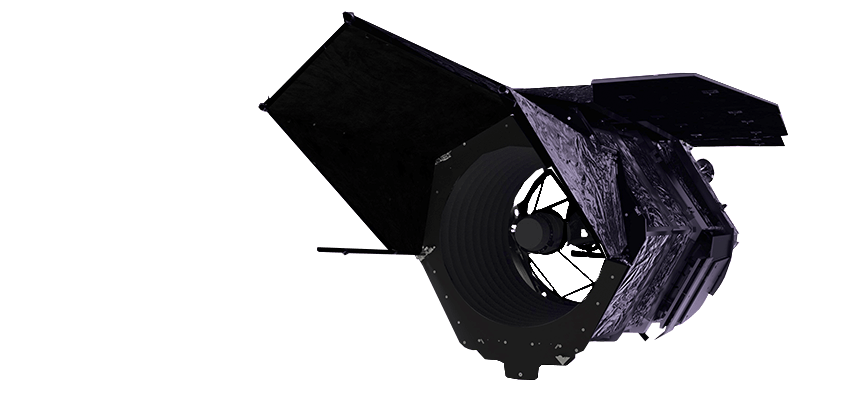
Source/Credit: Nancy Grace Roman Space Telescope from NASA.

With all the excitement about the James Webb Space Telescope coming online shortly, we do not want to forget about another space telescope in development. NASA’s Nancy Grace Roman Space Telescope, expected to be launched in 2027, will be even more productive than the Hubble Space Telescope. NASA noted the new space telescope will be:

Providing the same crisp infrared resolution as Hubble over a field of view 200 times larger, Roman will conduct sweeping cosmic surveys that would take hundreds of years using Hubble. Roman will map stars, galaxies, and dark matter to explore the formation and evolution of large cosmic structures, like clusters and superclusters of galaxies, and investigate dark energy, which is thought to accelerate the expansion of the universe.

The Nancy Grace Roman Space Telescope will also have a Coronagraph Instrument that will be able to detect more exoplanets, including smaller, rocky exoplanets similar to Earth. By using the parent star’s reflected light on a larger exoplanet, this instrument will also allow astronomers to analyze the colors of the exoplanet’s atmosphere and learn more about the content of that atmosphere (complementing other studies of large exoplanets, one of which was noted here earlier). If successful, this technology could be refined further to one day help to detect oxygen, methane, and other elements/compounds in the atmosphere of distant, Earth-sized exoplanets.

Astronomer Vanessa Bailey from NASA’s Jet Propulsion Laboratory stated:

To image Earth-like planets, we’ll need 10,000 times better performance than today’s instruments provide…The Coronagraph Instrument will perform several hundred times better than current instruments, so we will be able to see Jupiter-like planets that are more than 100 million times fainter than their host stars.

The telescope is named after Nancy Grace Roman, who was NASA’s first chief astronomer and also known as the “Mother of Hubble” for her efforts in making the Hubble Space Telescope a reality. You can read more about her here.

Viewing the Dark-side of an Exoplanet

Source/Credit: Artist’s image of WASP-121b from Engine House VFX.

It was not so long ago that we were questioning the very existence of exoplanets, and now we are measuring their dark-sides. MIT News has a story about a recent paper discussing the findings of astronomers observing an exoplanet approximately 850 light years from Earth. About twice the size of Jupiter and tidally-locked with its host star, the exoplanet has a very strange water cycle. The article states:

While on Earth, water cycles by first evaporating, then condensing into clouds, then raining out, on WASP-121b, the water cycle is far more intense: On the day side, the atoms that make up water are ripped apart at temperatures over 3,000 kelvins. These atoms are blown around to the night side, where colder temperatures allow hydrogen and oxygen atoms to recombine into water molecules, which then blow back to the day side, where the cycle starts again.

The article and paper go into many more details, yet I am most impressed with this level of observation already possible using a spectroscopic camera aboard NASA’s Hubble Space Telescope. With the James Webb Space Telescope soon to go online, we can only hope for more fascinating insights into distant exoplanets.

Pic of the Week: Giant Star on the Edge of Destruction

Source/Credit: NASA/ESA Hubble Space Telescope

This week’s image from the Hubble Space Telescope shows an erupting star, as explained by the European Space Agency’s (ESA) Hubble site:

The giant star…is waging a tug-of-war between gravity and radiation to avoid self-destruction. The star, called AG Carinae, is surrounded by an expanding shell of gas and dust — a nebula — that is shaped by the powerful winds of the star. The nebula is about five light-years wide, which equals the distance from here to our nearest star, Alpha Centauri.

The huge structure was created from one or more giant eruptions several thousand years ago. The star’s outer layers were blown into space, the expelled material amounting to roughly 10 times the mass of our Sun. These outbursts are typical in the life of a rare breed of star called a Luminous Blue Variable (LBV), a brief unstable phase in the short life of an ultra-bright, glamorous star that lives fast and dies young. These stars are among the most massive and brightest stars known. They live for only a few million years, compared to the roughly 10-billion-year lifetime of our own Sun. AG Carinae is a few million years old and resides 20,000 light-years away inside our Milky Way galaxy. The star’s expected lifetime is between 5 million and 6 million years.