Space Stories: Mystery on Saturn, an Interstellar Visitor, and Hunting a Rogue Planet

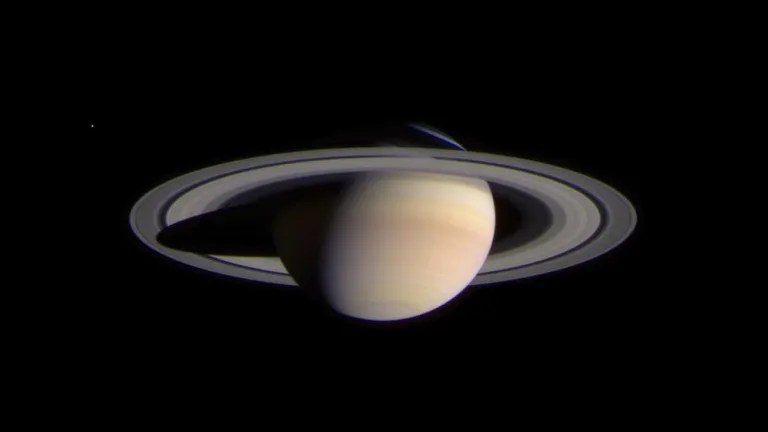
Image (Credit): Saturn as captured by NASA’s Cassini spacecraft on February 9, 2004 (NASA/JPL/Space Science Institute)

Here are some recent space-related stories of interest.

New Scientist: Did Something Just Hit Saturn? Astronomers Are Racing to Find Out

Something may have just hit Saturn – and, if so, an amateur astronomer could hold the key to confirming the event, which would be the first ever recorded on the gas giant. About seven asteroids or comets are estimated to impact Saturn every year, but no such event has ever been caught on camera. Now, NASA employee and amateur astronomer Mario Rana has recorded images that appear to show just that.

Astronomy.com: Astronomers Race to Learn More About Third Interstellar Visitor

Astronomers have spotted an object from outside our solar system bolting toward the Sun at around 150,000 mph (240,000 km/h). The big, frozen ball of ice and dust presents a rare chance to study an object that formed around an alien solar system, and potentially much earlier in the Milky Way’s history. The object named 3I/ATLAS — “3I” because it’s the third interstellar object detected so far, and “ATLAS” in honor of the system of telescopes that revealed it, the Asteroid Terrestrial-impact Last Alert System. Because the object is also showing tentative signs of cometary activity, it has also been designated C/2025 N1 (ATLAS).

Universe Today: Old Hubble Space Telescope Photos Unlock the Secret of a Rogue Planet

Astronomers have achieved a first in exoplanet hunting by using the Hubble Space Telescope images to investigate a mysterious event that could reveal the existence of a “rogue planet” drifting through space without a host star. The discovery centers on a brief astronomical phenomenon with the catchy name OGLE-2023-BLG-0524, detected in May 2023 by ground-based telescopes. The event lasted just eight hours and was caused by gravitational microlensing, an effect predicted by Einstein where a massive object acts like a magnifying glass in space, briefly brightening the light from a more distant object as it passes in front.

Pic of the Week: Spiral Galaxy UGC 11397

Image (Credit): The spiral galaxy UGC 11397 as captured by the Hubble Space Telescope. (ESA/Hubble & NASA, M. J. Koss, A. J. Barth)

This week’s image is from the Hubble Space Telescope. It is an image of the spiral galaxy UGC 11397, which is located about 250 million years light-years away.

At the time the light we are now seeing left UGC 11397, the Earth was a very different place. It was dealing with the Permian–Triassic mass extinction, also called the Great Dying. During this period about 94 percent of marine species and 70 percent of terrestrial vertebrate families disappeared from the planet.

Anyway, getting back to the image itself, here is a little more information from NASA to explain what you are seeing:

What sets UGC 11397 apart from a typical spiral lies at its center, where a supermassive black hole containing 174 million times the mass of our Sun grows. As a black hole ensnares gas, dust, and even entire stars from its vicinity, this doomed matter heats up and puts on a fantastic cosmic light show.

Material trapped by the black hole emits light from gamma rays to radio waves, and can brighten and fade without warning. But in some galaxies, including UGC 11397, thick clouds of dust hide much of this energetic activity from view in optical light. Despite this, UGC 11397’s actively growing black hole was revealed through its bright X-ray emission — high-energy light that can pierce the surrounding dust. This led astronomers to classify it as a Type 2 Seyfert galaxy, a category used for active galaxies whose central regions are hidden from view in visible light by a donut-shaped cloud of dust and gas.

Study Findings: No Certainty of a Milky Way–Andromeda Collision

Image (Credit): The Andromeda galaxy, or M31, spans 260,000 light-years across. (NASA/JPL-Caltech)

Nature Astronomy abstract of the study findings:

It is commonly believed that our own Milky Way is on a collision course with the neighbouring Andromeda galaxy. As a result of their merger, predicted in around 5 billion years, the two large spiral galaxies that define the present Local Group would form a new elliptical galaxy. Here we consider the latest and most accurate observations by the Gaia and Hubble space telescopes, along with recent consensus mass estimates, to derive possible future scenarios and identify the main sources of uncertainty in the evolution of the Local Group over the next 10 billion years. We found that the next most massive Local Group member galaxies—namely, M33 and the Large Magellanic Cloud—distinctly and radically affect the Milky Way–Andromeda orbit. Although including M33 increases the merger probability, the orbit of the Large Magellanic Cloud runs perpendicular to the Milky Way–Andromeda orbit and makes their merger less probable. In the full system, we found that uncertainties in the present positions, motions and masses of all galaxies leave room for drastically different outcomes and a probability of close to 50% that there will be no Milky Way–Andromeda merger during the next 10 billion years. Based on the best available data, the fate of our Galaxy is still completely open.

Citation: Sawala, T., Delhomelle, J., Deason, A.J. et al. No certainty of a Milky Way–Andromeda collision. Nat Astron (2025).
https://doi.org/10.1038/s41550-025-02563-1

Study-related stories:

PBS

National Geographic

Daily Finland

Pic of the Week: Barred Spiral Galaxy NGC 5335

Image (Credit): Barred Spiral Galaxy NGC 5335 (NASA, ESA, STScI)

This week’s image looks like something ginned up by AI, but it is from the Hubble Space Telescope. Just the number of stray galaxies in the image is amazing.

Here is the description of the image from the European Space Agency’s (ESA) Hubble page:

Barred spiral galaxy NGC 5335 observed by the Hubble Space Telescope takes up the majority of the view. At its center is a milky yellow, flattened oval that extends bottom left to top. Within the oval is a bright central region that looks circular, with the very center the brightest. In the bright central region is what looks like a bar, extending from top left to bottom right. Around this is a thick swath of blue stars speckled with white regions. Multiple arms wrap up and around in a counterclockwise direction, becoming fainter the farther out they are. Both the white core and the spiral arms are intertwined with dark streaks of dust. The background of space is black. Thousands of distant galaxies in an array of colors are speckled throughout.

Trump Administration Proposes 25 Percent Cut to NASA’s Budget

It should come as no surprise at this point that NASA will fall victim to massive budget cuts like so many other civilian agencies. While it will not disappear like the US Agency for International Development, it will be severely wounded as the result of a proposed 25 percent cut to its budget.

The White House’s proposed 2026 budget is setting aside $7 billion for the Moon missions and $1 billion for Mars missions, but it seems just about everything else is up for grabs. For instance, we would see the show shutdown of the Space Launch System rocket and the Orion spacecraft so they could become fully commercial. In addition, the orbiting lunar Gateway will be cut completely.

Specifically, the budget summary states:

The Budget phases out the grossly expensive and delayed Space Launch System (SLS) rocket and Orion capsule after three flights. SLS alone costs $4 billion per launch and is 140 percent over budget. The Budget funds a program to replace SLS and Orion flights to the Moon with more cost-effective commercial systems that would support more ambitious subsequent lunar missions. The Budget also proposes to terminate the Gateway, a small lunar space station in development with international partners, which would have been used to support future SLS and Orion missions.

Moreover, the Mars funding would not cover the sample return mission. Hence, SpaceX might get a boost to head towards Mars while we are stranding samples that help us to understand why we might want to go to Mars. We will also see the end of the Nancy Grace Roman Space Telescope, pruning back the accomplishments we have made since the Hubble Space Telescope to make the universe more available to scientists and the public.

If we ignore the future of the Artemis mission for a moment, a NASA press release boasted about all the events over the past 100 days to prepare for the Artemis mission. This is a hopeful sign that the Moon mission is still vital and viable at the moment, even with the defunding efforts underway. However, given some of the recent failures of the private sector efforts to reach the Moon, and the continual delays in SpaceX’s Starship, the future for Moon missions after the SLS does not look too promising at the moment.

The future also looks somewhat bleak when you look at proposed cuts to NASA’s funding for space science, space technology, and STEM programs. The endless faith in the private sector forgets the benefits of a government supporting and nudging these efforts.

As Casey Dreier, Chief of Space Policy for The Planetary Society, clearly stated:

These cuts would cause irreparable losses, throwing away billions of dollars invested by the U.S. taxpayers in productive space hardware and infrastructure. Space science is a critical national investment that engages our cutting edge economic, scientific, and educational abilities across the country.