Image (Credit): A planetary nebula named Kohoutek 4-55. (ESA/Hubble & NASA, K. Noll)
This image is from the ESA/Hubble Picture of the Week website. It shows a colorful planetary nebula called Kohoutek 4-55, which is about 4600 light-years away.
A planetary nebula, a glowing shell of material thrown off by a star. A small central region of greenish clouds is encircled by a glowing, jagged ring, like a hole torn in fabric. A band of silvery-blue clouds outside this is again encircled by a larger, fainter yellow ring of gas. Puffy, smoky clouds of orange and red gas billow out from there into a large oval nebula, fading into the dark background of space.
A SpaceX spacecraft carrying four international astronauts is on a pioneering journey circling Earth over its poles after launching Monday night from Florida…Fram2 follows in the footsteps of other commercial spaceflight ventures, including Inspiration4 and Polaris Dawn – two missions also bankrolled and led by billionaire Jared Isaacman. In fact, the Fram2 crew is now traveling on the same Dragon spacecraft that the Polaris Dawn crew rode to orbit in September for a five-day mission in which they completed a historic spacewalk.
In a bid to disrupt the United States’ long-held dominance in space exploration, China is quietly advancing a radical new rocket launch system – powered not by roaring engines but by electromagnetic force – that could propel satellites into orbit with unprecedented speed and efficiency. At the heart of the ambitious project is Galactic Energy, a private aerospace company that plans to debut the world’s first electromagnetic rocket launch pad by 2028, a project that could redraw the competitive lines of the global space industry.
Halfway through its fourth decade, Hubble’s long life has proven invaluable for studying the atmosphere of the mysterious ice giant Uranus. By repeatedly training Hubble on the distant cyan planet over the course of 20 years, researchers chronicled a two-decade story of seasonal changes. These astronomers have gained new understanding of the atmospheric dynamics of Uranus, which can serve as a proxy for studying exoplanets of similar size and composition.
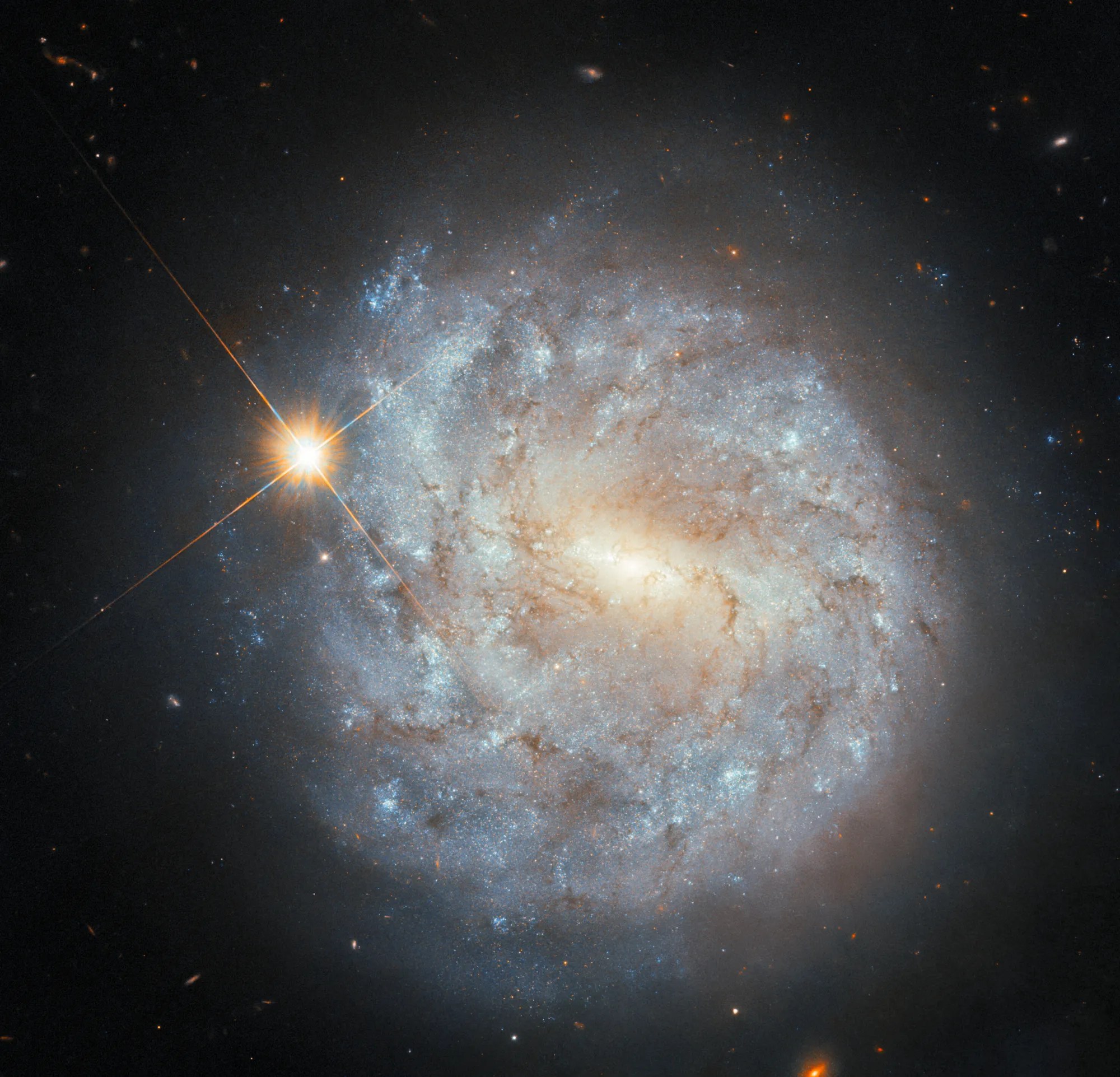
Image (Credit): Hubble Space Telescope image of a sparkling spiral galaxy paired with a prominent star, both in the constellation Virgo. (ESA/Hubble & NASA, S. J. Smartt, C. Kilpatrick)
This week’s image is from the NASA/ESA Hubble Space Telescope. It shows what appears to be two close neighbors – a star and a galaxy – but looks can be deceiving.
This NASA/ESA Hubble Space Telescope image features a sparkling spiral galaxy paired with a prominent star, both in the constellation Virgo. While the galaxy and the star appear to be close to one another, even overlapping, they’re actually a great distance apart. The star, marked with four long diffraction spikes, is in our own galaxy. It’s just 7,109 light-years away from Earth. The galaxy, named NGC 4900, lies about 45 million light-years from Earth.
This image combines data from two of Hubble’s instruments: the Advanced Camera for Surveys, installed in 2002 and still in operation today, and the older Wide Field and Planetary Camera 2, which was in use from 1993 to 2009. The data used here were taken more than 20 years apart for two different observing programs — a real testament to Hubble’s long scientific lifetime.
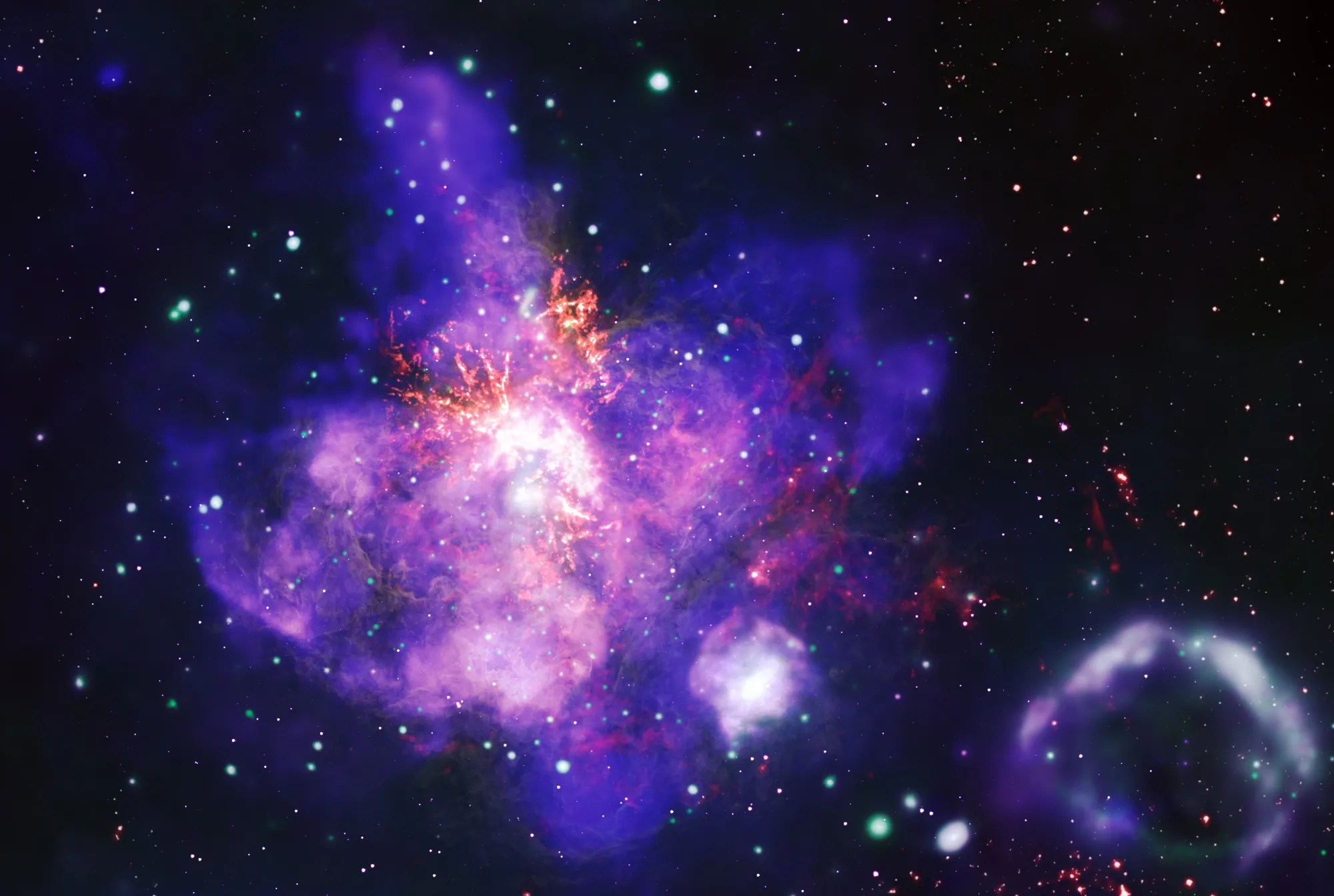
Image (Credit): Composite image of 30 Doradus. (X-ray: NASA/CXC/Penn State Univ./L. Townsley et al.; Infrared: NASA/JPL-CalTech/SST; Optical: NASA/STScI/HST; Radio: ESO/NAOJ/NRAO/ALMA; Image Processing: NASA/CXC/SAO/J. Schmidt, N. Wolk, K. Arcand)
Yes, NASA has an image ready for Valentine’s Day. This image comes from three sources – the Chandra X-ray Observatory, the Hubble Space Telescope, and the Atacama Large Millimeter/submillimeter Array.
Here is more from NASA (and even more can be found at the linked site):
Otherwise known as the Tarantula Nebula, 30 Dor is located about 160,000 light-years away in a small neighboring galaxy to the Milky Way known as the Large Magellanic Cloud (LMC). Because it one of the brightest and populated star-forming regions to Earth, 30 Dor is a frequent target for scientists trying to learn more about how stars are born.
With enough fuel to have powered the manufacturing of stars for at least 25 million years, 30 Dor is the most powerful stellar nursery in the local group of galaxies that includes the Milky Way, the LMC, and the Andromeda galaxy.
The massive young stars in 30 Dor send cosmically strong winds out into space. Along with the matter and energy ejected by stars that have previously exploded, these winds have carved out an eye-catching display of arcs, pillars, and bubbles.
A dense cluster in the center of 30 Dor contains the most massive stars astronomers have ever found, each only about one to two million years old. (Our Sun is over a thousand times older with an age of about 5 billion years.)
Image (Credit): Messier 104 (M104) captured by the JWST. (NASA, ESA, CSA, STScI)
This week’s image, released late last year, comes from NASA’s James Webb Space Telescope (JWST). Messier 104 (M104), called the Sombrero galaxy, shines in all its blueness. It is about 31 million light-years away. It would have been interesting to see this galaxy from above (or below, for that matter).
In Webb’s mid-infrared view of the Sombrero galaxy, also known as Messier 104 (M104), the signature, glowing core seen in visible-light images does not shine, and instead a smooth inner disk is revealed. The sharp resolution of Webb’s MIRI (Mid-Infrared Instrument) also brings into focus details of the galaxy’s outer ring, providing insights into how the dust, an essential building block for astronomical objects in the universe, is distributed. The galaxy’s outer ring, which appeared smooth like a blanket in imaging from NASA’s retired Spitzer Space Telescope, shows intricate clumps in the infrared for the first time.
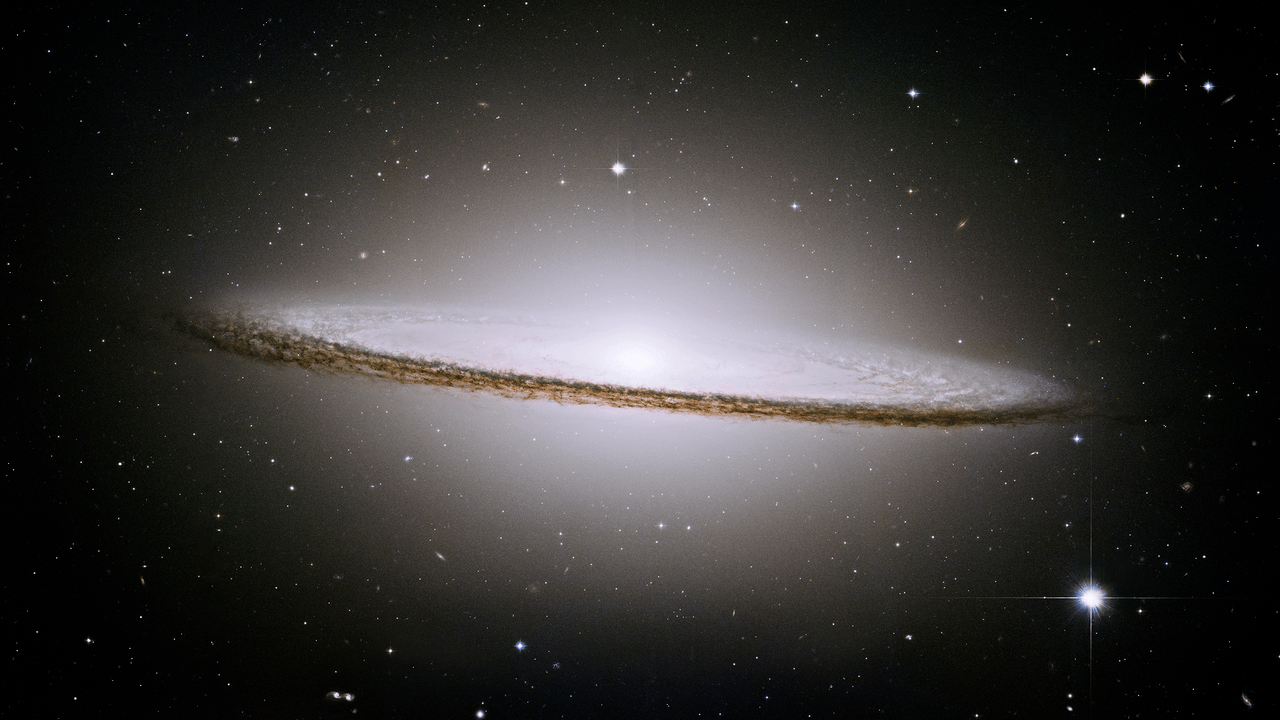
Note: Below is another view of the galaxy from the Hubble Space Telescope.
Image (Credit): Messier 104 (M104) captured by the Hubble Space Telescope. (This image was created from data from HST program 9714: K. Noll, H. Bond, C. Christian, L. Frattare, F. Hamilton, Z. Levay, and T. Royle (STScI)).



 Our Awesome Universe