Image (Credit): Image of Jupiter taken by the Hubble Space Telescope. (Amy A. Simon/NASA/European Space Agency)
“We find them down as small as one Jupiter mass, even half a Jupiter mass, floating freely, not attached to a star…Physics says you can’t even make objects that small. We wanted to see, can we break physics? And I think we have, which is good.”
–Statement by Mark McCaughrean, a senior adviser for science and exploration at the European Space Agency, regarding Jupiter Mass Binary Objects (JuMBO). These objects were spotted by the James Webb Space Telescope in the Orion Nebula. They may be a new astronomical body as they do not fit into the normal star or planet category.
Image (Credit): NGC 1087 as captured by the Hubble Space Telescope. (Space Telescope Science Institute and Gladys Kober, NASA/Catholic University of America)
This week’s image comes from the NASA/ESA Hubble Space Telescope. It is an image of the grainy-textured, colorful barred spiral galaxy NGC 1087, which is about 80 million light-years away.
It has a diameter of 87,000 light-years and a very small nucleus, or center. The galaxy’s dust lanes, seen in dark red, help define its spiral structure. NGC 1087’s stellar bar – the elongated, bright-white structure at the galaxy’s center – is also shorter compared to other barred galaxies. Typically, in barred galaxies, the gravity of the center pulls in large quantities of gas, causing a burst of star formation followed by a slow decay. Uniquely, NGC 1087 shows signs of new star formation, making it of special interest to scientists.
British astronomer William Herschel discovered NGC 1087 in 1785. The galaxy sits just south of the celestial equator, making it visible from both hemispheres. In 1995, astronomers discovered a Type II supernova within this galaxy. Type II supernovae occur when a massive star uses all of its nuclear fuel and its iron core collapses, then explodes. Named 1995V, it is the only supernova ever seen in this galaxy.
In this new ultraviolet, visible, and near-infrared light image from NASA’s Hubble Space Telescope, the dark red streaks are cold molecular gas, the raw material from which stars form. The spots of bright pink signal areas where new stars are forming, characterized by the presence of ionized hydrogen, oxygen, and sulfur. The bluer regions hold hot, young stars formed earlier in the lifetime of this galaxy. Hubble observed NGC 1087 to study the connection between young stars and cold gas, and especially to determine what happens to gaseous regions after stars are formed within them.
Image (Credit): NGC 6530 as captured by the NASA/ESA Hubble Space Telescope. (ESA/Hubble & NASA, ESO, O. De Marco)
This week’s image is from the Hubble Space Telescope. It shows a fantastic array of colors from a portion of NGC 6530, which is about 4,350 light-years from Earth.
A portion of the open cluster NGC 6530 appears as a roiling wall of smoke studded with stars in this image from the NASA/ESA Hubble Space Telescope…The cluster is set within the larger Lagoon Nebula, a gigantic interstellar cloud of gas and dust. It is the nebula that gives this image its distinctly smokey appearance; clouds of interstellar gas and dust stretch from one side of this image to the other.
You can also watch this short video that pans over the cluster.
Image (Credit): Galaxy NGC 6684 captured by the NASA/ESA Hubble Space Telescope. (ESA/Hubble & NASA, R. Tully)
This week’s image is from NASA/European Space Agency’s (ESA) Hubble Space Telescope. It shows the glowing galaxy NGC 6684, which is around 44 million light-years from Earth.
This oddly shaped galaxy is explained on the ESA’s website:
Lenticular galaxies like NGC 6684 (lenticular means lens-shaped) possess a large disc but lack the prominent spiral arms of galaxies like the Andromeda Galaxy. This leaves them somewhere between elliptical galaxies and spiral galaxies, and lends these galaxies a diffuse, ghostly experience. NGC 6684 also lacks the dark dust lanes that thread through other galaxies, adding to its spectral, insubstantial appearance.
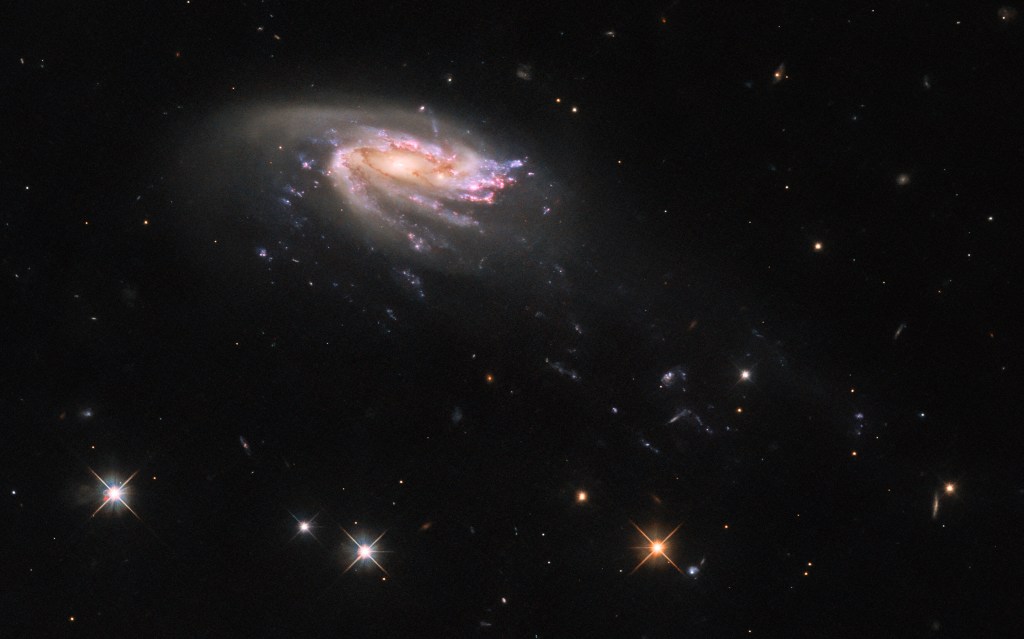
Image (Credit): The jellyfish galaxy JO206 trails across this image from the NASA/ESA Hubble Space Telescope. (ESA/Hubble & NASA, M. Gullieuszik and the GASP team)
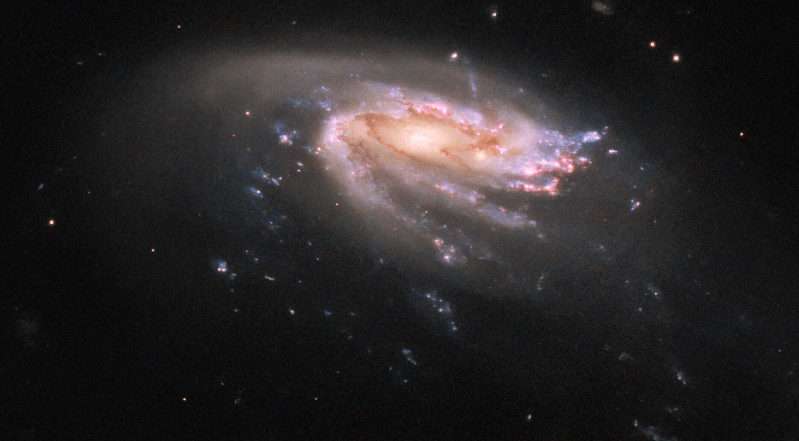
This week’s image is from the Hubble Space Telescope. It shows the jellyfish galaxy JO206, which is about 700 million light-years away. A close-up of the galaxy iteself is provided below.
[Galaxy JO206 is] showcasing a colorful star-forming disk surrounded by a pale, luminous cloud of dust. A handful of foreground bright stars with crisscross diffraction spikes stands out against an inky black backdrop at the bottom of the image…
Jellyfish galaxies are so-called because of their resemblance to their aquatic namesakes. In the bottom right of this image, long tendrils of bright star formation trail the disk of JO206, just as jellyfish trail tentacles behind them. The tendrils of jellyfish galaxies are formed by the interaction between galaxies and the intra-cluster medium, a tenuous superheated plasma that pervades galaxy clusters. As galaxies move through galaxy clusters, they ram into the intracluster medium, which strips gas from the galaxies and draws it into the long tendrils of star formation.
The tentacles of jellyfish galaxies give astronomers a unique opportunity to study star formation under extreme conditions, far from the influence of the galaxy’s main disk. Surprisingly, Hubble revealed that there are no striking differences between star formation in the disks of jellyfish galaxies and star formation in their tentacles, which suggests the environment of newly formed stars has only a minor influence on their formation.
Image (Credit): Close-up of the jellyfish galaxy JO206 from the NASA/ESA Hubble Space Telescope. (ESA/Hubble & NASA, M. Gullieuszik and the GASP team)


 Our Awesome Universe