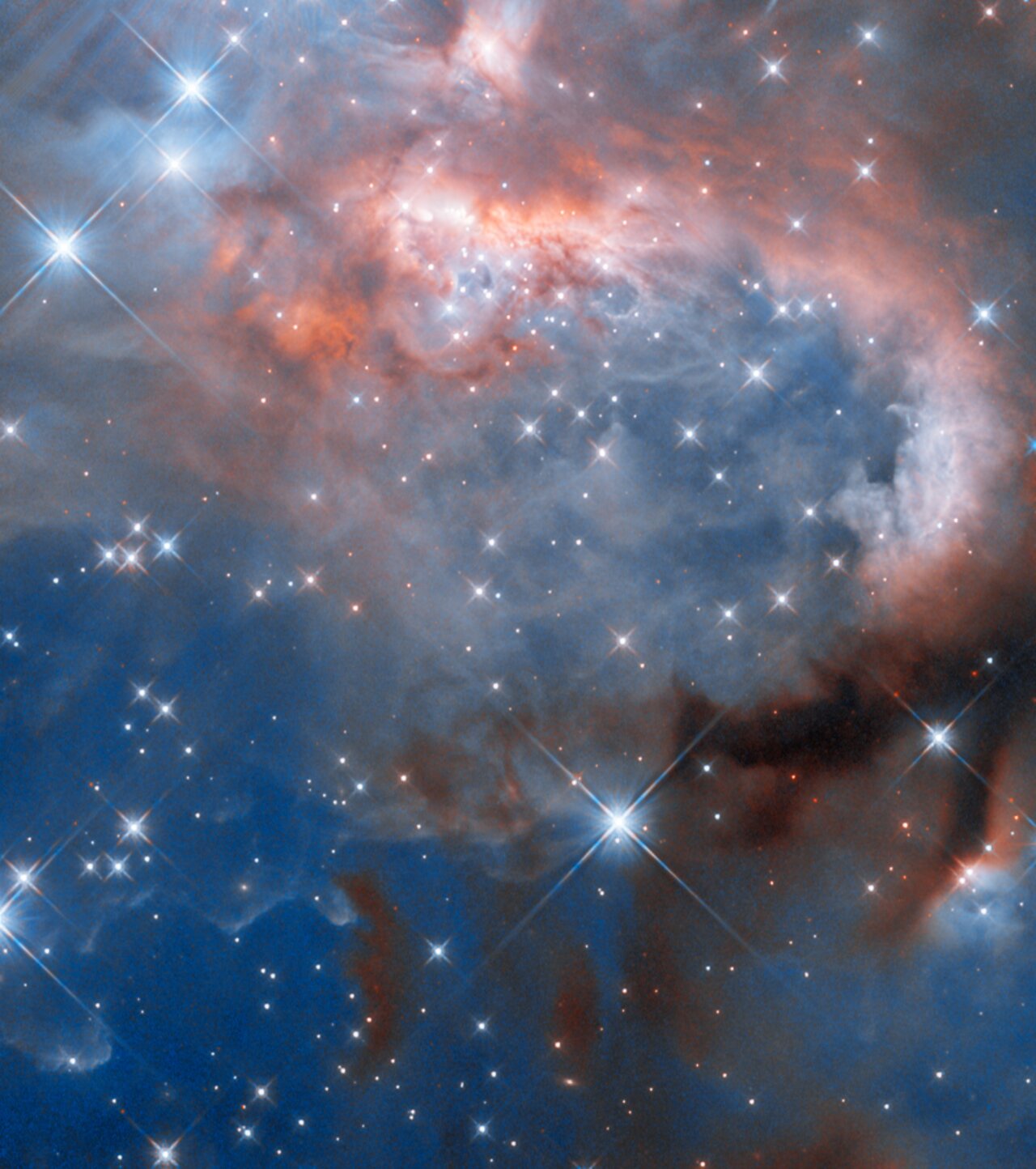
Image (Credit): RCW 7, a nebula located just over 5,300 light-years from Earth. (ESA/Hubble & NASA, J. Tan (Chalmers University & University of Virginia), R. Fedriani (Institute for Astrophysics of Andalusia))
This week’s image is from the NASA/European Space Agency’s (ESA) Hubble space telescope. It shows the nebula called RCW 7, which is located about 5,300 light-years away.
Clouds of gas and dust with many stars. The clouds form a flat blue background towards the bottom, and become more thick and smoky towards the top. They are lit on one side by stars in the nebula. A thick arc of gas and dust reaches around from the top, where it is brightly lit by many stars in and around it, to the bottom where it is dark and obscuring. Other large stars lie between the clouds and the viewer.
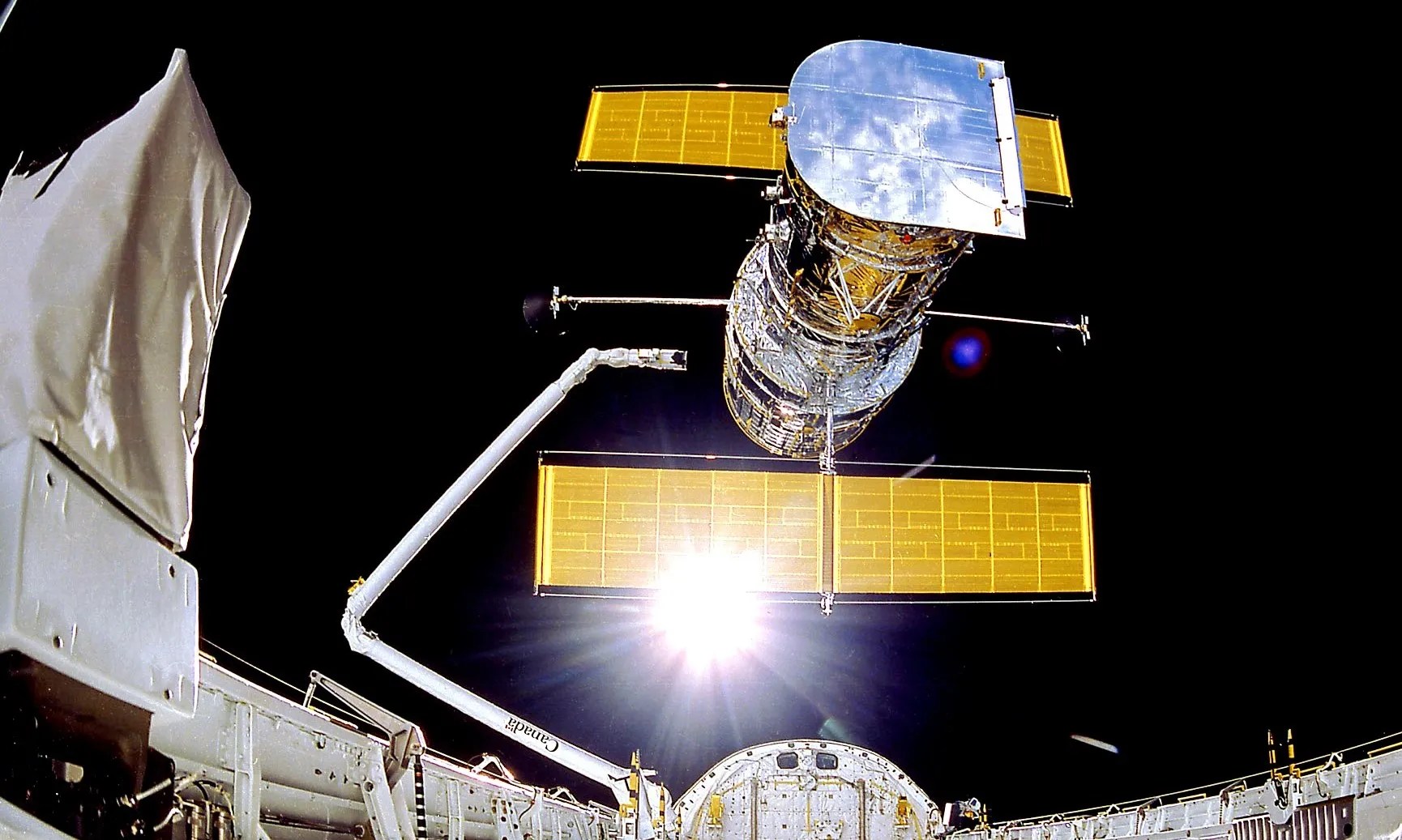
Image (Credit): The deployment of the Hubble Space Telescope on April 25, 1990 from the space shuttle Discovery. (NASA/Smithsonian Institution/Lockheed Corporation)
The Hubble Space Telescope is suffering the kinds of aches and pains that can come with being old, and NASA officials say they’re shifting into a new way of pointing the telescope in order to work around a piece of hardware that’s become intolerably glitchy. Officials also announced that, for now, they’ve decided not to pursue a plan put forward by a wealthy private astronaut who wanted to go to Hubble in a SpaceX capsule, in a mission aimed at extending the telescope’s lifespan by boosting it up into a higher orbit and perhaps even adding new technology to enhance its operations.
NASA announced Friday it selected three industry proposals to help develop technologies for future large space telescopes and plan for the agency’s Habitable Worlds Observatory mission concept, which could be the first space telescope designed to search for life outside our solar system. The mission would directly image Earth-like planets around stars like our Sun and study their atmospheres for the chemical signatures of life, as well as enable other investigations about our solar system and universe. NASA is currently in the early planning stages for this mission concept, with community-wide working groups exploring its fundamental science goals and how best to pursue them. The agency is also in the process of establishing a Habitable Worlds Observatory Technology Maturation project office at NASA’s Goddard Space Flight Center in Greenbelt, Maryland.
When NASA’s Lucy spacecraft flew past the tiny main belt asteroid Dinkinesh last November, the Southwest Research Institute-led mission discovered a trough and ridge structure on the main asteroid as well as the first-ever-encountered contact binary satellite. The flyby data of this half-mile-wide object revealed a dramatic history of sudden breakups and transformation. Scientists think a big chunk of Dinkinesh suddenly shifted, excavating the trough and flinging debris into its vicinity. Some materials fell back to the asteroid body, forming the ridge, while others coalesced to form a contact binary satellite known as Selam. The complex shapes show that Dinkinesh and Selam have significant internal strength and a complex, dynamic history.
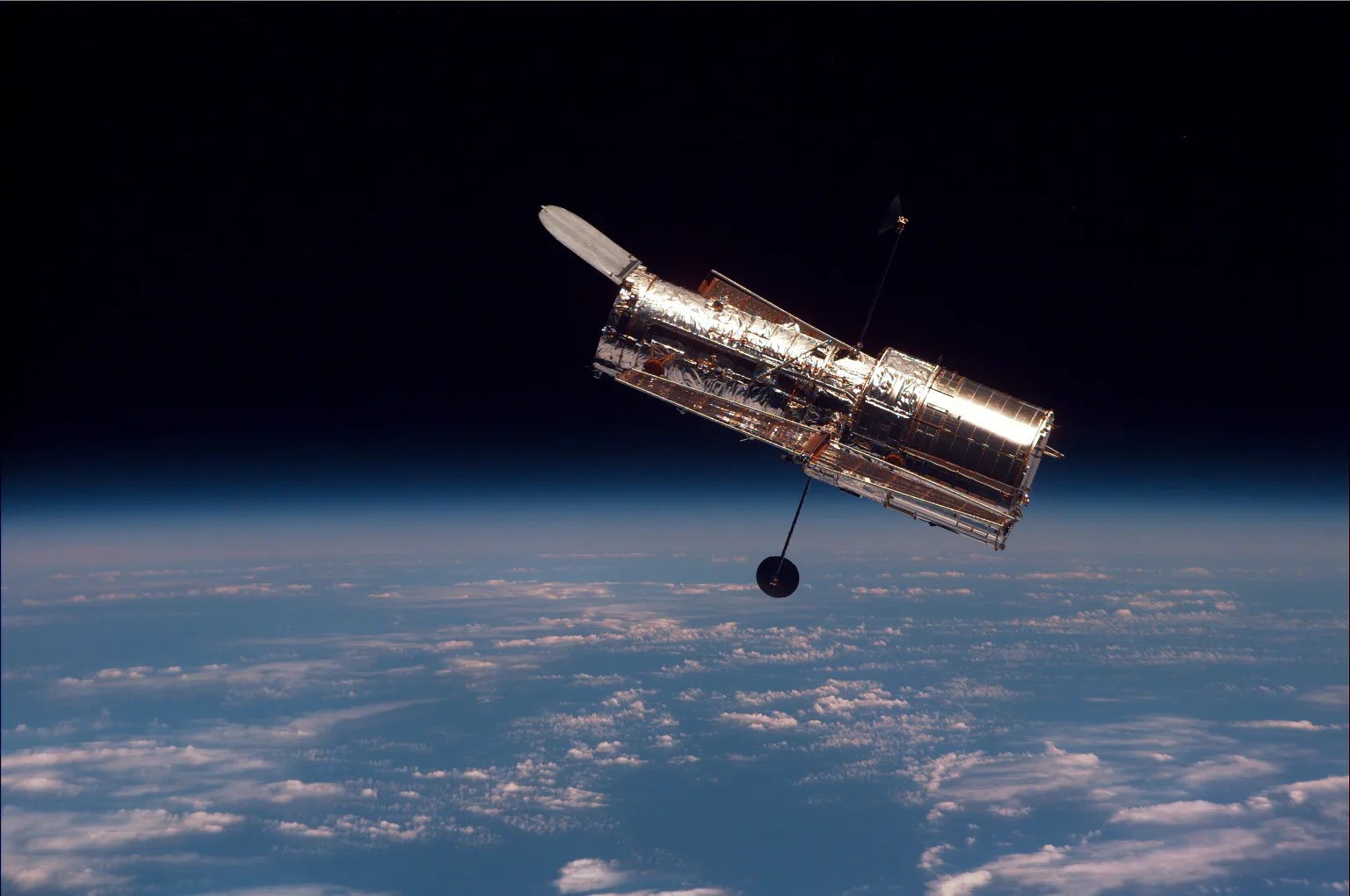
Image (Credit): The Hubble Space Telescope returning to orbit after its second servicing mission in February 1997. (NASA)
“Perhaps the opportunity with Polaris won’t be there, but NASA can work with Congress and the Administration to request funds for a Hubble reboost or enhancement mission, using a commercial partner where NASA is in the drivers [sic] seat, and the maturity of the space systems is higher and lower risk.”
-Statement by John Grunsfeld, an astronaut who operated on Hubble multiple times, in an NPR story regarding an offer by businessman Jared Isaacman to privately fund a mission to move the Hubble Space Telescope to a higher orbit and conduct necessary repairs to extend the telescope’s life. His offer has been met with some skepticism due to the difficulty of such a mission.
“An improved appropriation for FY 2025 of $9 billion for SMD will give the agency the necessary resources to pursue Decadal priorities such as the Earth System Observatory, Geophysical Dynamics Constellation, Habitable Worlds Observatory, and Mars Sample Return, while maintaining our nation’s highly-skilled workforce and fleet of operating and developing spacecraft including the Chandra X-Ray Observatory, Hubble Space Telescope, Perseverance and Curiosity rovers, among others. These investments in our high-tech STEM workforce and university systems will provide positive value to every congressional district.”
-Statement in a May 1, 2024 letter to the House Appropriations Subcommittee on Commerce, Justice, Science, and Related Agencies from 44 Members of Congress regarding increased funding to NASA related to its Science Mission Directorate (SMD). The letter notes that “…the FY 2025 President’s Budget Request of $7.6 billion for NASA Science represents a $1.1 billion decrease in purchasing power from its peak in FY 2020 and would be the smallest budget in eight years when adjusted for inflation.”
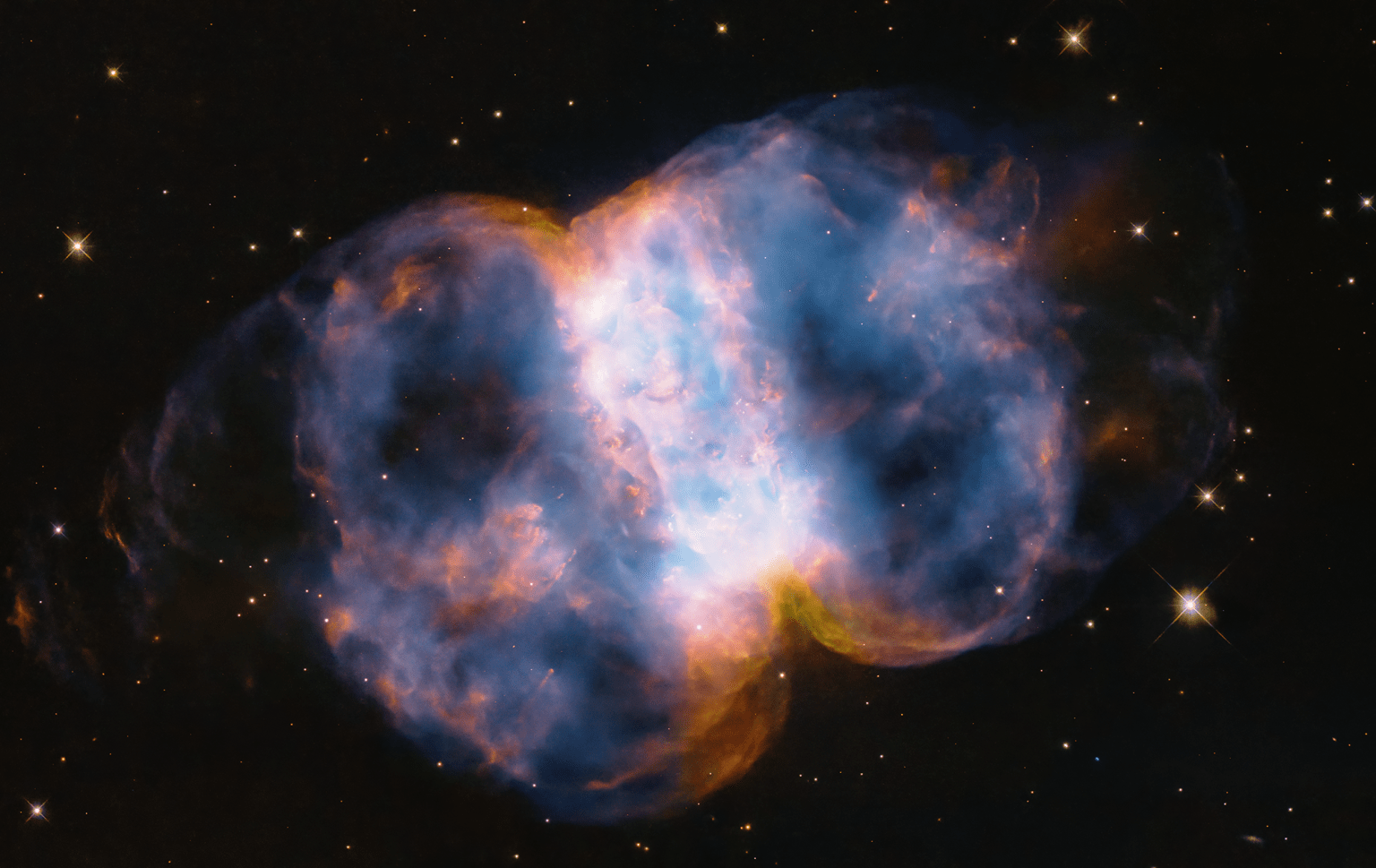
Image (Credit): The Little Dumbell Nebula as captured by the Hubble Space Telescope. (NASA, ESA, STScI)
This week’s image comes from the NASA/European Space Agency’s Hubble Space Telescope. It shows what is called the Little Dumbbell Nebula, more formally called Messier 76, M76, or NGC 650/651, which is about 3,400 light-years away. The image is being shared as part of the celebration of Hubble’s 34th anniversary, which is discussed in this video.
M76 is classified as a planetary nebula, an expanding shell of glowing gases that were ejected from a dying red giant star. The star eventually collapses to an ultra-dense and hot white dwarf. A planetary nebula is unrelated to planets, but have that name because astronomers in the 1700s using low-power telescopes thought this type of object resembled a planet.
M76 is composed of a ring, seen edge-on as the central bar structure, and two lobes on either opening of the ring. Before the star burned out, it ejected the ring of gas and dust. The ring was probably sculpted by the effects of the star that once had a binary companion star. This sloughed off material created a thick disk of dust and gas along the plane of the companion’s orbit. The hypothetical companion star isn’t seen in the Hubble image, and so it could have been later swallowed by the central star. The disk would be forensic evidence for that stellar cannibalism.
The primary star is collapsing to form a white dwarf. It is one of the hottest stellar remnants known at a scorching 250,000 degrees Fahrenheit, 24 times our Sun’s surface temperature. The sizzling white dwarf can be seen as a pinpoint in the center of the nebula. A star visible in projection beneath it is not part of the nebula.
Pinched off by the disk, two lobes of hot gas are escaping from the top and bottom of the “belt,” along the star’s rotation axis that is perpendicular to the disk. They are being propelled by the hurricane-like outflow of material from the dying star, tearing across space at two million miles per hour. That’s fast enough to travel from Earth to the Moon in a little over seven minutes! This torrential “stellar wind” is plowing into cooler, slower-moving gas that was ejected at an earlier stage in the star’s life, when it was a red giant. Ferocious ultraviolet radiation from the super-hot star is causing the gases to glow. The red color is from nitrogen, and blue is from oxygen.
Given our solar system is 4.6 billion years old, the entire nebula is a flash in the pan by cosmological timekeeping. It will vanish in about 15,000 years.