In Case You Missed It/Podcast: Retelling the Story of the Mission to the Moon

Image: Chesley Bonestell art printed in “The Conquest of the Moon” (1953). Mr. Bonestell’s art is mentioned in the Moonrise podcast.

If you are looking for a good story that you to listen to during your next car trip, you cannot do better than the Washington Post’s Moonrise podcast. It has a bit of everything, including science fiction stories, Nazi war machines, Russian persecution, American post-WWII politics, and a bit of astronomy as well.

Here is how the program sells itself:

Want to uncover the real origin story behind the United States’ decision to go to the moon? In the 50 years since the moon landing, as presidential documents have been declassified and secret programs revealed, a wild story has begun to emerge. “Moonrise,” a Washington Post audio miniseries hosted by Lillian Cunningham, digs into the nuclear arms race of the Cold War, the transformation of American society and politics ⁠— and even the birth of science fiction ⁠— to unearth what really drove us to the moon. Come along with us on a fascinating journey from Earth to the moon.

You can learn how President Kennedy tried to get the Soviet Union to join the Apollo program – twice. You can also hear about the Apollo 11 mission competing with a Soviet spacecraft trying to land on the Moon at the same time. And have you heard about the civil rights protests at the Apollo 11 launch site?

The podcast is a well crafted story trying to weave together many threads in a mostly successful way. It is still astonishing that the early Space Race was really lead by a former Nazi representing the United States and a former political prisoner representing the Soviets. Today the Apollo story is mostly a warm blur from the past, but I believe it is worth your time to listen to the full story. It is the foundation of our space exploration efforts, for better or worse.

In Case You Missed It: Moons of Exomoons

Image (Credit): Example of an Earth-sized moon around a Neptune-sized moon around Jupiter. (Cool World Labs)

Hearing about the moonlet targeted by the DART spacecraft reminded me of a recent video discussing whether exomoons could have their own moons. It was a piece by Cool World Labs titled “Can Moons Have Moons?” It gets into the “Hill Sphere,” which is an astronomical body’s region in which it dominates the attraction of satellites. It can get pretty complex, as the drawing above demonstrates, but its an interesting concept that has yet to be proven in our own solar system or elsewhere. Given that Cool World Labs is already finding exomoons, it may be only a matter of time before we experience these submoons.

In Case You Missed It: Hubble Finds Water on an Exoplanet

Image (Credit): Recent JWST analysis of exoplanet WASP-96 b. (NASA, ESA, CSA, and STScI)

The recent James Webb Space Telescope (JWST) images included hot gas giant exoplanet WASP-96 b, with NASA noting that the space telescope “…has captured the distinct signature of water, along with evidence for clouds and haze, in the atmosphere surrounding a hot, puffy gas giant planet orbiting a distant Sun-like star.”

The same NASA article also noted that the Hubble Space Telescope had found the first evidence of water on a exoplanet back in 2013. So I thought I would dig out that earlier from the European Space Agency, titled “Hubble Finds Water Vapour on Habitable-Zone Exoplanet for the First Time“:

With data from the NASA/ESA Hubble Space Telescope, water vapour has been detected in the atmosphere of a super-Earth within the habitable zone by University College London (UCL) researchers in a world first. K2-18b, which is eight times the mass of Earth, is now the only planet orbiting a star outside the Solar System, or exoplanet, known to have both water and temperatures that could support life.

The parent star, K2-18, is 110 light years from Earth in the constellation of Leo. Maybe we can convince the ESA and others to take another look with the JWST, assuming it is not already on the list of many upcoming projects.

In Case You Missed It: Public Views on the Space Program

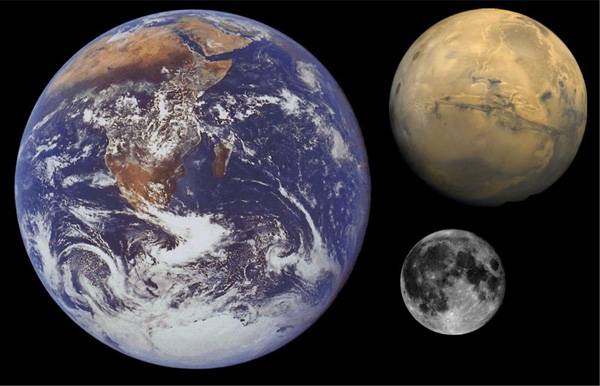
Image (Credit): Size of the Earth compared to Mars and the Moon. (hyperphysics.phy-astr.gsu.edu/)

Back in July 2019, the Pew Research Institute issued the results of earlier surveys about the US space program. Let’s look at the answers to six of the questions:

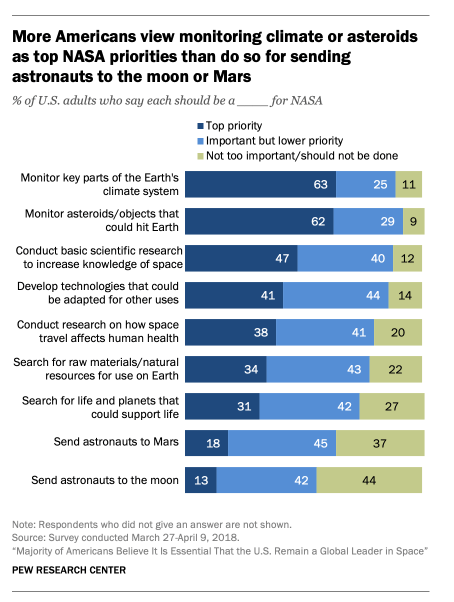
  1. Most Americans think sending astronauts to Mars or the Moon should be a lower priority for NASA – or say it should not be done at all (see graphic below).
  2. Americans see priorities other than a Moon or Mars landing as more pressing for NASA.
  3. Half of Americans think space travel will become routine during the next 50 years of space exploration.
  4. A majority of Americans say the U.S. must remain a global leader in space exploration, and that NASA’s continued involvement is essential.
  5. Americans have little confidence that private space companies will minimize space debris. 
  6. Americans are not enthusiastic about the idea of creating a military Space Force.

NASA may not be listening given that a trip back to the Moon was the lowest priority of Americans and yet is it the largest program currently in the U.S. space program, with a Moon satellite and trip to Mars as part of future plans. As far as minimizing space debris, the public seemed right on the mark regarding private space companies. If Elon Musk is any indicator, the commercial sector will not be deterred as it adds thousands of new satellites and related debris. And the ship has sailed on the Space Force question with the creation of the US Space Force in December 2019.

This would not be the first time Washington, DC goes down its own path regardless of public sentiment.

Image (Credit): Second question on the Pew survey on the space program. (Pew Research Institute)

In Case You Missed It: Farming on Mars

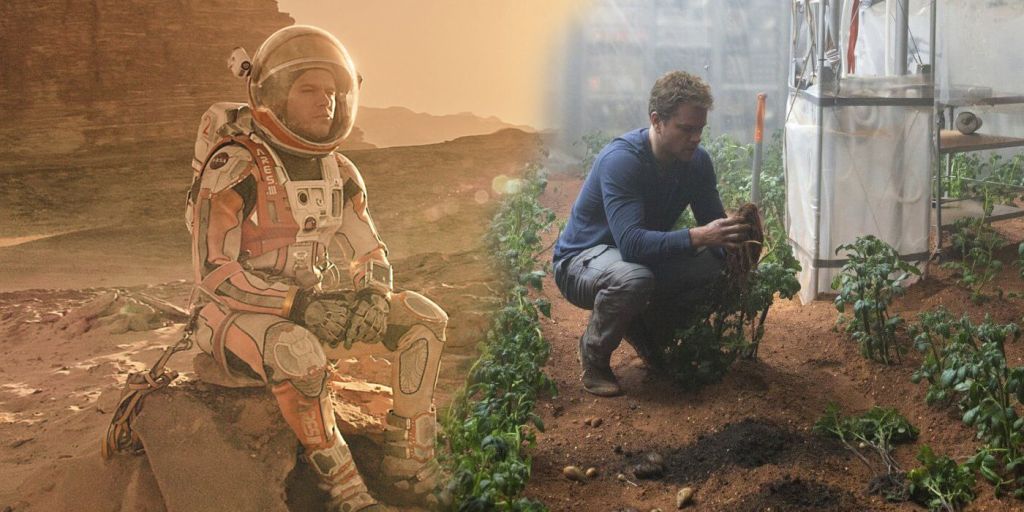
Image (Credit): Matt Damon on Mars in the film The Martian. (20th Century Fox)

Back in a November 2020 article, Science News discussed the difficulties of farming on Mars, noting it was not as easy as Matt Damon’s character made it seem in the film The Martian. In fact, toxins discovered in the Martian soil has proven that growing potatoes with a bit of man-made manure is not possible.

In the article, “Farming on Mars will be a Lot Harder Than ‘The Martian’ Made it Seem,” the author noted that researchers put together a variety of soil samples to match the surface of Mars and determined that the soil that most closely matched the Martian soil was unable to grow vegetation for any length of time. Once that soil was modified to include calcium perchlorate, which makes up about 2 percent of Martian soil, nothing could grow at all. In other words, Matt Damon would have starved if he only had a latrine to support him.

The researchers are testing other possible soil types using materials that can be found on Mars, so Martian potatoes (or at least legumes) may be possible. We will just need to send Mr. Damon back to Mars to test these new approaches.

Extra: The BBC’s Science Focus website posted a more hopeful article around the same time highlighting what can be grown on Mars, but it also outlined a number of problems that will impact Martian farming, including less sunlight, lower temperatures, thinner atmosphere, radiation, and extreme seasonal variations. We don’t always realize how good we have it back here on our home planet.