The Successful Launch of the NISAR Satellite

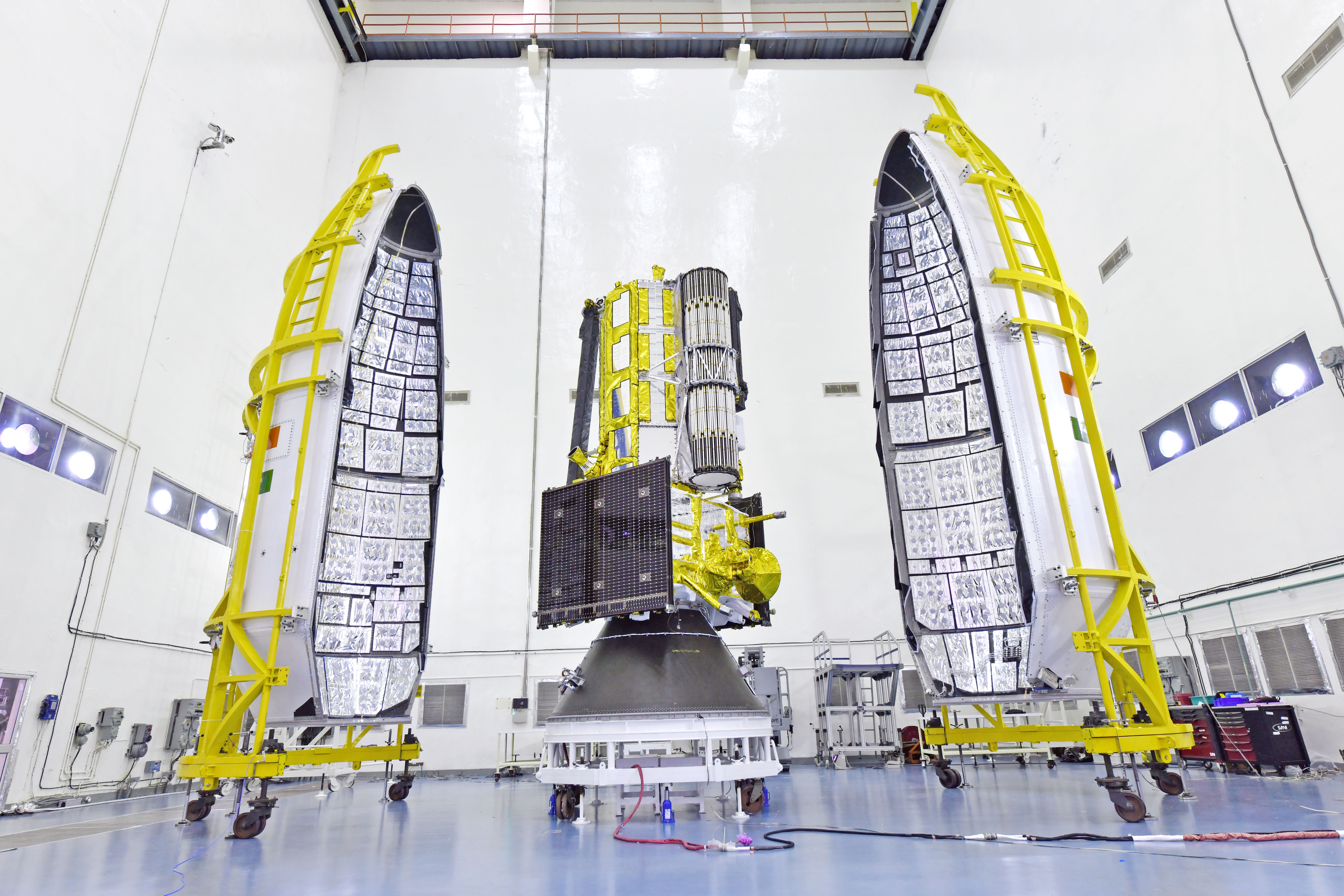
Image (Credit): The NISAR satellite and its casing. (ISRO)

Earlier today the NASA-ISRO Synthetic Aperture Radar (NISAR) satellite was successfully launched from India’s Satish Dhawan Space Centre. ISRO stands for the Indian Space Research Organisation, which is India’s national space agency.

This first of its kind mission between NASA and India puts into orbit the NISAR satellite that can see the Earth in a new way, detecting the smallest of changes in the Earth’s surface from its 464 mile high orbit, including ground deformation, ice sheet movement, and vegetation dynamics. The addition list of satellite capabilities on the ISRO site include:

…sea ice classification, ship detection, shoreline monitoring, storm characterization, changes in soil moisture, mapping & monitoring of surface water resources and disaster response.

NASA’s Earth Science division director, Karen St. Germain, stated:

Observations from NISAR will provide new knowledge and tangible benefits for communities both in the U.S. and around the world…This launch marks the beginning of a new way of seeing the surface of our planet so that we can understand and foresee natural disasters and other changes in our Earth system that affect lives and property.

This will be useful information given that we run the risk of reverse-terraforming our Earth.

2024 Space Hightlights – Missions

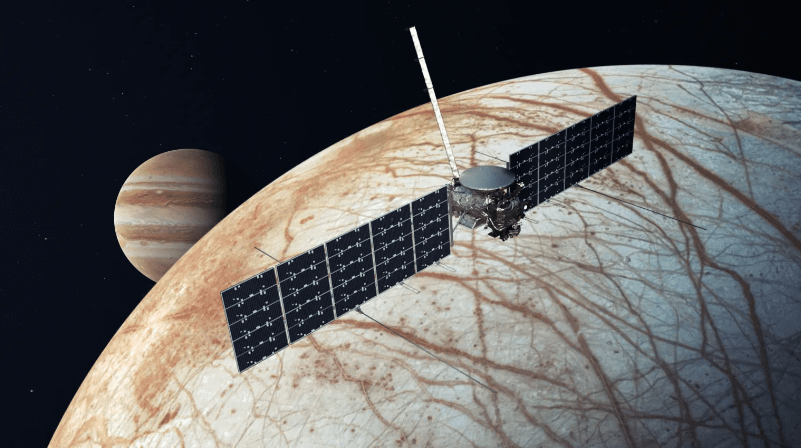
Image (Credit): An artist’s rendering of NASA’s Europa Clipper spacecraft over Europa. (NASA/JPL-Caltech)

Another list worth highlighting at year-end covers all of the space missions from 2024. For example, this list from Freethink, “the top 10 space stories of 2024,” includes the launch of the Europa Clipper, China’s Chang’e 6 round-trip to the Moon, and a successful commercial launch to the Moon (Odysseus lunar lander).

Here are some other lists of missions from 2024:

Note: The Awesome-Universe list of top missions looking back in 2024 include:

ISS May Soon Have an Indian Astronaut

Image (Credit): India’s Vikram lander on the Moon’s surface. (India Space Research Organization)

A U.S. official speaking in India promised that an Indian astronaut would be on the International Space Station (ISS) soon, maybe by year end. The Hindustan Times reports that the comments were made by U.S. Envoy Eric Garcetti at the US-India Commercial Space Conference: Unlocking Opportunities for US & Indian Space Startups.

Mr. Garcetti was quoted as stating:

NASA will soon provide advanced training to Indian astronauts, with the goal of mounting a joint effort to the International Space Station, hopefully, this year or shortly thereafter, which was one of the promises of our leaders’ visit together.

India already has a growing space program, including last year’s rover mission on the Moon, yet this is a smart move by the U.S. It is similar to Russian efforts to expand the list of visitors to the ISS.

Space Stories: DART Damage, India Plans for Orbiting Crew, and SLIM Awakes on the Moon

Image (Credit): Illustration of how DART’s impact altered the orbit of Dimorphos about Didymos. (https://dart.jhuapl.edu/)

Here are some recent stories of interest.

NDTV: NASA’s Mission Not Only Altered Asteroid’s Path, But Its Shape Too, Says New Study

A recent study suggests NASA’s DART mission, designed to test asteroid deflection methods, may have revealed more than planned. While successfully altering the target asteroid’s trajectory, scientists now believe the impact also significantly changed its shape, hinting at a surprising composition. Previously thought to be a solid rock, Dimorphos, the impacted asteroid, may actually be a loose collection of debris. This conclusion stems from the unexpected level of deformation observed after the collision. Unlike a typical crater, the impact appears to have caused a broader, flatter dent, resembling an M&M candy.

Reuters: India Announces Four-member Crew for ‘Gaganyaan’ Space Mission

India on Tuesday introduced four crew members for its maiden ‘Gaganyaan’ space voyage, as it aims to become the world’s fourth country to send a crewed mission into space just months after a historic landing on the south pole of the moon. Gaganyaan, or “sky craft” in Hindi, is the first mission of its kind for India and will cost about 90.23 billion rupees ($1.1 billion). It involves the launch of a habitable space capsule over the next year to an orbit of 400 km (250 miles) and its return via a landing in the Indian Ocean.

SpaceNews.com: “Japan’s SLIM Moon Lander Stages Unexpected Revival After Lunar Night

Japan’s space agency made contact with its SLIM moon lander Sunday, despite the spacecraft not being expected to function after lunar night. Contact with the Smart Lander for Investigating Moon (SLIM) spacecraft was reestablished on Sunday, Feb. 25, the Japan Aerospace Exploration Agency (JAXA) announced via its dedicated SLIM account on X, formerly known as Twitter, early Feb. 26.

Space Stories: A Volcanic Moon, an Indian X-ray Launch, and New Chinese Communication Satellites

Image (Credit): JunoCam image of Jupiter’s moon Io during its close encounter. The image was taken at an altitude of about 1,500 miles. (NASA JPL and Southwest Research Institute)

Here are some recent stories of interest.

Forbes: “A NASA Spacecraft Just Had A Close Encounter With A Volcanic Moon—See The Stunning First Image

NASA’s spacecraft Juno just had a super-close encounter with the most volcanic world in the solar system—but its stunning first image could be among its last after 56 orbits of Jupiter. On December 30, the bus-sized spacecraft—orbiting Jupiter since 2016—got very close to Io, the giant moon of Jupiter. It reached a mere 930 miles (1,500 kilometers) from the moon’s surface. However, the spacecraft’s camera has suffered radiation damage and may not last much longer.

Fox51 News: “India Kicks Off 2024 with X-ray Astronomy Satellite Launch

India began 2024 with the launch of an X-ray astronomy satellite aboard the sixtieth flight of its Polar Satellite Launch Vehicle. The PSLV C58 mission lifted off at 9:10 AM local time (03:40 UTC) on Monday, Jan. 1, from the Satish Dhawan Space Centre. XPoSat, or X-ray Polarimeter Satellite, carries a pair of instruments that will be used to study X-ray emissions from astronomical sources. After deploying XPoSat, PSLV C58’s upper stage has remained in orbit as the third flight of the PSLV Orbital Experimental Module (POEM-3), serving as a free-flying platform hosting a range of attached payloads.

SpaceNews: “First Satellite for Chinese G60 Megaconstellation Rolls Off Assembly Line

The first satellite for a second planned Chinese low Earth orbit communications megaconstellation has been produced in new facilities in Shanghai. A new generation flat-panel satellite rolled off the assembly at the G60 digital satellite production factory in Shanghai’s Songjiang District Tuesday, Dec. 27, according to Chinese press reports. The satellite is the first for the G60 Starlink low Earth orbit communications megaconstellation. An initial 108 satellites of a total of around 12,000 G60 Starlink satellites are to be launched across 2024.