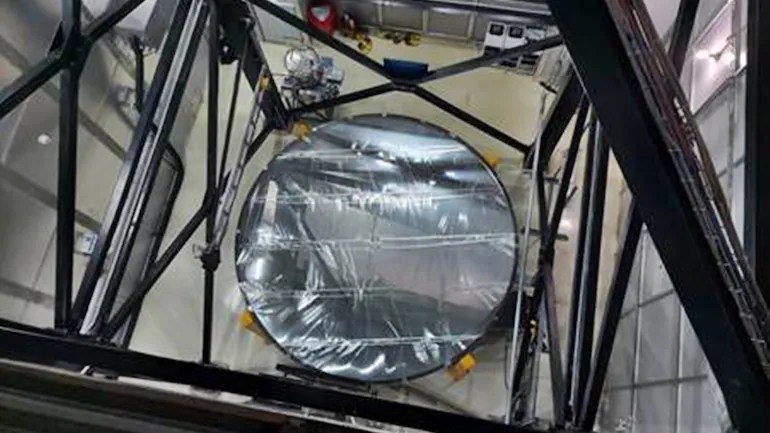
World’s First Liquid Mirror Telescope

Image (Credit): Top view of the International Liquid Mirror Telescope located at the Devasthal Observatory of the Aryabhatta Research Institute of Observational Sciences showing the liquid mercury mirror covered by a thin mylar film. (India Today)

An earlier post mentioned NASA’s plans for a liquid mirror telescope in space. Well, India now has one here on Earth.

The Indian Express reports that the liquid mirror telescope was designed and built at the Advanced Mechanical and Optical Systems Corporation and the Centre Spatial de Liege, Belgium. While funded by Canada and Belgium, it will be maintained and operated by India. The article states:

India’s first liquid-mirror telescope, which will observe asteroids, supernovae, space debris and all other celestial objects from an altitude of 2,450 metres in the Himalayas, has seen its first light. It has now entered the commissioning phase and will start scientific observations some time in October this year.

Liquid mirror telescopes have a few advantages, including being inexpensive to build and providing a very efficient way to image a large area of the sky. A disadvantage is that such a telescope must lie flat on Earth and can only observe what passes overhead (unlike space where the lack of gravity may offer other options). Even so, India expects to obtain plenty of information using this new form of telescope.

A new way to view the heavens. This may be the start of something pretty amazing.

Follow-up: Other Anti-Satellite Tests

Source: Indian Space Research Organization.

In an earlier posting, I pointed out that both China and Russia have left debris in orbit after conducting anti-satellite tests. To be fair, they are not alone. Back in March 2019, India also blew up one of its satellites with a ground-based missile, spreading debris and jeopardizing its own space program as well as that of others. Luckily, the explosion happened at a height that does not threaten the International Space Station or the majority of satellites in orbit. Moreover, most of the pieces of debris were expected to burn up and disappear quickly.

There have been other such anti-satellite missions as well, with the U.S, Russia, and China in the lead. So who started all of this, you may ask. The same Forbes story cited above makes it clear that the U.S. began this space arms race more than 60 years ago:

The U.S. tested its first anti-satellite missile in 1959, when the space lanes were mostly empty. Russia followed suit in the late 1960s and early 1970s, but after the end of the Cold War, space warfare mostly fell off the defense policy radar. 

The radar is active again given the continuing series of destructive anti-satellite missions in Earth’s orbit. You can add to this the various other secret spacecraft believed to already be in orbit to enhance each nation’s ability to kill another nation’s satellites. Things are pretty ugly on the ground these days, and the heavens above seem to be fair game as well.