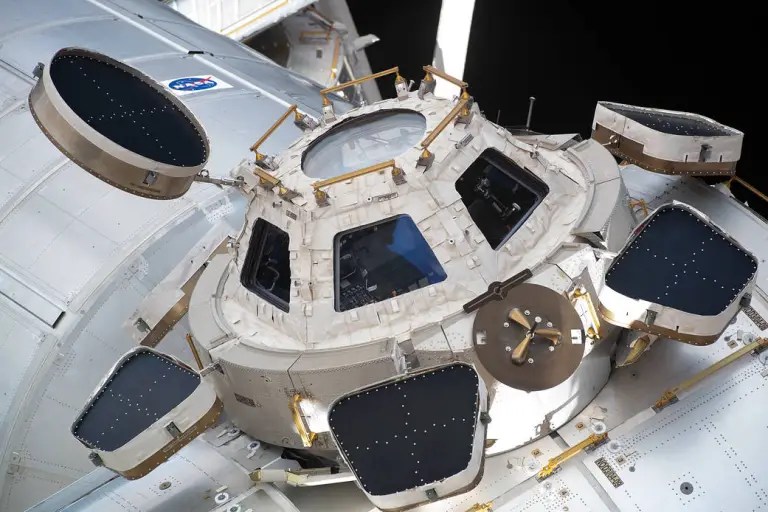
Image (Credit): Astronauts aboard the ISS showing the boots ready for Santa. (NASA)
Santa’s gift-giving territory is pretty wide, but it is not clear whether he will make it to the International Space Station (ISS). However, the astronauts are ready if he does show up. They have hung their space boots by the airlock with cheer.
For the complete ISS holiday message, play this video from NASA astronauts Mike Fincke, Zena Cardman, and Chris Williams, along with Japan Aerospace Exploration Agency (JAXA) astronaut Kimiya Yui. The message was recorded on December 17, 2025.
Image (Credit): A portion of the International Space Station’s Russian segment is pictured with docked spacecraft including Europe’s Automated Transfer Vehicle (ATV) and the Soyuz TMA-20 crew vehicle. (NASA)
Here are some recent space-related stories of interest.
For several years now, in discussing plans for its human spaceflight program beyond the International Space Station, Russian officials would proudly bring up the Russian Orbital Station, or ROS…Oleg Orlov, director of the Institute of Biomedical Problems of the Russian Academy of Sciences, said ROS will no longer be composed of entirely new modules. Rather, its core will be the Russian segment of the International Space Station. “The Scientific and Technical Council of Roscosmos supported this proposal and approved the deployment of a Russian orbital station as part of the Russian segment of the ISS,” Orlov reportedly said.
NASA is losing critical communication links with its Mars missions. After recently losing contact with the MAVEN spacecraft, the agency faces the impending loss of the Mars Odyssey orbiter, which has been circling the Red Planet for over two decades. As both orbiters approach the end of their operational lifespans, NASA will soon have to find ways to maintain data relay capabilities for its rovers and other missions on the fourth planet.
A key discovery from NASA’s Cassini mission in 2008 was that Saturn’s largest moon Titan may have a vast water ocean below its hydrocarbon-rich surface. But reanalysis of mission data suggests a more complicated picture: Titan’s interior is more likely composed of ice, with layers of slush and small pockets of warm water that form near its rocky core. Led by researchers at NASA’s Jet Propulsion Laboratory in Southern California and published in the journal Nature on Wednesday, the new study could have implications for scientists’ understanding of Titan and other icy moons throughout our solar system.
Image (Credit): Apollo Astronaut James B. Irwin, lunar module pilot, works at the Lunar Roving Vehicle during the first Apollo 15 lunar surface extravehicular activity (EVA) at the Hadley-Apennine landing site. (NASA)
Just as Jared Isaacman, NASA’s new Administrator, started to settle into his new post, the White House updated the nation’s space priorities.
Returning to the Moon by 2028, and the establishment of initial elements of a permanent lunar outpost by 2030;
Deploying of nuclear reactors on the Moon and in orbit, including a lunar surface reactor ready for launch by 2030; and
Spurring private sector innovation and investment by upgrading launch infrastructure and developing a commercial pathway to replace the International Space Station by 2030.
Adding nuclear reactors as its own goal seems a little odd since it could simply be wrapped into the first goal related to a permanent lunar outpost, but maybe this is just to kick regolith into the eyes of the Chinese who announced a similar intention.
Returning to the Moon by 2028 will certainly be a challenge, but luckily Administrator Isaacman is showing no favorites when it comes to meeting this goal. This week he made this statement about plans to return to the Moon:
I don’t think it was lost on either vendor that whichever lander was available first to ensure that America achieves its strategic objectives on the moon is the one we were going to go with.
His friend Elon Musk was certainly listening, but so far we have not heard him say that the new NASA Administrator has a 2 digit IQ. Of course, it has only been a few days, though the honeymoon is likely to be very short.
A NASA astronaut and two cosmonaut crewmates strapped into their Soyuz ferry ship and undocked from the International Space Station on Monday, heading for landing on the steppe of Kazakhstan to wrap up an eight-month mission…With Soyuz commander Sergey Ryzhikov strapped into the descent module’s center seat, flanked on his left by cosmonaut Alexey Zubritsky and on the right by NASA’s Jonny Kim, the Soyuz MS-27/73S spacecraft undocked from the lab at 8:41 p.m. ET.
The U.S. Senate Commerce Committee voted late on Monday to advance the nomination of billionaire private astronaut Jared Isaacman to lead NASA...Senate Commerce Committee Chair Ted Cruz said: “You are as committed to American supremacy in the final frontier as is this committee and the entire Senate. My hope is that you will be confirmed and in this role before the end of this year.” He also won support of the panel’s top Democrat, Senator Maria Cantwell.
Launched in 2004 to study gamma-ray bursts, Swift has been a crucial asset in understanding some of the most energetic events in the universe. However, over time, the spacecraft’s orbit has been decaying due to the drag from Earth’s atmosphere. As the orbit continues to degrade, the telescope is set to fall from its current 249-mile altitude unless action is taken. The problem is that Swift lacks onboard thrusters for orbit adjustments. With no replacement mission in the pipeline, NASA has turned to the private sector for a solution, and Katalyst is stepping in with a bold plan…For Neil Gehrels Swift Observatory, however, no astronauts will be involved. Instead, Katalyst will perform the rescue entirely remotely.
Russia’s only crewed-mission launch site has suffered major damage following a rocket launch on Thursday. The Baikonur Cosmodrome in Kazakhstan will be unable to host launches until repairs are made, according to the space agency Roscosmos, marking the first time in decades that Russia has lost the ability to send people to space. The launch of the Soyuz MS-28 spacecraft was otherwise successful, with none of the crew members injured.
Russian cosmonaut Oleg Artemyev has been removed from the prime crew of SpaceX’s Crew-12 mission to the International Space Station and replaced by fellow Roscosmos cosmonaut Andrey Fedyaev after sources alleged he photographed confidential SpaceX materials in California in violation of US export control rules, according to The Insider on December 2. The outlet reported that Trishkin also said NASA did not want the controversy around Artemyev to become public, while Artemyev was removed from training at SpaceX’s Hawthorne California, facility last week after allegedly photographing SpaceX engines and other internal materials on his phone and taking them off-site.
A new study published in PNAS from researchers at The University of Texas at Austin is the first to define large river drainage systems on the red planet. They outlined 16 large-scale river basins where life would have been most likely to thrive on the neighboring planet. “We’ve known for a long time that there were rivers on Mars,” said co-author Timothy A. Goudge, an assistant professor in the Department of Earth and Planetary Sciences at the UT Jackson School of Geosciences. “But we really didn’t know the extent to which the rivers were organized in large drainage systems at the global scale.”