More Satellite Pollution Impacting Ground Telescopes

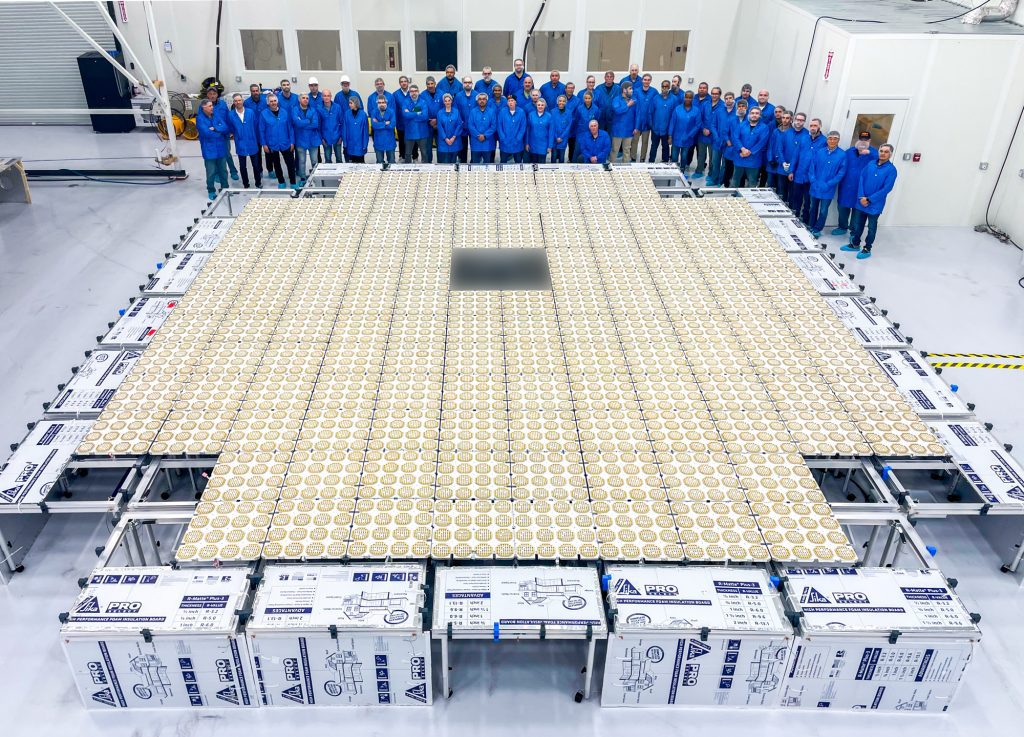
Image (Credit): AST SpaceMobile’s BlueWalker 3 test satellite, which is 693 square feet in size. (AST SpaceMobile)

It is called Bluewalker 3, and it may change the night sky for years to come. Launched in September 2022 aboard a SpaceX rocket, the Bluewalker3 prototype communications satellite from AST SpaceMobile spread its 693 square feet antenna array in low-Earth orbit. It has now become as bright as the brightest stars in the evening sky. And more of these satellites will soon be launched – 168 of them.

Needless to say, astronomers on the ground are perturbed. As noted in Science, astronomer Meredith Rawls of the University of Washington, Seattle, stated, “It’ll show up as a superbright streak in images and potentially saturate camera detectors at observatories.”

That is not to say it will be the brightest man-made object in the night sky. The International Space Station wins that battle being about 40 times brighter than the Bluewalker3, but there is only one ISS versus the 168 Bluewalker satellites being planned.

But wait, there’s more. The Bluewalker satellites direct-to-mobile cell service will also impact radio astronomers.

All of this has astronomers up in arms, leading to complaints against the use of such satellites. The Federal Communications Commission (FCC) is monitoring the matter.

As reported by NBC News, the FCC is also placing new restrictions on satellites at the end of their mission life, but this will not help with all of the new satellites going up today that will be crowding the night sky for many years to come.

If this continues, we may need that planned lunar base as a telescope collection point, at least until the objects orbiting the Moon become a problem.
Space Stories: Challenger Debris Located, Chinese Mars Engine, and Risky Trip to the Space Station

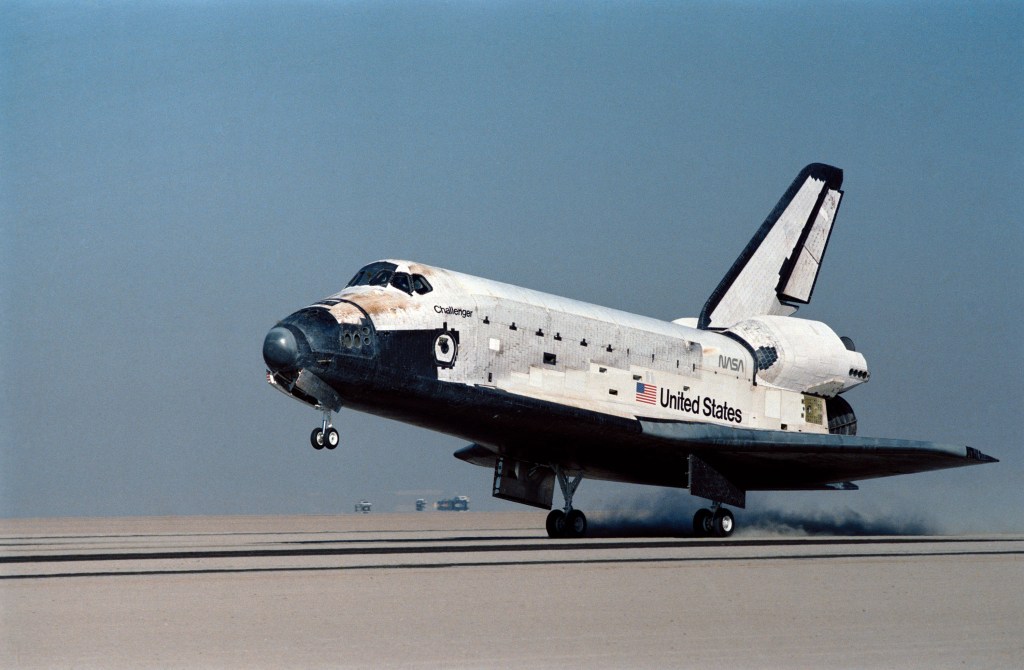
Image (Credit): Space shuttle Challenger landing at Edwards Air Force Base in California on Nov. 6, 1985. (NASA)

Here are some recent stories of interest.

NASA: “NASA Views Images, Confirms Discovery of Shuttle Challenger Artifact

NASA leaders recently viewed footage of an underwater dive off the East coast of Florida, and they confirm it depicts an artifact from the space shuttle Challenger. The artifact was discovered by a TV documentary crew seeking the wreckage of a World War II-era aircraft. Divers noticed a large humanmade object covered partially by sand on the seafloor. The proximity to the Florida Space Coast, along with the item’s modern construction and presence of 8-inch square tiles, led the documentary team to contact NASA.

Space.com:China Just Test-fired the Engine for its Huge New Moon and Mars Rocket

China has completed a first hot fire test of a fully-assembled powerful new engine that could power new launch vehicles and boost the country’s space capabilities. The full system test of the 500-ton-thrust, dual nozzle kerosene-liquid oxygen staged combustion cycle engine took place on Nov. 5, marking a milestone for the rocket engine. 

Phys.org:Cargo Ship Reaches Space Station Despite Jammed Solar Panel

A Northrop Grumman capsule delivered several tons of supplies to the International Space Station on Wednesday despite a jammed solar panel. The shipment arrived two days after launching from Virginia. Only one of the cargo ship’s two round solar panels opened following liftoff. Flight controllers tried in vain to open the stuck panel, but managed to draw enough power for the flight with just one.

Pic of the Week: A View of Peru

Image (Source): View of the Pacific from the ISS. More information provided below. (NASA)

This week’s image is from the International Space Station (ISS). It shows an October 1, 2022 photo of European Space Agency (ESA) astronaut Samantha Cristoforetti enjoying a view of the Pacific Ocean off the coast of Peru. She is sitting in the ISS’s so called “window to the world.” You can learn more about photo’s taken from this window via this short NASA video.

Gift Ideas: Lego Lunar Research Base

Image (Credit): Lego Lunar Research Base playset. (Lego)

While we await the Artemis III crew landing on the Moon and related lunar base, you might want to create your own mission with the Lego Lunar Research Base (shown above), which has “NASA-inspired” details. The playset has almost 800 Lego pieces, so you can build it yourself (to NASA specs, of course).

The playset comes with a “… lunar lander, VIPER rover and a domed accommodation module with laboratories, garage and air lock, plus 6 astronaut minifigures. I’m assuming the rocket that gets the astronaut minifigures to the Moon is sold separately.

And below is the Lego International Space Station is you are looking for something more traditional (and less expensive).

It’s great to see that Lego is allowing kids to build their own space missions at home.

Image (Credit): Lego International Space Station playset. (Lego)

Some of you may have played with Star Wars and Star Trek sets as kids, but at least these latest Lego set have a ring of credibility. Star Wars helped you destroy the galaxy, whereas Star Trek seemed more interest in exploration and at least had the veneer of Artemis CXXV.

I checked on whether Chinese and Russian kids with have their own space playsets and found the Russian Roscosmos Soyuz MS spacecraft (still a concept) and China’s Jiuquan Satellite Launch Center (made by a Lego copycat), both shown below.

Image (Credit): Lego version of the Russian Roscosmos Soyuz MS spacecraft. (Lego Ideas)
Image (Credit): Sembo Blocks version of the Jiuquan Satellite Launch Center. (http://www.whatsonweibo.com)

The Jiuquan Satellite Launch Center playset comes with a Long March 2F rocket and an authentic warning sign stating, “Those stealing secrets will be caught, once they’re caught they will be killed [decapitated].”

Maybe even reality is not always the best model for play.

Extra: You can find more Lego space models at the NASA gift shop.

Space Mission: Saudi Arabians to Visit the International Space Station

Image (Credit): Nighttime photograph of Riyadh, Saudi Arabia, taken in November 2012 by one of the Expedition 33 crew members aboard the ISS. (NASA)

While the Biden Administration appears to have its issues with Saudi Arabia, this is not stopping the visit of two Saudi Arabian private astronauts to the International Space Station (ISS). Space News reports that NASA has confirmed that a male and female astronaut from Saudi Arabia will travel to the ISS next spring aboard a SpaceX rocket as part of the privately-run Axiom Space. Plans for this mission were reported back in September.

This will be the second Axiom Space mission to the ISS. Other missions are being planned involving additional countries, including astronauts from Turkey, Hungary, Canada, and the United Arab Emirates. Mission participants need to be approved by a NASA-chaired panel that includes the countries involved with the ISS program.

Axiom Space will send four crew members to the ISS for 12 days. Here is the pitch for the second mission, or Ax-2:

The Axiom Mission 2 (Ax-2) astronauts are part of the latest class of space explorers and Axiom’s next crew to advance a new method of access to the International Space Station (ISS) and low-Earth orbit. Aboard the orbiting laboratory, the four-person, multinational crew will conduct extensive research, investigate novel technologies, and engage with audiences around the world as champions of science, technology, engineering, mathematics, and the arts. Their efforts will continue to lay the groundwork and establish key capabilities for the future Axiom Station, the world’s first commercial space station.  

You may recall that Saudi Arabia also signed onto the Artemis Accords over the summer. The Accords were established in 2020 to affirm each signatory’s commitment to sustainable space exploration “guided by a common set of principles that promote the beneficial use of space for all of humanity.”

All of this shows that space still remains a realm that does not need to be militarized or abused even if we have yet to figure out to resolve these issues here on Earth. Whatever problems with have with our neighbors, it’s good to see we are building some things together.

As noted earlier, even if the press on this Ax-2 mission demonstrates some unity, let’s just hope these “astronauts” are there for more than a joy ride. I am not convinced that space tourism is what we need. But given that Axiom Space is considering its own commercial space station, maybe there is some interest in real work in space by these parties.