Image (Credit): Launch of the SpaceX Falcon 9 rocket from Kennedy Space Center earlier today sending the latest ISS crew into orbit. (NASA)
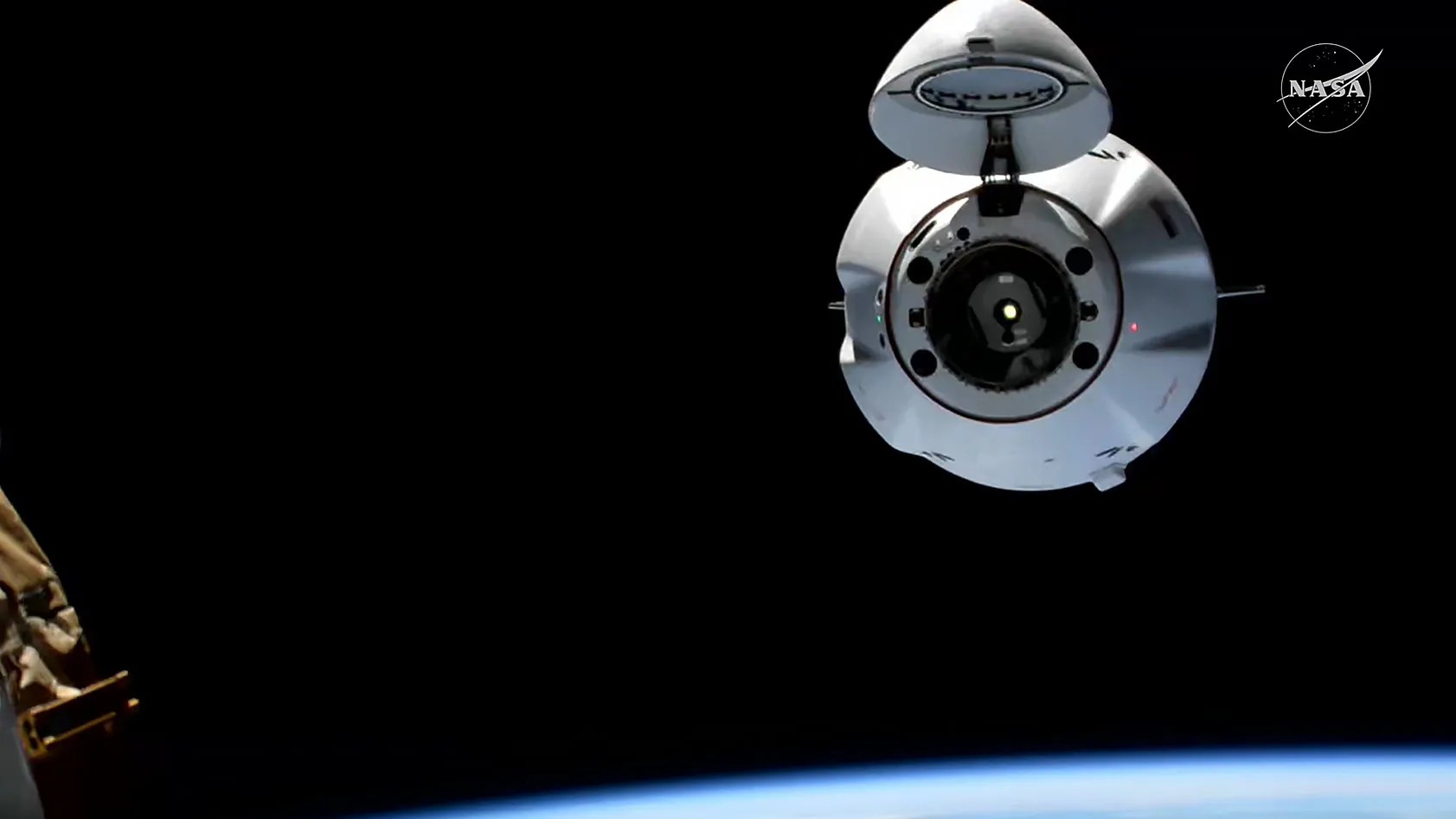
After a one day delay due to rain, a new crew is heading to the International Space Station (ISS). Earlier today, three astronauts and one cosmonaut departed from Launch Complex 39A at NASA’s Kennedy Space Center in Florida. The crew members are NASA astronauts Zena Cardman and Mike Fincke, Japan Aerospace Exploration Agency (JAXA) astronaut Kimiya Yui, and Roscosmos cosmonaut Oleg Platonov.
Acting NASA Administrator Sean Duffy issued a strange message about “bold leadership,” then praising the launch as though this was something new. He went on to link it to future Moon and Mars missions. I think he is a little too eager to be relevant here.
The bottom line is that this is a typical mission for NASA, showing that the agency can still get a rocket off the ground even as its employees are jumping out of windows (okay, walking out of doors). The Moon and Mars will need to wait for another day (and a new NASA administrator).
The new crew will rendezvous with the ISS early Saturday morning.
NASA and its partners have supported humans continuously living and working in space since November 2000. A truly global endeavor, the International Space Station has been visited by more than 280 people from 23 countries and a variety of international and commercial spacecraft. The unique microgravity laboratory has hosted more than 4,000 experiments from more than 5,000 researchers in more than 110 countries. The space station also is facilitating the growth of a commercial market in low Earth orbit for research, technology development, and crew and cargo transportation.
Using the Atacama Large Millimeter/submillimeter Array (ALMA), a team of astronomers led by Abubakar Fadul from the Max Planck Institute for Astronomy (MPIA) has discovered complex organic molecules – including the first tentative detection of ethylene glycol and glycolonitrile – in the protoplanetary disc of the outbursting protostar V883 Orionis. These compounds are considered precursors to the building blocks of life. Comparing different cosmic environments reveals that the abundance and complexity of such molecules increase from star-forming regions to fully evolved planetary systems. This suggests that the seeds of life are assembled in space and widespread.
Curtin University researchers have undertaken the world’s biggest survey of low frequency satellite radio emissions, finding Starlink satellites are significantly interfering with radio astronomy observations, potentially impacting discovery and research. Unintended signals from satellites – leaked from onboard electronics – can drown out the faint radio waves astronomers use to study the universe.
Image (Credit): The Starliner capsule outside the ISS in July 2024. (Boeing)
The good news is that Boeing’s CST-100 Starliner spacecraft will be returning to the International Space Station (ISS). However, the not so good news is that NASA may not trust it enough to carry humans – what it was designed to do – so it will probably be carrying cargo on its next mission instead.
Overall, this is good news in that Boeing is not throwing in the towel. We need a backup to SpaceX’s Dragon, and Boeing’s spacecraft is the best bet at the moment.
The Starliner is designed to carry seven crew members or a mix of crew and cargo. That means it can carry quite a bit of cargo if that is all it is doing on its next trip.
NASA is still sorting things out, but this cargo mission, if it occurs, is expected to take place next year.
Image (Credit): Launch of the Progress 92 cargo craft from the Baikonur Cosmodrome in Kazakhstan. (NASA)
Russia launched another cargo mission to the International Space Station ((SS) yesterday. A Soyuz rocket launched the Progress 92 spacecraft towards the space station at 3:32 pm ET from the Baikonur Cosmodrome in Kazakhstan. The spacecraft will dock with the ISS tomorrow afternoon, ensuring critical supplies are available to the crew member.
In the meantime, you can watch a Fourth of July message from NASA’s Expedition 73 Flight Engineers Anne McClain, Nichole Ayers, and Jonny Kim.
Image (Credit): NASA Astronaut Terry Virts. (NASA)
It is a disaster. You know, NASA’s budget overall is cut by a quarter — this is proposed — and the science budget is cut by half. Here in Houston — you know, I’m from Houston — it’s going to be a disaster. Thousands and thousands of people are going to lose their jobs. They’re already having profoundly negative effects on the space station’s science ability — the ability to do science on the International Space Station that I helped build and commanded. They are going to cut important space probes. I saw there’s going to be 41 space missions that are canceled. There’s over a dozen space missions that are currently in operation, things like New Horizons, Juno and others that are costing pennies on the dollar. These things are super cheap. We’ve already paid all the expense. We should just keep them operating, and they’re going to cancel those. It’s just a disaster.
-Statement by former NASA astronaut Terry Virts, who last week announced his plans to run the U.S. Senate in Texas to replace incumbent Senator John Cornyn. He made this statement after being asked “What is your take on the White House’s proposed NASA budget?” during an interview with Space.com.