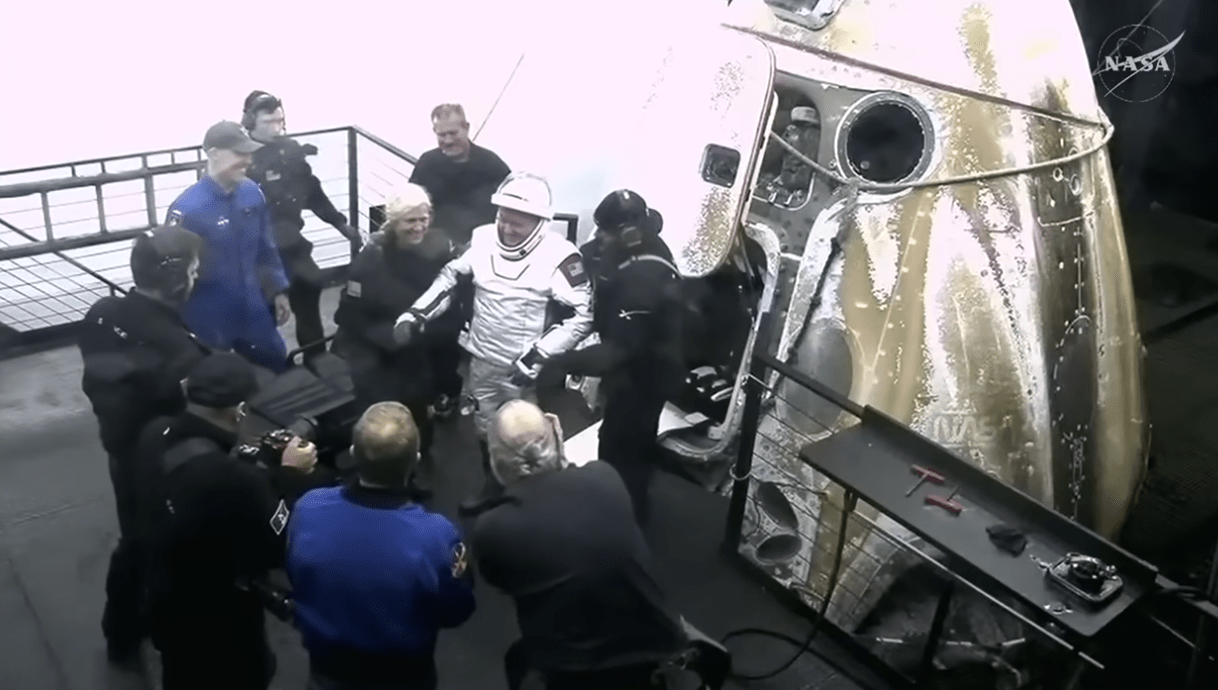
Image (Credit): NASA astronaut Mike Fincke as he exits the Dragon Endeavour spacecraft on January 15, 2025. (NASA)
This week’s image shows return of Crew-11 from the International Space Station (ISS). They landed safely on the morning of January 15th. As shown above, NASA astronaut Mike Fincke was the first member of the mission to exit the capsule. You can watch the entire video here.
Earlier this week, Mr. Fincke posted a few comments about the team’s early departure from the ISS:
What stands out most to me is how clearly NASA cares about its people. Flight surgeons, engineers, managers, and support teams came together quickly and professionally to chart the best path forward. The ground teams—across mission control centers and partner organizations around the world—have been extraordinary. We’re proud of the joint work we’ve done and the camaraderie we’ve shared, including some great songs and more than a few dad jokes.
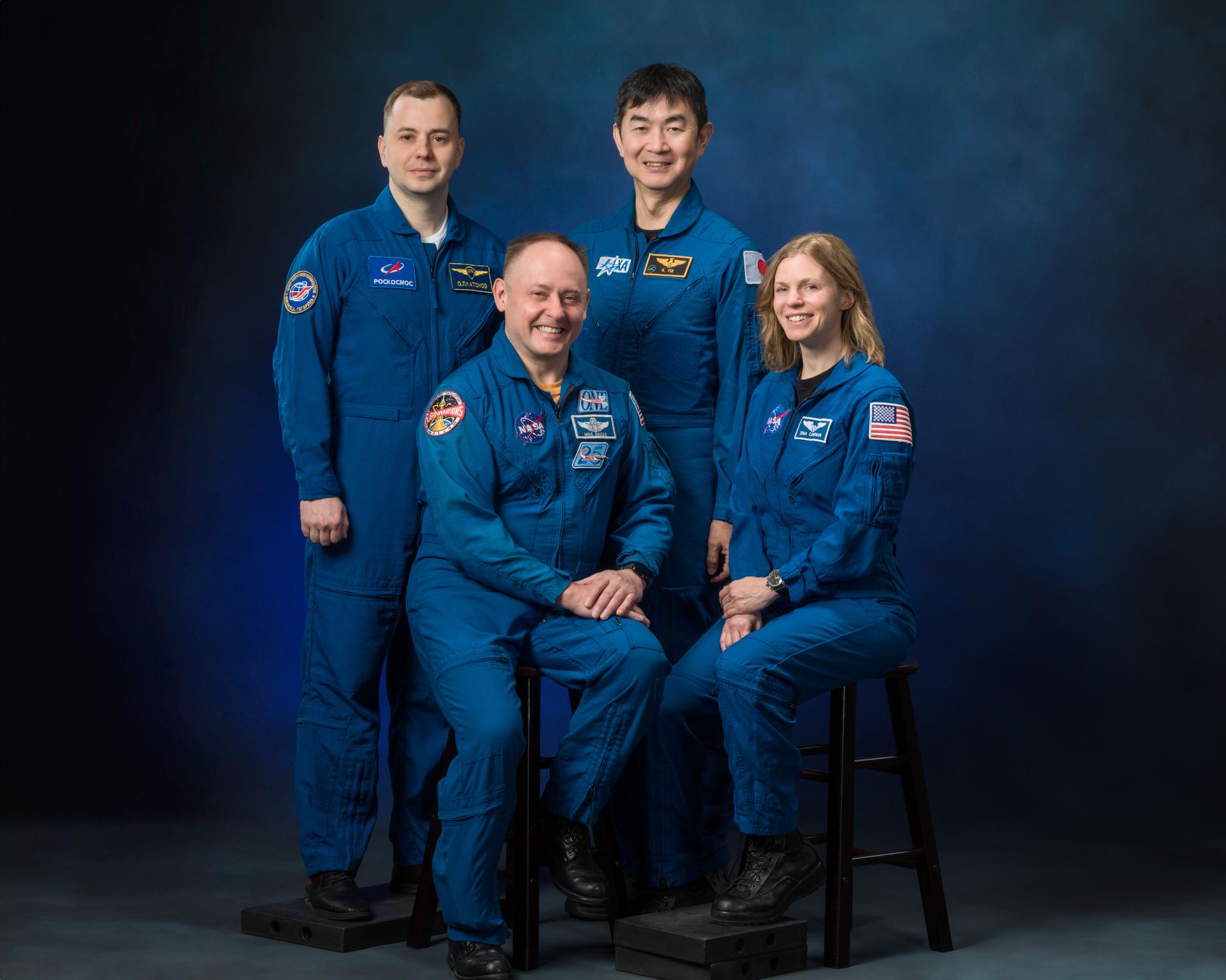
Image (Credit): The official portrait of the four members of NASA’s SpaceX Crew-11 mission aboard the ISS. From left, are Roscosmos cosmonaut Oleg Platonov, NASA astronaut Mike Fincke, Japan Aerospace Exploration Agency (JAXA) astronaut, and NASA astronaut Zena Cardman. (NASA)
The Crew-11 mission departed the International Space Station (ISS) earlier today for their trip home. The four astronauts that are part of this medical evacuation – NASA astronauts Zena Cardman and Mike Fincke, Japan Aerospace Exploration Agency (JAXA) astronaut Kimiya Yui, and Roscosmos cosmonaut Oleg Platonov – are expected to splash down off the coast of California early Thursday morning.
3 p.m. – Hatch closure coverage begins on NASA+, Amazon Prime, and YouTube.
3:30 p.m. – Hatch closing
5 p.m. – Undocking coverage begins on NASA+, Amazon Prime, and YouTube.
5:20 p.m. – Undocking
Following the conclusion of undocking coverage, NASA will distribute audio-only communications between Crew-11, the space station, and flight controllers during Dragon’s transit away from the orbital complex.
Thursday, Jan. 15
2:15 a.m. – Return coverage begins on NASA+, Amazon Prime, and YouTube.
2:51 a.m. – Deorbit burn
3:41 a.m. – Splashdown
5:45 a.m. – NASA Administrator Jared Isaacman will lead a Return to Earth news conference streaming live on NASA+, Amazon Prime, and the agency’s YouTube channel.
The remaining member of Expedition 74 will be commanded by Roscosmos cosmonaut Sergey Kud-Sverchkov, who will remain on board with Flight Engineers Sergei Mikaev (Roscosmos) and Chris Williams (NASA). The Crew-12 mission may be moved up to cover the gap caused by this early departure.
NASA is keeping quite about the underlying medical conditions, yet something will probably need to be said sooner rather than later. Maybe the news conference tomorrow will give us a few more details.
With all the talk about the current set of astronauts returning early from the International Space Station (ISS) due to medical issues as well as last year’s issue with Chinese astronauts stuck on their station, it is hard to keep track of who is in space these days.
Hence, you may want to stay up to date on those floating in space by using this website – https://whoisinspace.com/. As of today, there are 10 humans in space – 6 on the ISS (3 from the US, 3 from Russia, and 1 from Japan) and 3 on China’s Tiangong space station.
As shown in the image above, the site also gives some stats on the crews, such as the mission that brought them to the station as well as each person total amount of time in space.
Just think of it as a Who’s Who listing for low Earth orbit.
“NASA is postponing the Thursday, Jan. 8, spacewalk outside the International Space Station. The agency is monitoring a medical concern with a crew member that arose Wednesday afternoon aboard the orbital complex. Due to medical privacy, it is not appropriate for NASA to share more details about the crew member. The situation is stable. NASA will share additional details, including a new date for the upcoming spacewalk, later.”
–Statement on NASA’s website regarding a spacewalk that was to take place tomorrow outside the International Space Station (ISS). The planned spacewalk, which was to fix a solar array and last for six and a half hours, involved astronauts Mike Fincke and Zena Cardman. It would have been Cardman’s first and Fincke’s tenth spacewalk.
Update: The four astronauts that are part of Crew-11 on the ISS will be returning to Earth earlier than planned because of health issues. According to NBC News, the matter relates to a single astronaut with a medical condition who is currently in stable condition.
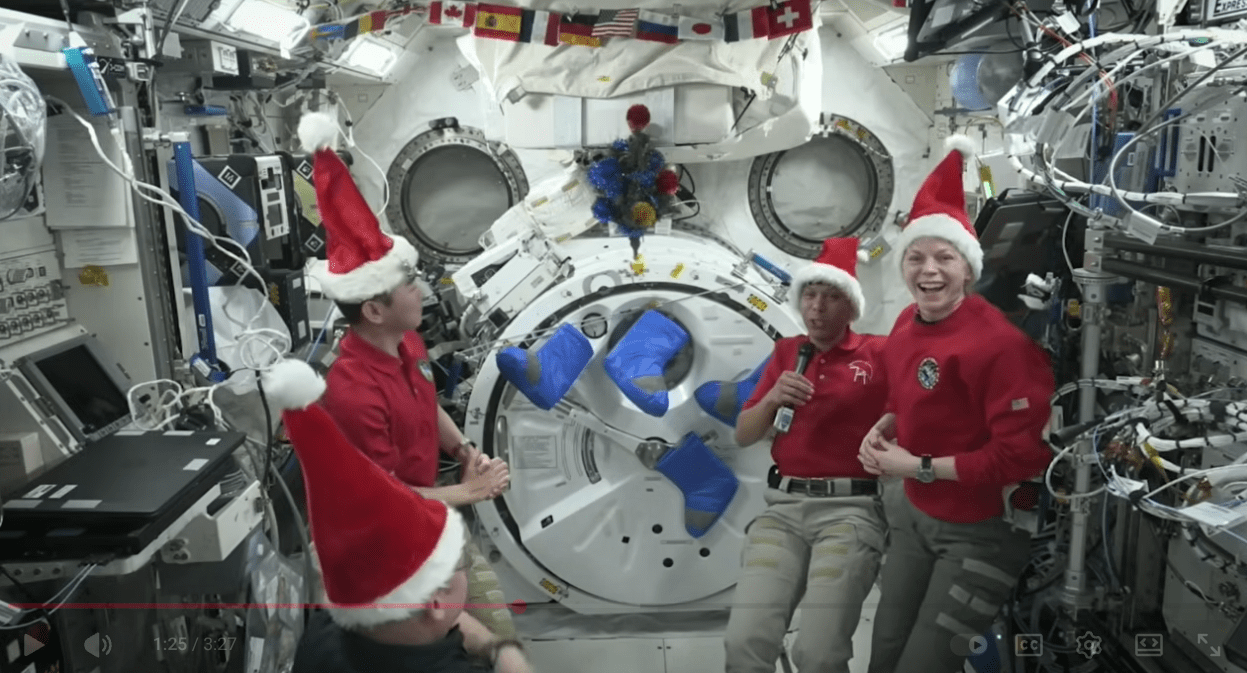
Image (Credit): Astronauts aboard the ISS showing the boots ready for Santa. (NASA)
Santa’s gift-giving territory is pretty wide, but it is not clear whether he will make it to the International Space Station (ISS). However, the astronauts are ready if he does show up. They have hung their space boots by the airlock with cheer.
For the complete ISS holiday message, play this video from NASA astronauts Mike Fincke, Zena Cardman, and Chris Williams, along with Japan Aerospace Exploration Agency (JAXA) astronaut Kimiya Yui. The message was recorded on December 17, 2025.