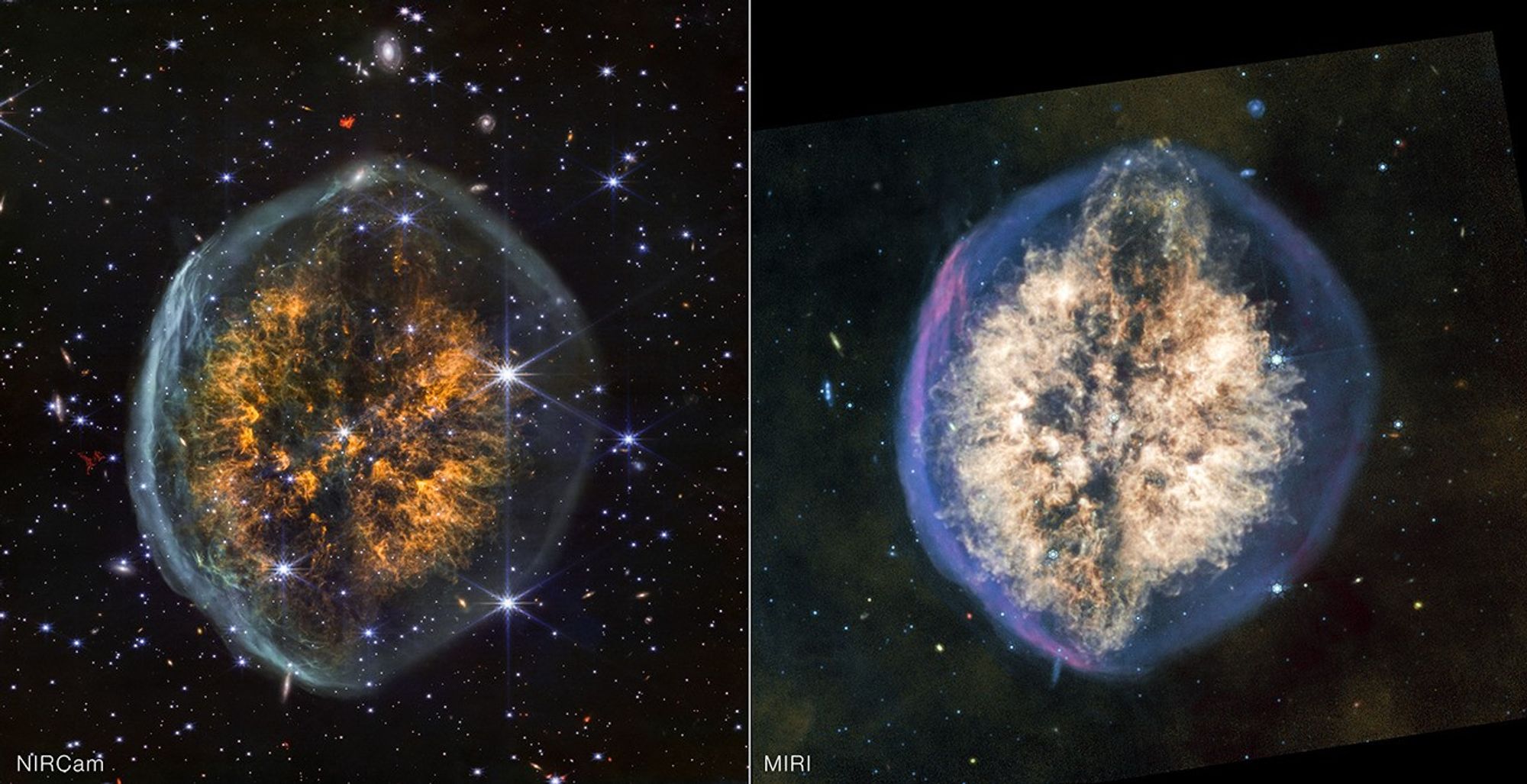
Image (Credit): Dust spirals surrounding Wolf-Rayet Apep, as captured by the JWST. (NASA, ESA, CSA, STScI, Y. Han (Caltech), R. White (Macquarie University), A. Pagan (STScI))
This week’s embryonic image comes from the James Webb Space Telescope (JWST). It shows what NASA calls “four serpentine spirals of dust” around a pair of Wolf-Rayet stars. Such stars are rare, with NASA estimating that only a thousand can be found in our galaxy consisting of hundreds of billions of stars. And binary Wolf-Rayet stars are even rarer.
NASA notes that the JWST, or Webb, provided a much better image of the spiraling dust:
Observations taken prior to Webb only detected one shell, and while the existence of outer shells was hypothesized, searches using ground-based telescopes were unable to uncover any. These shells were emitted over the last 700 years by two aging Wolf-Rayet stars in a system known as Apep, a nod to the Egyptian god of chaos...Webb also confirmed that there are three stars gravitationally bound to one another in this system. The dust ejected by the two Wolf-Rayet stars is “slashed” by a third star, a massive supergiant, which carves holes into each expanding cloud of dust from its wider orbit. (All three stars are shown as a single bright point of light in Webb’s image.)
The evolution and structure of sub-Neptunes may be strongly influenced by interactions between the outer gaseous envelope of the planet and a surface magma ocean. However, given the wide variety of permissible interior structures of these planets, it is unclear whether conditions at the envelope–mantle boundary will always permit a molten silicate layer or whether some sub-Neptunes might instead host a solid silicate surface. In this work, we use internal structure modeling to perform an extensive exploration of surface conditions within the sub-Neptune population across a range of bulk and atmospheric parameters. We find that a significant portion of the population may lack present-day magma oceans. In particular, planets with a high atmospheric mean molecular weight and large envelope mass fraction are likely to instead have a solid silicate surface, since the pressure at the envelope–mantle boundary is high enough that the silicates will be in solid postperovskite phase. This result is particularly relevant given recent inferences of high-mean molecular weight atmospheres from JWST observations of several sub-Neptunes. We apply this approach to a number of sub-Neptunes with existing or upcoming JWST observations and find that in almost all cases, a range of solutions exist that do not possess a present-day magma ocean. Our analysis provides critical context for interpreting sub-Neptunes and their atmospheres.
Citation: Bodie Breza et al. Not all sub-Neptune exoplanets have magma oceans. ApJL993 L46 (2025).
Image (Credit): The Pismis 24 star cluster as captured by the JWST. (NASA, ESA, CSA, and STScI, A. Pagan (STScI))
This week’s amazingly vibrant image was captured by the James Webb Space Telescope (JWST). It shows a young star cluster, called Pismis 24, which is approximately 5,500 light-years away.
What appears to be a craggy, starlit mountaintop kissed by wispy clouds is actually a cosmic dust-scape being eaten away by the blistering winds and radiation of nearby, massive, infant stars.Home to a vibrant stellar nursery and one of the closest sites of massive star birth, Pismis 24 provides rare insight into large and massive stars. This region is one of the best places to explore the properties of hot young stars and how they evolve.
Image (Credit): NASA’s JWST poster showing the Cat’s Paw Nebula. (NASA, ESA, CSA, STScI; Designer: Elizabeth Wheatley (STScI))
This week’s image highlights a NASA poster that you can download (in a variety of versions). It shows the Cat’s Paw Nebula (NGC 6334) as captured by the James Webb Space Telescope (JWST).
Here is a short summary of what you are seeing from NASA:
Located approximately 4,000 light-years away in the constellation Scorpius, the Cat’s Paw Nebula offers scientists the opportunity to study the turbulent cloud-to-star process in great detail. Webb’s observation of the nebula in near-infrared light builds upon previous studies by NASA’s Hubble and retired Spitzer Space Telescope in visible- and infrared-light, respectively.
With its sharp resolution, Webb shows never-before-seen structural details and features: Massive young stars are carving away at nearby gas and dust, while their bright starlight is producing a bright nebulous glow represented in blue. It’s a temporary scene where the disruptive young stars, with their relatively short lives and luminosity, have a brief but important role in the region’s larger story. As a consequence of these massive stars’ lively behavior, the local star formation process will eventually come to a stop.
For more details and videos, visits the NASA page on the Cat’s Paw Nebula, which helps to commemorate the third anniversary of the JWST.
This time last year I highlighted a paper that discussed a possible exomoon circling an exoplanet called WASP-49Ab located about 635 light-years away . It was spotted by the European Southern Observatory’s Very Large Telescope in Chile.
Well, now the James Webb Space Telescope (JWST) has provided data related to another possible exomoon orbiting a hot Jupiter-like exoplanet called WASP-39b. It is located about 700 million light-years away.
In a Scientific American article titled “Have Astronomers Finally Found an Exomoon?” we learn that a paper is being released shortly outlining the argument for this potential “hypervolcanic exomoon.” This presumed IO-like exomoon is being cooked by the parent sun.
Recent infrared spectroscopy from the James Webb Space Telescope (JWST) has spurred analyses of common volcanic gases such as carbon dioxide (CO2), sulfur dioxide (SO2), alongside alkali metals sodium (Na I) and potassium (K I) surrounding the hot Saturn WASP-39 b. We report more than an order-of-magnitude of variability in the density of neutral Na, K, and SO2 between ground-based measurements and JWST, at distinct epochs, hinting at exogenic physical processes similar to those sourcing Io’s extended atmosphere and torus. Tidally-heated volcanic satellite simulations sputtering gas into a cloud or toroid orbiting the planet, are able to reproduce the probed line-of-sight column density variations. The estimated SO2 flux is consistent with tidal gravitation predictions, with a Na/SO2 ratio far smaller than Io’s. Although stable satellite orbits at this system are known to be < 15.3 hours, several high-resolution alkali Doppler shift observations are required to constrain a putative orbit. Due to the Roche limit interior to the planetary photosphere at ~ 8 hours, atmosphere-exosphere interactions are expected to be especially important at this system.
It is a dense summary, but also a hopeful finding that may lead to more focused searches for exomoons.
The addition of exomoons to the list of new discoveries will only increase the chances that some form of life can be found among he many solar systems we can study. Interestingly enough, we are still probing our own solar system’s moons with the same hope.