Space Stories: Oceans on Ariel, Dinosaur-Killer Asteroid from Beyond Jupiter, and the Launch of the Polaris Dawn Mission

Image (Credit): Uranus and distant galaxies as seen by the James Webb Space Telescope. (NASA, ESA, CSA, STScI)

Here are some recent stories of interest.

ForbesNASA’s Webb Telescope Finds Evidence For An Ocean World Around Uranus

New observations by the James Webb Space Telescope suggest that an icy moon around Uranus may have an underground liquid ocean. Ariel is one of 27 moons around Uranus, the seventh planet from the sun and the third largest planet in the solar system. It’s one of four moons that scientists have long been interested in as part of a search for water across the solar system, the others being Umbriel, Titania and Oberon.

Nature: Dinosaur-killing Chicxulub Asteroid Formed in Solar System’s Outer Reaches

The object that smashed into Earth and kick-started the extinction that wiped out almost all dinosaurs 66 million years ago was an asteroid that originally formed beyond the orbit of Jupiter, according to geochemical evidence from the impact site in Chicxulub, Mexico. The findings, published on 15 August in Science, suggest that the mass extinction was the result of a train of events that began during the birth of the Solar System. Scientists had long suspected that the Chicxulub impactor, as it is known, was an asteroid from the outer Solar System, and these observations bolster the case.

Space DailyPolaris Dawn Mission Set for August 26 to Advance Commercial Space Exploration

The Polaris Program, focused on testing and developing new spaceflight technology, is preparing to launch its first mission, Polaris Dawn, aboard SpaceX’s Falcon 9 rocket on Monday, August 26, 2024. This mission marks a significant step forward in commercial space exploration. Key objectives include testing a next-generation spacesuit during the first commercial spacewalk, attempting to achieve the highest altitude for a human spaceflight since the Apollo missions, and evaluating a new communication system through Starlink.

Pic of the Week: View of a Nearby Exoplanet

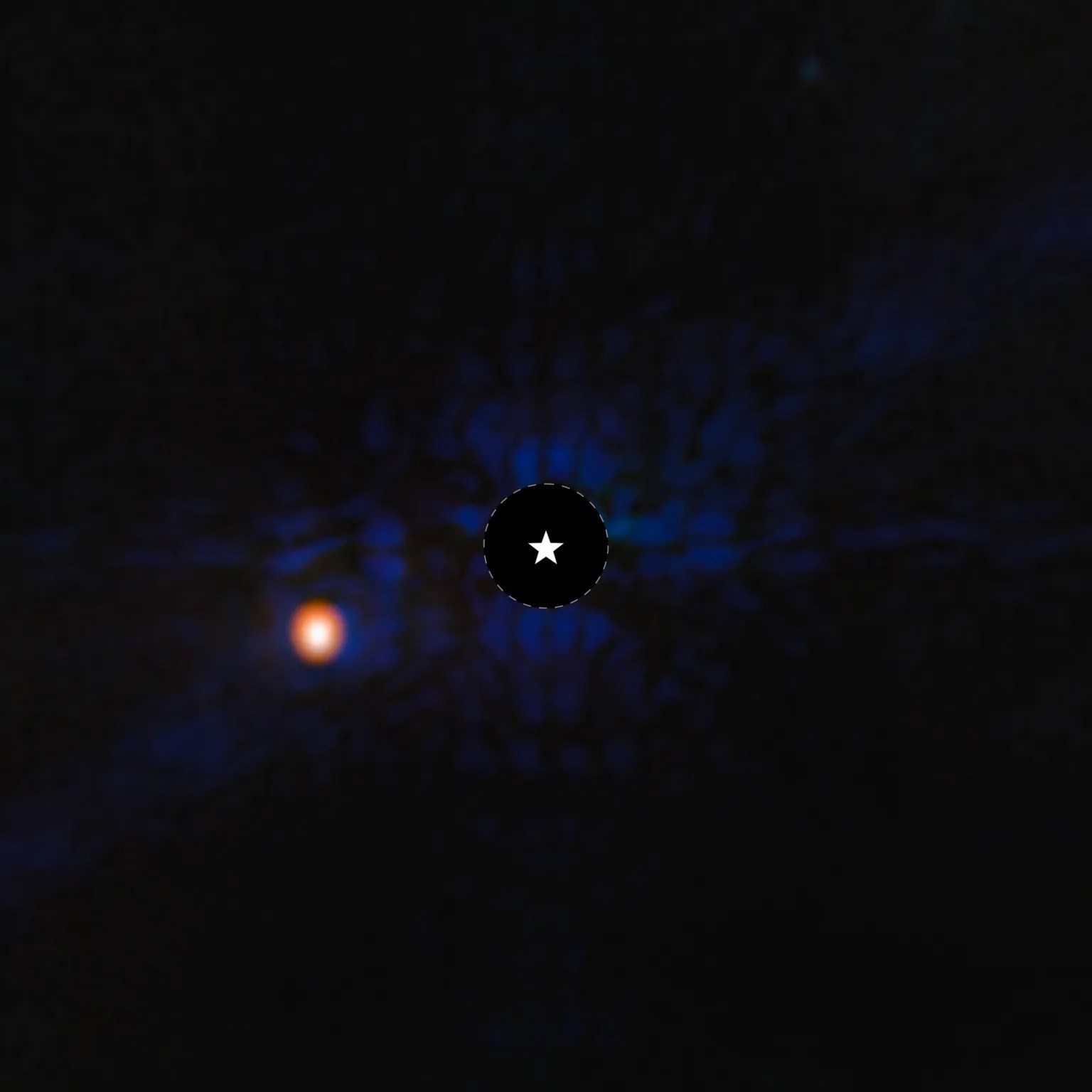
Image (Credit): JWST’s view of exoplanet Epsilon Indi Ab. (NASA, ESA, CSA, STScI, E. Matthews (Max Planck Institute for Astronomy))

This week’s image looks dark and simple, and yet it is an amazing sight provided by NASA’s James Webb Space Telescope (JWST). It shows a directly imaged exoplanets that resides about 12 light-years from us. It is called Epsilon Indi Ab and is several times the mass of Jupiter.

Here is an explanation from NASA about what you are seeing in the image:

This image of the gas-giant exoplanet Epsilon Indi Ab was taken with the on NASA’s James Webb Space Telescope’s MIRI (Mid-Infrared Instrument). A star symbol marks the location of the host star Epsilon Indi A, whose light has been blocked by the coronagraph, resulting in the dark circle marked with a dashed white line. Epsilon Indi Ab is one of the coldest exoplanets ever directly imaged. Light at 10.6 microns was assigned the color blue, while light at 15.5 microns was assigned the color orange. MIRI did not resolve the planet, which is a point source.

Space Stories: Good Time to View the Heavens, Nearby Super-Jupiter, and Spotting Deepfakes

Credit: Vikash Kr Singh from Pixabay

Here are some recent stories of interest.

Live ScienceWhy the 1st Week of August is the Best Time to See ‘Shooting Stars’ and the Milky Way — No Telescope Required

The arrival of August means two things for stargazers — “shooting stars” and the Milky Way. In 2024, you can see both at the same time if you know exactly where and when to look…This month, there’s a new moon on Aug. 4, which will keep the post-sunset sky dark until about Aug. 8. That makes the first week of August ideal for spotting “shooting stars” — while you also look for the Milky Way. True darkness won’t come until midnight for most of the Northern Hemisphere, but look to the southeast after dark, and you’ll have a chance of seeing the Sagittarius arm of the Milky Way arching across the night sky.

Max Planck Institute for AstronomyWebb Images Nearest Super-Jupiter, Opening a New Window to Exoplanet Research

Using the James Webb Space Telescope (JWST), an MPIA-led team of astronomers imaged a new exoplanet that orbits a star in the nearby triple system Epsilon Indi. The planet is a cold super-Jupiter exhibiting a temperature of around 0 degrees Celsius and a wide orbit comparable to that of Neptune around the Sun. This measurement was only possible thanks to JWST’s unprecedented imaging capabilities in the thermal infrared. It exemplifies the potential of finding many more such planets similar to Jupiter in mass, temperature, and orbit. Studying them will improve our knowledge of how gas giants form and evolve in time.

NatureAI ‘Deepfake’ Faces Detected Using Astronomy Methods

Researchers are turning to techniques from astronomy to help spot computer-generated ‘deepfake’ images — which can look identical to genuine photographs at first glance. By analysing images of faces using methods that are usually used to survey distant galaxies, astronomers can measure how a person’s eyes reflect light, which can reveal telltale signs of image manipulation.

Pic of the Week: Stellar Penguin and Egg

Image (Credit): The Penguin and Egg galaxies, known jointly as Arp 142. (NASA, ESA, CSA, STScI)

This week’s fun image comes from the James Webb Space Telescope. Called the Penguin and the Egg, these two galaxies of similar mass are locked together.

Here is the story of the two galaxies from NASA:

Before their first approach, the Penguin held the shape of a spiral. Today, its galactic center gleams like an eye, its unwound arms now shaping a beak, head, backbone, and fanned-out tail.

Like all spiral galaxies, the Penguin is still very rich in gas and dust. The galaxies’ “dance” gravitationally pulled on the Penguin’s thinner areas of gas and dust, causing them to crash in waves and form stars. Look for those areas in two places: what looks like a fish in its “beak” and the “feathers” in its “tail.”

Surrounding these newer stars is smoke-like material that includes carbon-containing molecules, known as polycyclic aromatic hydrocarbons, which Webb is exceptional at detecting. Dust, seen as fainter, deeper orange arcs also swoops from its beak to tail feathers.

In contrast, the Egg’s compact shape remains largely unchanged. As an elliptical galaxy, it is filled with aging stars, and has a lot less gas and dust that can be pulled away to form new stars. If both were spiral galaxies, each would end the first “twist” with new star formation and twirling curls, known as tidal tails.

Another reason for the Egg’s undisturbed appearance: These galaxies have approximately the same mass or heft, which is why the smaller-looking elliptical wasn’t consumed or distorted by the Penguin.

It is estimated that the Penguin and the Egg are about 100,000 light-years apart — quite close in astronomical terms. For context, the Milky Way galaxy and our nearest neighbor, the Andromeda Galaxy, are about 2.5 million light-years apart. They too will interact, but not for about 4 billion years.

Space Stories: Launch of GOES-U Satellite, Jupiter’s Surprising Atmosphere, and the Role of Black Holes in Dark Matter

Image (Credit): June 25, 2024 launch of NASA’s GOES-U satellite. (SpaceX)

Here are some recent stories of interest.

America Space: Falcon Heavy Launches, GOES-U Heads for Geostationary Orbit

SpaceX successfully launched its first Falcon Heavy of the year on Wednesday evening, the triple-barreled booster lifting the 11,000-pound (5,000-kilogram) Geostationary Operational Environmental Satellite (GOES-U) almost to Geostationary Earth Orbit (GEO) on behalf of the National Oceanic and Atmospheric Administration (NOAA). The Heavy—flying for the first time since November 2022 with a brand-new center core and pair of side-mounted strap-on boosters—went airborne from historic Pad 39A at Florida’s Kennedy Space Center (KSC) at 5:26 p.m. EDT, ten minutes after the opening of a two-hour “launch window”.

European Space Agency: Jupiter’s Upper Atmosphere Surprises Astronomers

The Great Red Spot of Jupiter was observed by Webb’s Near-InfraRed Spectrograph (NIRSpec) in July 2022, using the instrument’s Integral Field Unit capabilities. The team’s Early Release Science observations sought to investigate if this region was in fact dull, and the region above the iconic Great Red Spot was targeted for Webb’s observations. The team was surprised to discover that the upper atmosphere hosts a variety of intricate structures, including dark arcs and bright spots, across the entire field of view. “We thought this region, perhaps naively, would be really boring,” shared team leader Henrik Melin of the University of Leicester in the United Kingdom. “It is in fact just as interesting as the northern lights, if not more so. Jupiter never ceases to surprise.”

University of Warsaw: Is Dark Matter Made of Black Holes?

Gravitational wave detectors, LIGO and Virgo, have detected a population of massive black holes whose origin is one of the biggest mysteries in modern astronomy. According to one hypothesis, these objects may have formed in the very early Universe and may compose dark matter, a mysterious substance filling the Universe. A team of scientists from the OGLE (Optical Gravitational Lensing Experiment) survey from the Astronomical Observatory of the University of Warsaw have announced the results of nearly 20-year-long observations indicating that such massive black holes may comprise at most a few percent of dark matter. Another explanation, therefore, is needed for gravitational wave sources. The results of the study were published in two articles, in Nature and the Astrophysical Journal Supplement Series.