Video: Cool Worlds Labs Emphasizes the Need for Greater NASA Funding

Image (Credit): A graphic explaining the various instruments on the Chandra X-ray Observatory. (NASA)

Even with a good space week in hand, we still need to keep an eye on NASA’s budget to maintain a robust set of programs to explore the cosmos. A recent Youtube video by Cool Worlds Labs, “NASA’s in Trouble,” highlights those budgetary issues and focuses on what individuals can do as well, such as visiting https://www.savechandra.org/ and asking Congress to restore funds cut from the Chandra X-ray Observatory.

Professor David Kipping makes it clear he is not going to remain silent while these cuts are being considered. He and his team demonstrate their love for astronomy in every video and podcast, making them great ambassadors in this debate for continued NASA funding.

The video is forthright about the internal issues creating budgetary issues. For example, the considerable cost overruns and delays prior to the launch of the now successful James Webb Space Telescope came at a cost to other NASA programs over many years. And similar overruns are expected with future large projects as well, further squeezing other line items in the budget.

The video also highlights some promising developments that could help to lower costs in the future, though the issue on the table now is NASA’s FY 2025 budget.

View the video for yourself to learn more about the proposed budget cuts as well as what you can do to help.

Space Stories: Missing Water on Venus, More About Planet Nine, and Possible Life on an Exoplanet

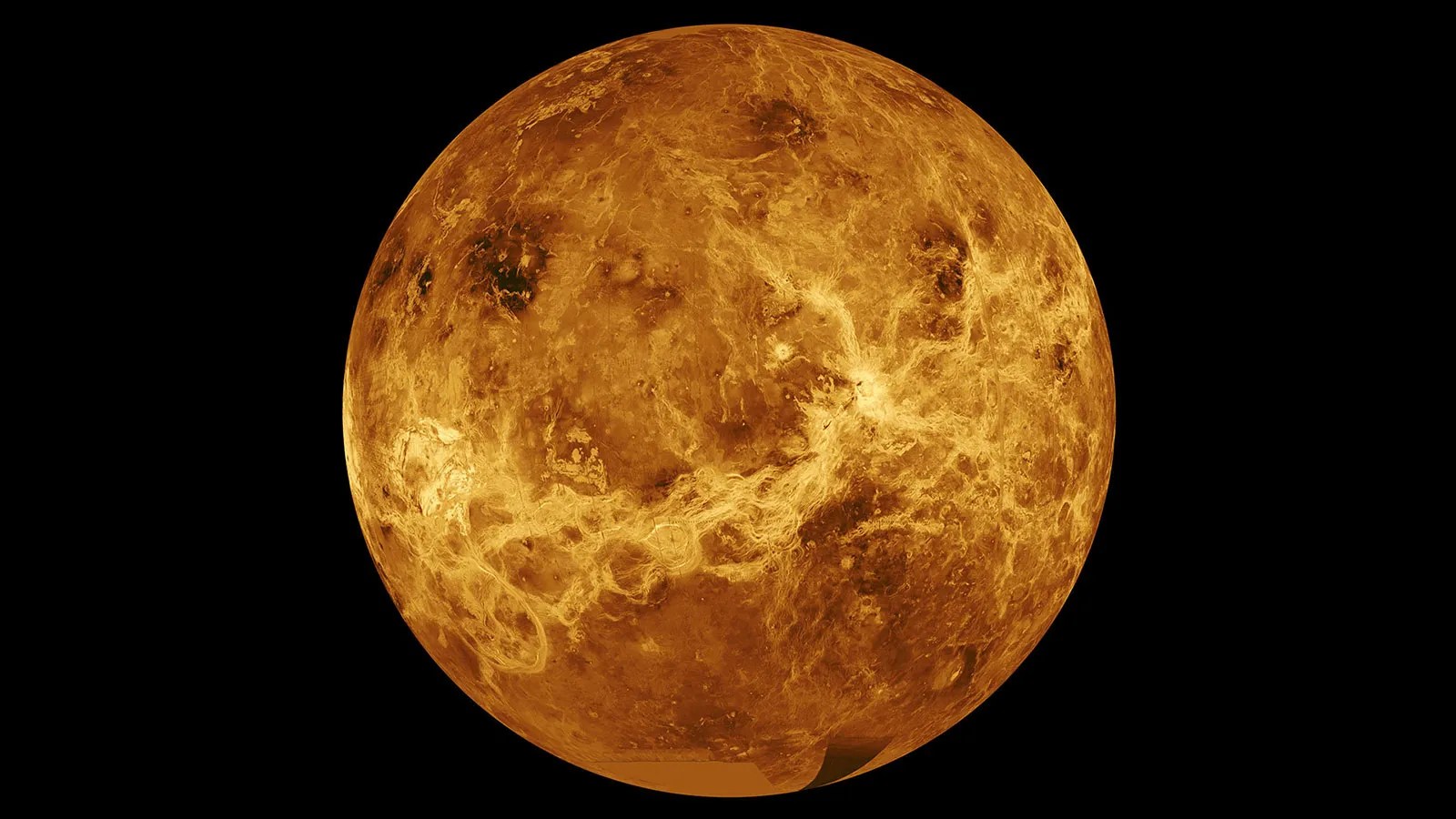
Image (Credit): Venus from a composite of data from NASA’s Magellan spacecraft and Pioneer Venus Orbiter. (NASA/JPL-Caltech)

Here are some recent stories of interest.

University of Colorado at Boulder: Venus Has Almost No Water: A New Study May Reveal Why

Planetary scientists at the University of Colorado Boulder have discovered how Venus, Earth’s scalding and uninhabitable neighbor, became so dry. The new study fills in a big gap in what the researchers call “the water story on Venus.” Using computer simulations, the team found that hydrogen atoms in the planet’s atmosphere go whizzing into space through a process known as “dissociative recombination” — causing Venus to lose roughly twice as much water every day compared to previous estimates.

UniverseToday: New Evidence for Our Solar System’s Ghost: Planet Nine

Does another undetected planet languish in our Solar System’s distant reaches? Does it follow a distant orbit around the Sun in the murky realm of comets and other icy objects? For some researchers, the answer is “almost certainly.” The case for Planet Nine (P9) goes back at least as far as 2016. In that year, astronomers Mike Brown and Konstantin Batygin published evidence pointing to its existence. Along with colleagues, they’ve published other work supporting P9 since then. Now, they’ve published another paper along with colleagues Alessandro Morbidelli and David Nesvorny, presenting more evidence supporting P9. It’s titled “Generation of Low-Inclination, Neptune-Crossing TNOs by Planet Nine.” It’s published in The Astrophysical Journal Letters.

Astonomy.com: Possible Hints of Life Found on Exoplanet K2-18b – How Excited Should We Be?”

Data from the James Webb Space Telescope (JWST) has shown that an exoplanet around a star in the constellation Leo has some of the chemical markers that, on Earth, are associated with living organisms. But these are vague indications. So how likely is it that this exoplanet harbours alien life? …The planet in question is named K2-18b. It’s so named because it was the first planet found to orbit the red dwarf star K2-18.

Pic of the Week: Close-up of the Horsehead Nebula

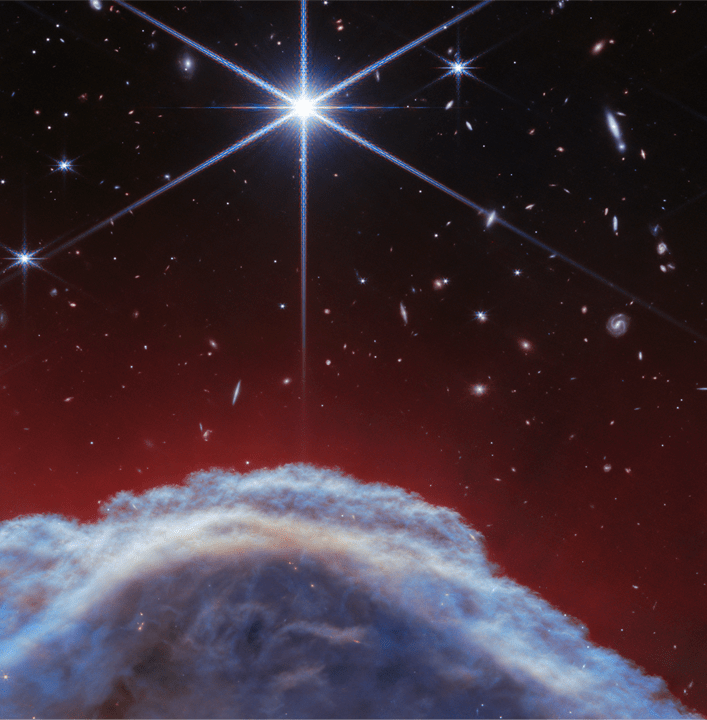
Image (Credit): The Horsehead Nebula captured by the JWST. (NASA, ESA, CSA, Karl Misselt (University of Arizona), Alain Abergel (IAS, CNRS))

This week’s image comes from the James Webb Space Telescope (JWST). It shows a close-up of the well known Horsehead Nebula, which is about 1,375 light years from Earth. The clarity of the many galaxies in the distance makes this an even more amazing image.

Here is more about the image from the Webb Space Telescope site:

This image of the Horsehead Nebula from NASA’s James Webb Space Telescope focuses on a portion of the horse’s “mane” that is about 0.8 light-years in width. It was taken with Webb’s NIRCam (Near-infrared Camera). The ethereal clouds that appear blue at the bottom of the image are filled with a variety of materials including hydrogen, methane, and water ice. Red-colored wisps extending above the main nebula represent both atomic and molecular hydrogen. In this area, known as a photodissociation region, ultraviolet light from nearby young, massive stars creates a mostly neutral, warm area of gas and dust between the fully ionized gas above and the nebula below. As with many Webb images, distant galaxies are sprinkled in the background.

Space Stories: More on Planet 9, A Collision with Pluto, and Explaining Free-Floating Planets

Here are some recent stories of interest.

IFLScience: Astronomers Find Evidence Of A Massive Object Beyond The Orbit Of Neptune

A team of researchers say they have found the “strongest statistical evidence yet that Planet 9 is really out there” in the solar system after studying a population of distant, unstable objects that cross Neptune’s orbit...In a new paper, the team looked at long-period objects that crossed the path of Neptune’s orbit, finding that their closest point of orbit to the sun was around 15-30 astronomical units (AU), with one AU being the distance between the sun and the Earth.

CNN: Pluto Gained a ‘Heart’ After Colliding with a Planetary Body

A huge heart-shaped feature on the surface of Pluto has intrigued astronomers since NASA’s New Horizons spacecraft captured it in a 2015 image. Now, researchers think they have solved the mystery of how the distinctive heart came to be — and it could reveal new clues about the dwarf planet’s origins…an international team of scientists has determined that a cataclysmic event created the heart. After an analysis involving numerical simulations, the researchers concluded a planetary body about 435 miles (700 kilometers) in diameter, or roughly twice the size of Switzerland from east to west, likely collided with Pluto early in the dwarf planet’s history.

University of Nevada: Astronomers Offer New Model for Formation of Recently Discovered ‘Free-floating’ Planets

The recent discovery of a potential new class of distant and mysterious “free-floating” planets has intrigued astronomers since stunning new images captured by the James Webb Space Telescope were shared late last year. These candidate planets, known as Jupiter-mass Binary Objects (JuMBOs), seem to orbit one another as they float freely in space unbound to any star—which counters prevailing theories of how planetary systems were thought to work. Now, a new study by a team of astrophysicists from UNLV and Stony Brook University, published April 19 in the journal Nature Astronomy, introduces a compelling model for how these JuMBOs may have formed.

Pic of the Week: Tightly Bound Herbig-Haro 46/47

Image (Credit): JWST view of actively forming stars known as Herbig-Haro 46/47. (NASA, ESA, CSA)

This week’s image, released last year, is from the James Webb Space Telescope (JWST). It shows two forming stars in what is called Herbig-Haro 46/47.

Here is a full explanation of what you are seeing from NASA:

NASA’s James Webb Space Telescope has captured a tightly bound pair of actively forming stars, known as Herbig-Haro 46/47, in high-resolution near-infrared light. Look for them at the center of the red diffraction spikes. The stars are buried deeply, appearing as an orange-white splotch. They are surrounded by a disk of gas and dust that continues to add to their mass.

Herbig-Haro 46/47 is an important object to study because it is relatively young – only a few thousand years old. Stars take millions of years to fully form. Targets like this also give researchers insight into how stars gather mass over time, potentially allowing them to model how our own Sun, a low-mass star, formed.

The two-sided orange lobes were created by earlier ejections from these stars. The stars’ more recent ejections appear in a thread-like blue, running along the angled diffraction spike that covers the orange lobes.

Actively forming stars ingest the gas and dust that immediately surrounds them in a disk (imagine an edge-on circle encasing them). When the stars “eat” too much material in too short a time, they respond by sending out two-sided jets along the opposite axis, settling down the star’s spin, and removing mass from the area. Over millennia, these ejections regulate how much mass the stars retain.

Don’t miss the delicate, semi-transparent blue cloud. This is a region of dense dust and gas, known as a nebula. Webb’s crisp near-infrared image lets us see through its gauzy layers, showing off a lot more of Herbig-Haro 46/47, while also revealing a deep range of stars and galaxies that lie far beyond it. The nebula’s edges transform into a soft orange outline, like a backward L along the right and bottom.

The blue nebula influences the shapes of the orange jets shot out by the central stars. As ejected material rams into the nebula on the lower left, it takes on wider shapes, because there is more opportunity for the jets to interact with molecules within the nebula. Its material also causes the stars’ ejections to light up.

Over millions of years, the stars in Herbig-Haro 46/47 will fully form – clearing the scene.