Space Stories: Oxygen Issues on Europa, the Puzzling Expansion Rate of the Universe, and Mini Moon-Bound Rovers

Image (Credit): Europa as captured by NASA’s Galileo spacecraft. (NASA/JPL/Ted Stryk)

Here are some recent stories of interest.

The Columbian: Europa Might Have Less Oxygen Than Expected

New research suggests there’s less oxygen on the icy surface of Jupiter’s moon Europa than thought — and that could affect what, if any, life might be lurking in the moon’s underground ocean. Even with little or no oxygen, microbes might still be bustling around in the ocean believed to exist miles beneath Europa’s frozen crust. As for what else, “who knows,” said NASA scientist Kevin Hand, who was not involved in the study published Monday in Nature Astronomy.

Webbtelescope.org: NASA’s Webb, Hubble Telescopes Affirm Universe’s Expansion Rate, Puzzle Persists

The best measurements from Hubble show the universe is now expanding faster than predicted based on observations of how it looked shortly after the big bang. These observations were made by the Planck satellite mapping of the cosmic microwave background radiation – sort of a blueprint for how the universe would evolve structure after it cooled down from the big bang. The simple solution to the dilemma is to say that maybe Hubble observations are wrong due to some creeping inaccuracy in its deep-space yardstick. Then along came the James Webb Space Telescope to crosscheck Hubble’s results. Webb’s sharp infrared views of Cepheids agreed with Hubble data. Webb confirmed that the Hubble telescope’s keen eye was right all along.

NASA JPL: NASA’s Network of Small Moon-Bound Rovers Is Ready to Roll

A trio of small rovers that will explore the Moon in sync with one another are rolling toward launch. Engineers at NASA’s Jet Propulsion Laboratory in Southern California recently finished assembling the robots, then subjected them to a punishing series of tests to ensure they’ll survive their jarring rocket ride into space and their travels in the unforgiving lunar environment. Part of a technology demonstration called CADRE (Cooperative Autonomous Distributed Robotic Exploration), each solar-powered rover is about the size of a carry-on suitcase.

Pic of the Week: Spiral galaxy NGC 1300

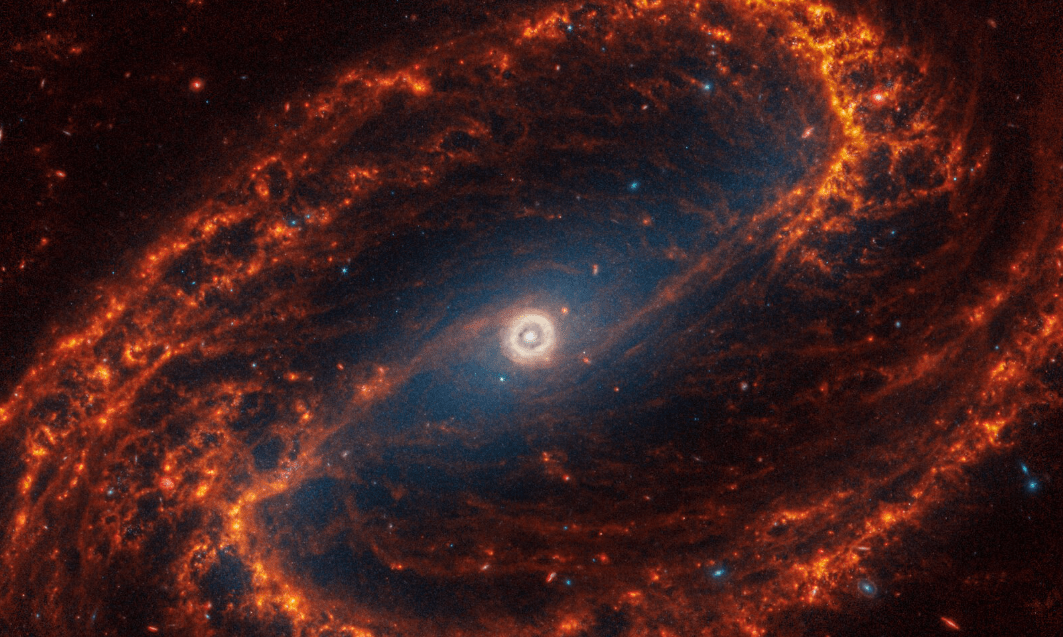
Image (Credit): JWST’s view of spiral galaxy NGC 1300. (NASA, ESA, CSA, STScI, Janice Lee (STScI), Thomas Williams (Oxford), and the PHANGS team)

This week’s image is from the James Webb Space Telescope (JWST). It shows a face-on view of spiral galaxy NGC 1300, which is 69 million light-years away.

Here is more about the image from NASA:

Webb’s image of NGC 1300 shows a face-on barred spiral galaxy anchored by its central region, which is circular and shows a bright white point at the center with a light yellow circle around it. The central core is tiny compared to the rest of the galaxy. The core extends into the galaxy’s prominent diagonal bar structure, which is filled with a blue haze of stars. Orange dust filaments cross the bar, extending diagonally to the top and bottom, connecting the yellow circle in the central core to the galaxy’s spiral arms. There are two distinct orange spiral arms made of stars, gas, and dust that start at the edges of the bar and rotate counterclockwise. Together, the arm and bars form a backward S shape. The spiral arms are largely orange, ranging from dark to bright orange. Scattered across the packed scene are very few bright blue pinpoints of light. There are vast areas between where the orange spiral arms wrap that appear black. The top left and bottom right edges are dark black and there are some larger red and blue points of light, some that appear like disks seen from the side.

Space Stories: Biomolecules on Mars, a “Dead” Galaxy, and the Most Distant Galaxies

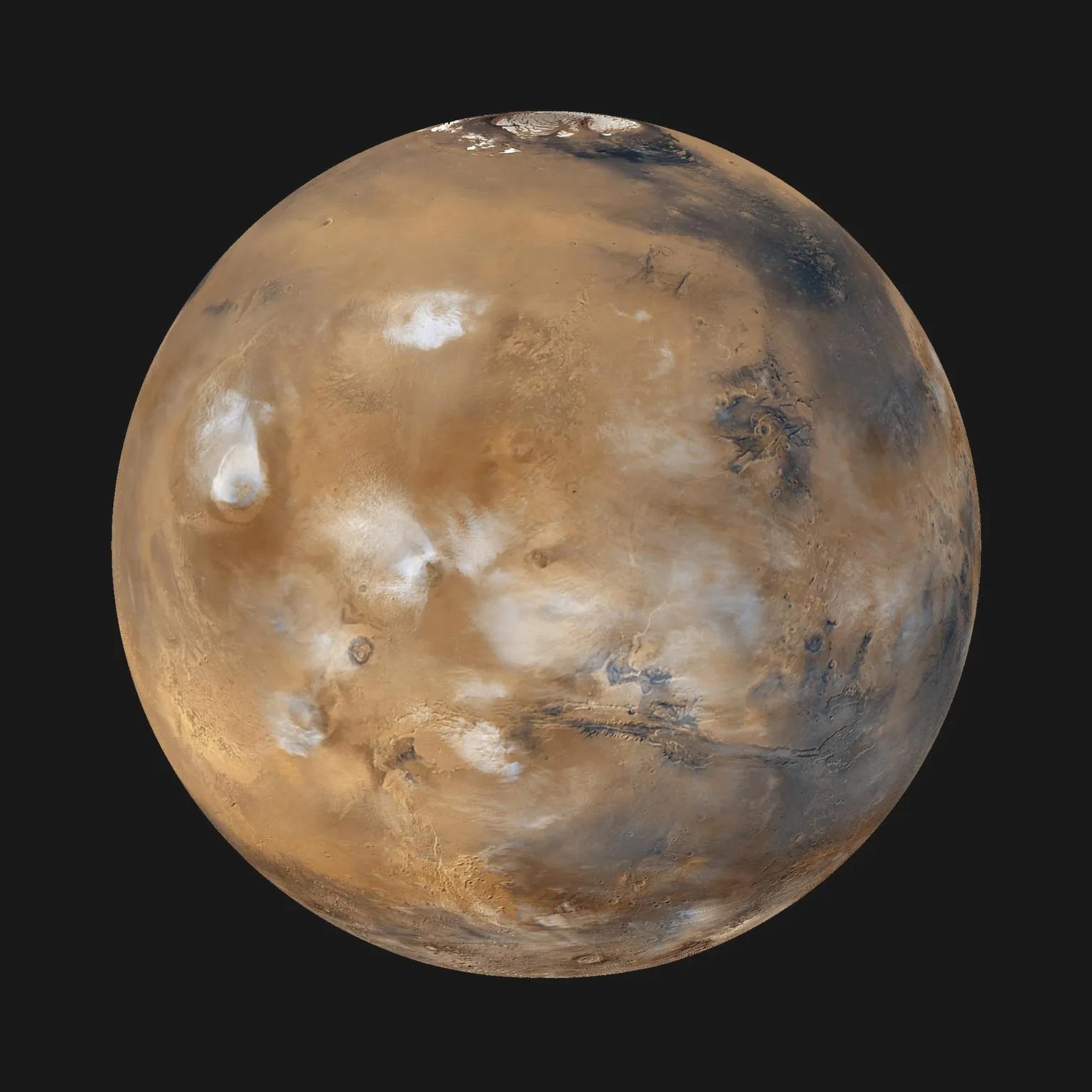
Image (Credit): Image of Mars captured by the NASA Mars Global Surveyor MOC wide angle cameras. (NASA)

Here are some recent stories of interest.

Tohoku University: Biomolecules from Formaldehyde on Ancient Mars

Organic materials discovered on Mars may have originated from atmospheric formaldehyde, according to new research, marking a step forward in our understanding of the possibility of past life on the Red Planet. Scientists from Tohoku University have investigated whether the early atmospheric conditions on Mars had the potential to foster the formation of biomolecules – organic compounds essential for biological processes. Their findings, published in Scientific Reports, offer intriguing insights into the plausibility of Mars harboring life in its distant past.

University of Cambridge: Astronomers Spot Oldest “Dead” Galaxy Yet Observed

A galaxy that suddenly stopped forming new stars more than 13 billion years ago has been observed by astronomers. Using the James Webb Space Telescope, an international team of astronomers led by the University of Cambridge has spotted a ‘dead’ galaxy when the universe was just 700 million years old, the oldest such galaxy ever observed. This galaxy appears to have lived fast and died young: star formation happened quickly and stopped almost as quickly, which is unexpected for so early in the universe’s evolution. However, it is unclear whether this galaxy’s ‘quenched’ state is temporary or permanent, and what caused it to stop forming new stars.

Webbtelescope.org: Webb Unlocks Secrets of One of the Most Distant Galaxies Ever Seen

Delivering on its promise to transform our understanding of the early universe, the James Webb Space Telescope is probing galaxies near the dawn of time. One of these is the exceptionally luminous galaxy GN-z11, which existed when the universe was just a tiny fraction of its current age. One of the youngest and most distant galaxies ever observed, it is also one of the most enigmatic. Why is it so bright? Webb appears to have found the answer. Scientists using Webb to study GN-z11 have also uncovered some tantalizing evidence for the existence of Population III stars nestled in the outskirts of this remote galaxy. These elusive stars — the first to bring light to the universe — are purely made of hydrogen and helium. No definitive detection of such stars has ever been made, but scientists know they must exist. Now, with Webb, their discovery seems closer than ever before.

New Postage Stamps for Space Enthusiasts

Image (Credit): One of the new USPS Priority Mail JWST postage stamps. (U.S. Postal Service)

If you are in the market for a stamp to mail your Priority Mail package, then look no further than the two new James Webb Space Telescope (JWST) stamps recently issued by the U.S. Postal Service.

You can enjoy the “Pillars of Creation” or “Cosmic Cliffs” stamps, both of which demonstrate some of the most amazing images captured by the telescope.

Image (Credit): The second new USPS Priority Mail JWST postage stamps. (U.S. Postal Service)

Pic of the Week: Surfboards in Space

Image (Credit): JWST image showing an array of odd shapes when the universe was only 600 million to 6 billion years old. The elongated shape in the left bottom part of the image is one of the most common identified shapes so far in Webb’s survey. (NASA, ESA, CSA, Steve Finkelstein (UT Austin), Micaela Bagley (UT Austin), Rebecca Larson (UT Austin))

This week’s image is one from the James Webb Space Telescope (JWST) showing galaxies from long ago. Many of these galaxies have an elongated shape similar to a surfboard. Again, JWST is opening our eyes everyday to the wonder and weirdness of the universe.

Here is more about the image from NASA:

Researchers analyzing images from NASA’s James Webb Space Telescope have found that galaxies in the early universe are often flat and elongated, like surfboards and pool noodles – and are rarely round, like volleyballs or frisbees. “Roughly 50 to 80% of the galaxies we studied appear to be flattened in two dimensions,” explained lead author Viraj Pandya, a NASA Hubble Fellow at Columbia University in New York. “Galaxies that look like pool noodles or surfboards seem to be very common in the early universe, which is surprising, since they are uncommon nearby.”

The team focused on a vast field of near-infrared images delivered by Webb, known as the Cosmic Evolution Early Release Science (CEERS) Survey, plucking out galaxies that are estimated to exist when the universe was 600 million to 6 billion years old.