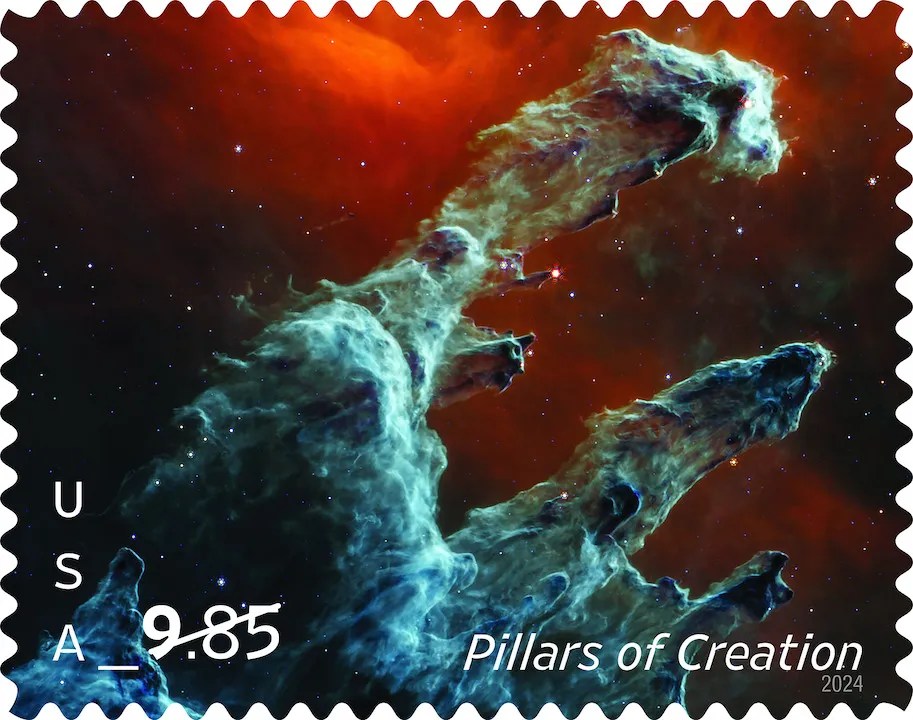
Image (Credit): One of the new USPS Priority Mail JWST postage stamps. (U.S. Postal Service)
If you are in the market for a stamp to mail your Priority Mail package, then look no further than the two new James Webb Space Telescope (JWST) stamps recently issued by the U.S. Postal Service.
You can enjoy the “Pillars of Creation” or “Cosmic Cliffs” stamps, both of which demonstrate some of the most amazing images captured by the telescope.
Image (Credit): The second new USPS Priority Mail JWST postage stamps. (U.S. Postal Service)
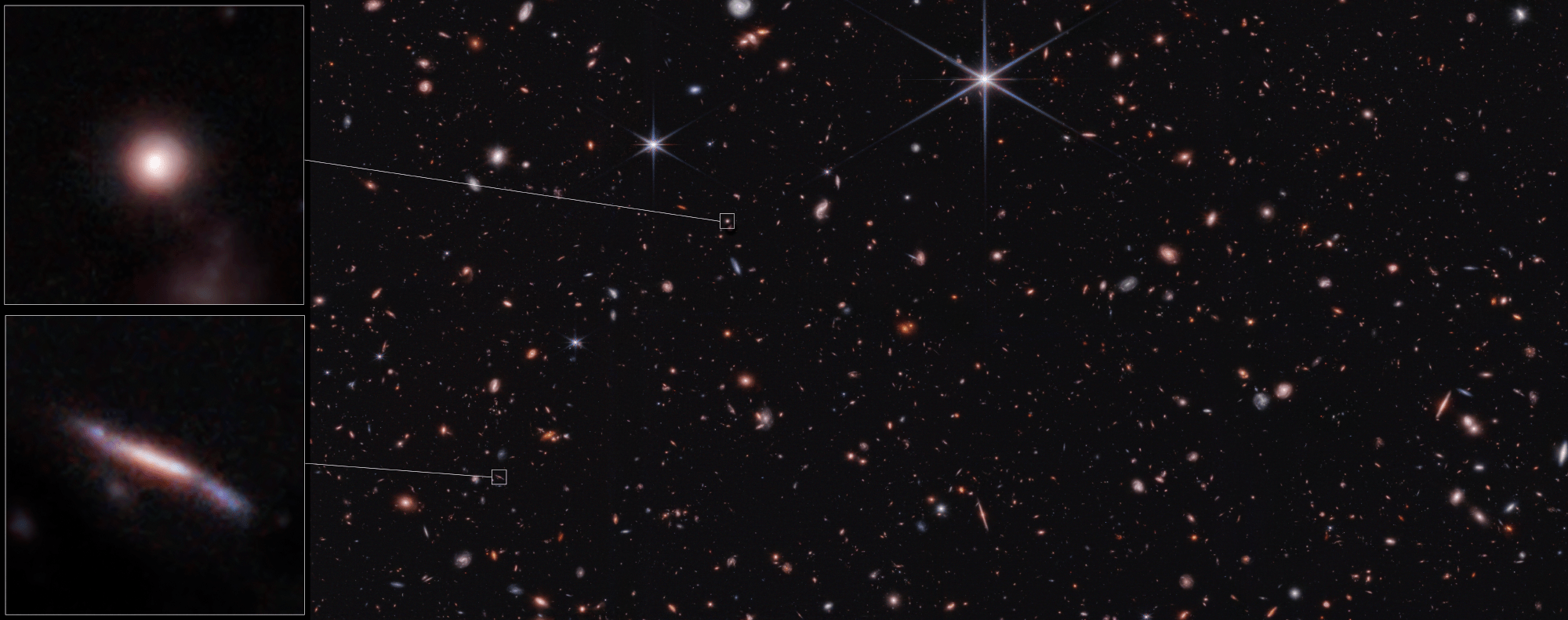
Image (Credit): JWST image showing an array of odd shapes when the universe was only 600 million to 6 billion years old. The elongated shape in the left bottom part of the image is one of the most common identified shapes so far in Webb’s survey. (NASA, ESA, CSA, Steve Finkelstein (UT Austin), Micaela Bagley (UT Austin), Rebecca Larson (UT Austin))
This week’s image is one from the James Webb Space Telescope (JWST) showing galaxies from long ago. Many of these galaxies have an elongated shape similar to a surfboard. Again, JWST is opening our eyes everyday to the wonder and weirdness of the universe.
Researchers analyzing images from NASA’s James Webb Space Telescope have found that galaxies in the early universe are often flat and elongated, like surfboards and pool noodles – and are rarely round, like volleyballs or frisbees. “Roughly 50 to 80% of the galaxies we studied appear to be flattened in two dimensions,” explained lead author Viraj Pandya, a NASA Hubble Fellow at Columbia University in New York. “Galaxies that look like pool noodles or surfboards seem to be very common in the early universe, which is surprising, since they are uncommon nearby.”
The team focused on a vast field of near-infrared images delivered by Webb, known as the Cosmic Evolution Early Release Science (CEERS) Survey, plucking out galaxies that are estimated to exist when the universe was 600 million to 6 billion years old.
Image (Credit): Chart showing the planned travel of the JUICE spacecraft. (ESA, work performed by ATG under contract to ESA)
I wanted to start out the new year by first remembering all of the great missions from 2023. I also decided to group this work rather than focus on single missions.
NASA Asteroid Missions: Asteroids were the big news this year, with Lucy encountering a surprise pair of asteroids, OSIRIS-REx bringing back a sample from the asteroid Bennu, and NASA launching the Psyche mission.
JWST Discoveries: This year we celebrated the anniversary of the James Webb Space Telescope (JWST), which has been better than ever imaged. It is helping to change our understanding of the origin of the universe while poking and prodding at exoplanets to review their secrets.
ESA Missions: The European Space Agency (ESA) has also been very busy in 2023. For instance, the launch of the Euclid mission to study dark matter and dark energy, as well as the JUICE mission to study Jupiter and its moons, will assist with our understanding of the big picture as well as our own neighborhood.
That’s an impressive record, and I look forward to even more great news in 2024.
The conventional observables to identify a habitable or inhabited environment in exoplanets, such as an ocean glint or abundant atmospheric O2, will be challenging to detect with present or upcoming observatories. Here we suggest a new signature. A low carbon abundance in the atmosphere of a temperate rock`y planet, relative to other planets of the same system, traces the presence of a substantial amount of liquid water, plate tectonics and/or biomass. Here we show that JWST can already perform such a search in some selected systems such as TRAPPIST-1 via the CO2 band at 4.3 μm, which falls in a spectral sweet spot where the overall noise budget and the effect of cloud and/or hazes are optimal. We propose a three-step strategy for transiting exoplanets: detection of an atmosphere around temperate terrestrial planets in about 10 transits for the most favourable systems; assessment of atmospheric carbon depletion in about 40 transits; and measurements of O3 abundance to disentangle between a water- versus biomass-supported carbon depletion in about 100 transits. The concept of carbon depletion as a signature for habitability is also applicable for next-generation direct-imaging telescopes.
Citation: Triaud, A.H.M.J., de Wit, J., Klein, F. et al. Atmospheric carbon depletion as a tracer of water oceans and biomass on temperate terrestrial exoplanets. Nat Astron (2023). https://doi.org/10.1038/s41550-023-02157-9
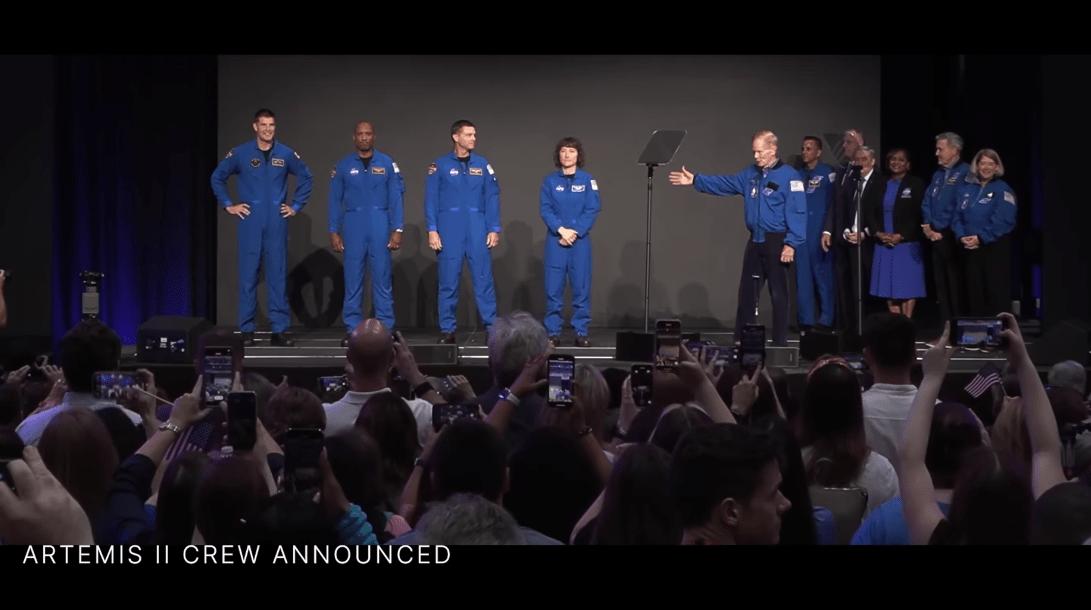
Image (Credit): The introduction of the Artemis II crew, just one of many items highlighted in NASA’s new video summarizing 2023. (NASA)
This is the time of year for lists, so I wanted to highlight one of the more important lists, at least in the opinion of this writer. That’s right, we need to remember the important space milestones from this year.
Fortunately, NASA recently summed up its successes in 2023 with a new video titled NASA 2023: Nothing is Beyond Our Reach. The video highlights many of the Agency’s accomplishments this year, including the launch of the Psyche mission, the announcement of a crew for the Artemis II mission, and the OSIRIS-REx capsule retrieval.
It is quite a list. Luckily, NASA provided a list of links so you can read more about the various efforts:




 Our Awesome Universe