Pic of the Week: Ice Chemistry

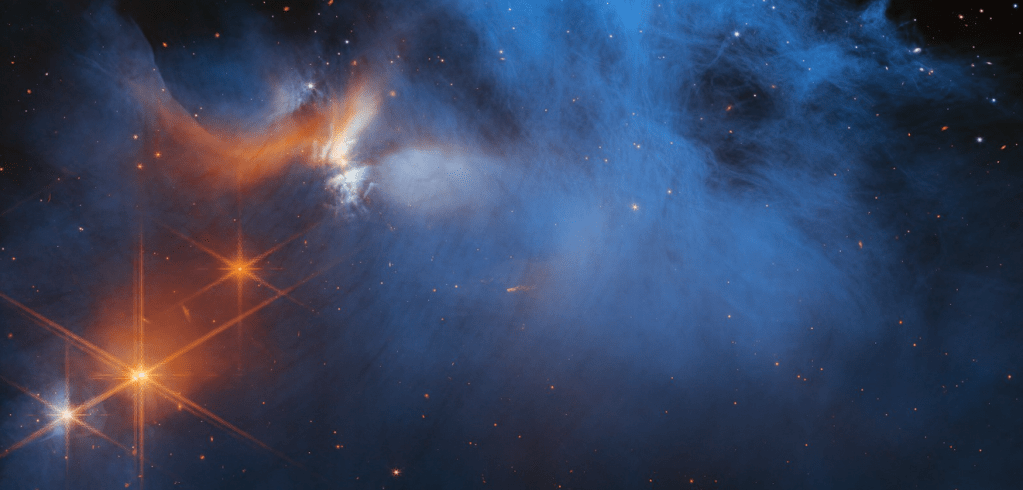
Image (Credit): The Chamaeleon I dark molecular cloud. (NASA, ESA, CSA, and M. Zamani (ESA). Science: M. K. McClure (Leiden Observatory), F. Sun (Steward Observatory), Z. Smith (Open University), and the Ice Age ERS Team)

This week’s image is from the James Webb Space Telescope (JWST). It shows Chamaeleon I dark molecular cloud where both stars and planets are born. Here is more about the image from NASA:

A Webb image of the central region of the Chamaeleon I dark molecular cloud, which resides 630 light-years away. This image primarily shows blue smoky wisps on a dark background. The left top side additionally features orange and white wisps. Just below them are four bright points of light. Three are orange and one is a mix of white and orange. Each of these points have Webb’s signature 8-point diffraction spikes emanating around them in long, thick orange lines, so that they look like huge snowflakes. Scattered throughout the image are distant stars or galaxies in shades of red, orange and blue, seen as tiny blobs.

A Day in Astronomy: The Hubble Space Telescope is Launched

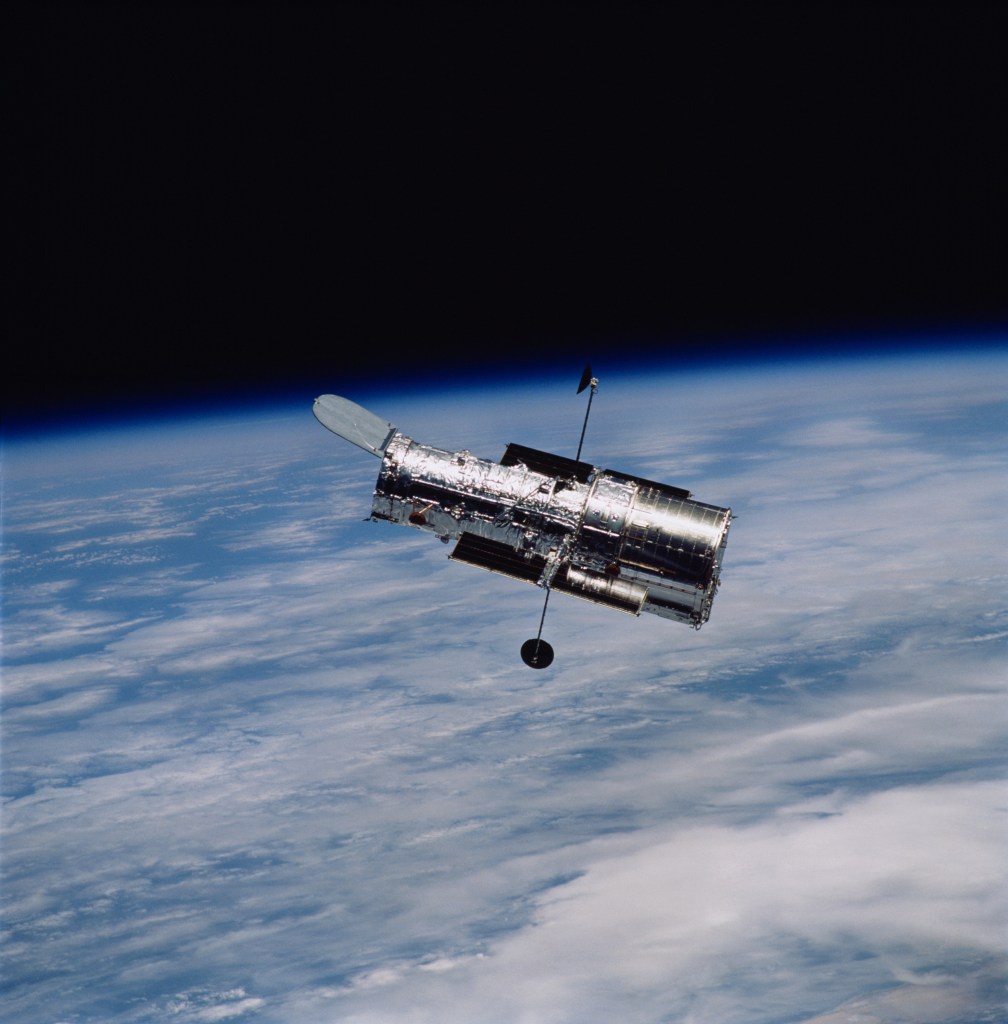
Image (Credit): The Hubble Space Telescope orbits with Earth in the background. (NASA)

On this day in 1990, NASA’s Space Shuttle Discovery launched the Hubble Space Telescope. We do not think of the shuttles anymore as we discuss reusable rockets, but the shuttles were the first reusable spacecraft-launching vehicles.

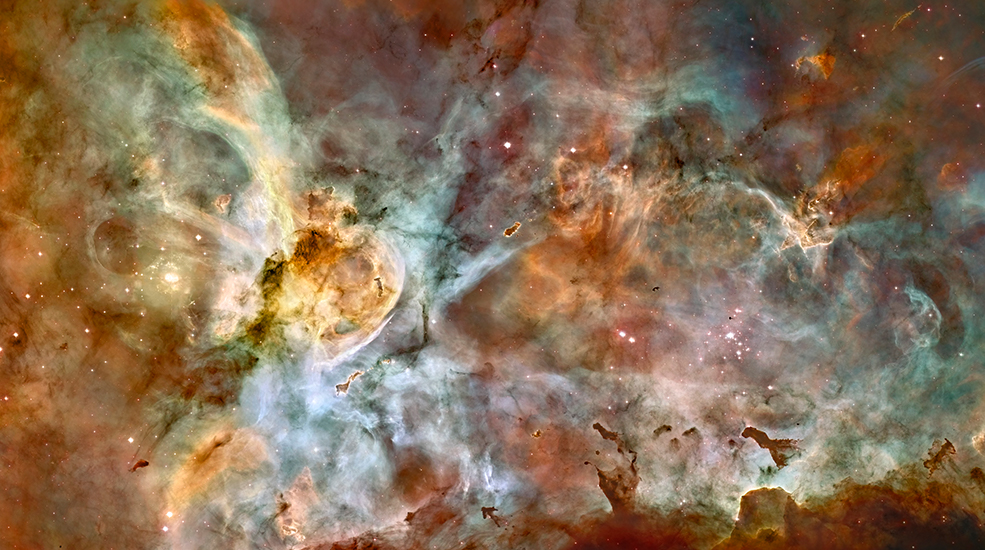
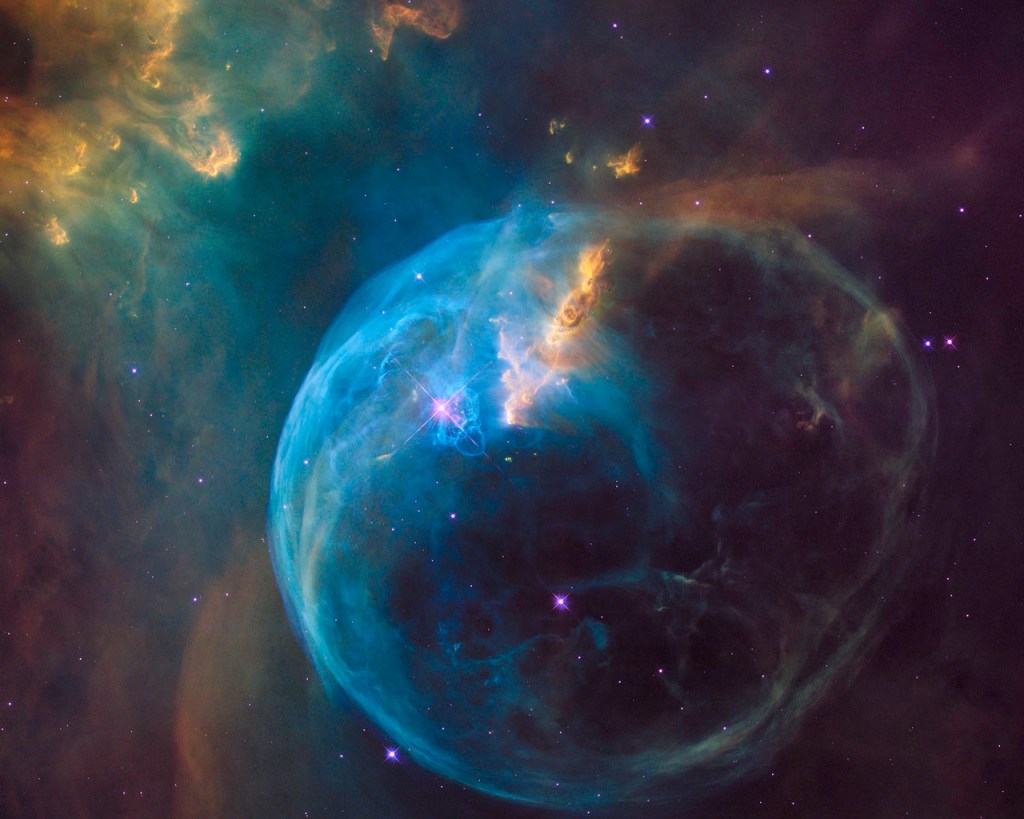
After some initial problems, the Hubble became a critical component in the exploration of the universe. Some of the telescope’s amazing images are shown below.

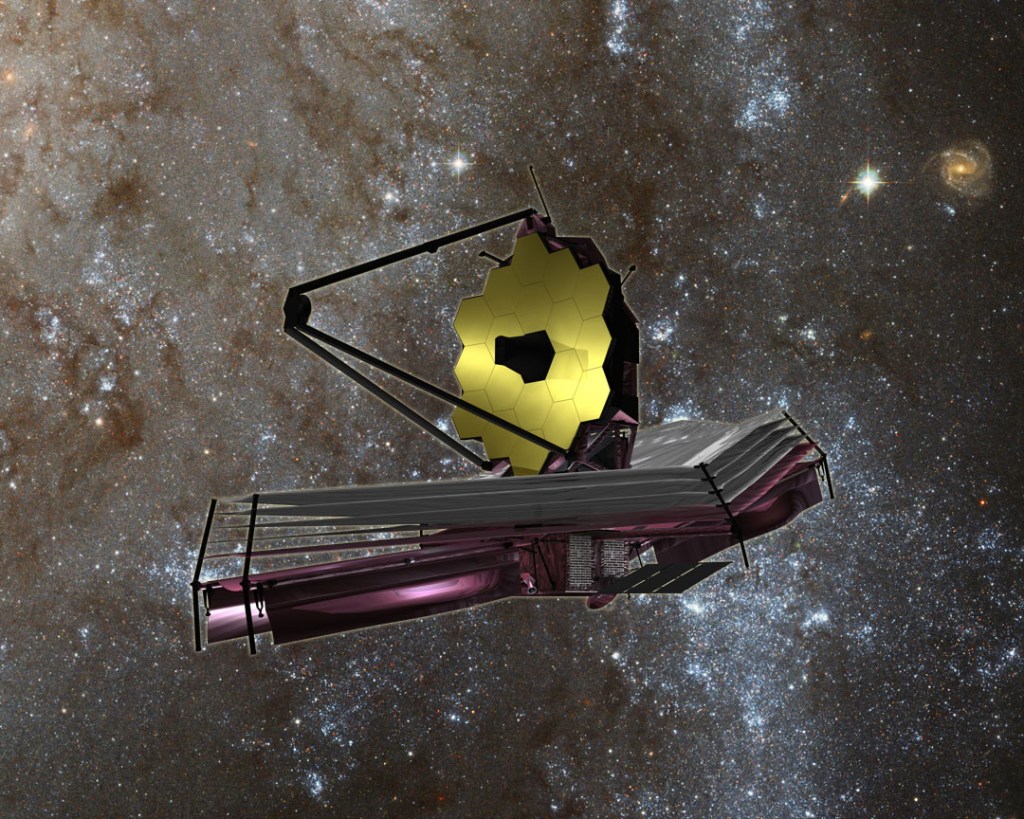
It is still going strong, even though its successor, the James Webb Space Telescope (JWST), is the more powerful of the two. Launched in late 2021, the JWST has expanded on some of Hubble’s earlier work. The pair are a powerful team.

Here are a few interesting facts about Hubble:

  • Hubble has made more than 1.5 million observations since its mission began in 1990.
  • Astronomers using Hubble data have published more than 19,000 scientific papers, making it one of the most productive scientific instruments ever built. Those papers have been cited in other papers over 1.1 million times.
  • Hubble has no thrusters. To change angles, it uses Newton’s third law by spinning its wheels in the opposite direction. It turns at about the speed of a minute hand on a clock, taking 15 minutes to turn 90 degrees.
  • Hubble has peered back into the very distant past, to locations more than 13.4 billion light-years from Earth.
  • Hubble’s mirror is about 7.9 feet (2.4 m) across. It was so finely polished that if you scaled it to be the diameter of the Earth, you would not find a bump more than 6 inches (15 cm) tall.
Image (Credit): The Carina Nebula. (NASA, ESA, N. Smith (University of California, Berkeley), and The Hubble Heritage Team (STScI/AURA)
Image (Credit): NGC 3603. (NASA, ESA and the Hubble Heritage (STScI/AURA)-ESA/Hubble Collaboration)
Image (Credit): The Horsehead Nebula, otherwise known as Barnard 33. (NASA, ESA, and the Hubble Heritage Team (AURA/STScI))

Good Article: Telescope Mishaps on Earth and in the Heavens

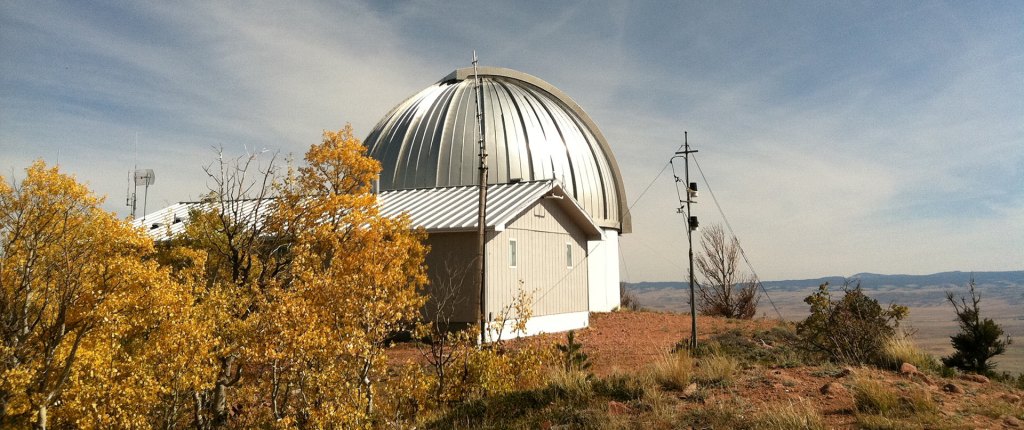
Image (Copy): The Wyoming Infrared Observatory (WIRO). (WIRO)

The New York Times had a good article on various mishaps related to telescopes here on Earth (such as WIRO above) as well as those now floating in space. The story, “From Bullets to ‘Bird Residue,’ the Many Trials of Telescopes,” shares stories about various natural (bird poop) and man-made (dropped tool) events that have left their marks on astronomy.

We have all heard about the misshaped mirror on the Hubble Space Telescope as well as micrometeors hitting the James Webb Space Telescope, but have you heard about the employee who shot and hammered the primary mirror at the McDonald Observatory in West Texas?

Take a look at the article. You will find plenty of stories to amuse you as well as give you pause.

Space Stories: Merging Galaxies, Anniversary for TESS, and Helicopter Flights on Mars

Image (Credit): Arp 220 as captured by NASA’s James Webb Space Telescope. (NASA, ESA, CSA, STScI, Alyssa Pagan)

Here are some recent stories of interest.

PetaPixel:Webb Captures Star-Forming Galactic Merger Brighter Than 1 Trillion Suns’”

NASA’s James Webb Space Telescope has captured a stunning “smash-up” of two spiral galaxies. Collectively called Arp 220, the collision of the pair of galaxies has facilitated massive star formation. Arp 220 is located within the constellation Serpens, about 250 million light-years from Earth. Arp 220 gets its namesake because it is the 220th object in Hallton Art’s Atlas of Peculiar Galaxies. Arp 220 is “peculiar” because it’s an ultra-luminous infrared galaxy (ULIRG), and the nearest ULIRG to Earth.

Phys.org:NASA’s TESS Celebrates Fifth Year Scanning the Sky for New Worlds’”

Now in its fifth year in space, NASA’s TESS (Transiting Exoplanet Survey Satellite) remains a rousing success. TESS’s cameras have mapped more than 93% of the entire sky, discovered 329 new worlds and thousands more candidates, and provided new insights into a wide array of cosmic phenomena, from stellar pulsations and exploding stars to supermassive black holes.

NASA:NASA’s Ingenuity Mars Helicopter Completes 50th Flight’”

NASA’s Ingenuity Mars Helicopter has completed its 50th flight on Mars. The first aircraft on another world reached the half-century mark on April 13, traveling over 1,057.09 feet (322.2 meters) in 145.7 seconds. The helicopter also achieved a new altitude record of 59 feet (18 meters) before alighting near the half-mile-wide (800-meter-wide) “Belva Crater.”

Space Stories: An Exoplanet’s Atmosphere, A Cosmic Explosion, and Stars Halfway to the Andromeda Galaxy

Here are some recent stories of interest.

WebbTelescope.org: “Weather Report: Expect Scattered, Patchy Clouds Made Up of Silicates on Planet VHS 1256 b

Ever had hot sand whip across your face? That’s a soothing experience compared to the volatile conditions discovered high in the atmosphere of planet VHS 1256 b. Researchers using NASA’s James Webb Space Telescope proved that its clouds are made up of silicate particles, ranging from fine specks to small grains. Plus, its near-constant cloud cover is on the move! The team projects that the silicates swirling in these clouds periodically get too heavy and rain into the depths of the planet’s atmosphere. Webb’s observations also show clear signatures of water, methane and carbon monoxide, and provide evidence for carbon dioxide. This is only the beginning of the team’s research – many more findings are expected as they continue to dig in to Webb’s “downpour” of data.

The Guardian: “Cosmic Explosion Last Year May be ‘Brightest Ever Seen’”

A cosmic explosion that blinded space instruments last year may be the brightest ever seen, according to astronomers. The blast took place 2bn light years from Earth, producing a pulse of intense radiation that swept through the solar system in October last year. The cosmic event, known as a gamma-ray burst (GRB), produced some of the strongest and brightest explosions in the universe, triggering detectors on multiple spacecraft. The October blast was deemed so exceptional that astronomers said it was the brightest of all time since the beginning of human civilisation.

Astronomy.com: “Milky Way Stars Found Nearly Halfway to Andromeda Galaxy

Astronomers have discovered a slew of stars lingering in the far fringes of our galaxy. And when we say far, we mean far. The most distant of these stars is located more than 1 million light-years away. That’s almost halfway to our largest galactic neighbor, the Andromeda Galaxy, which is located some 2.5 million light-years away. “This study is redefining what constitutes the outer limits of our galaxy,” said Raja GuhaThakurta, professor and chair of astronomy and astrophysics at UC Santa Cruz, in a news release. “Our galaxy and Andromeda are both so big, there’s hardly any space between the two galaxies.”