Pic of the Week: Globular Cluster M92

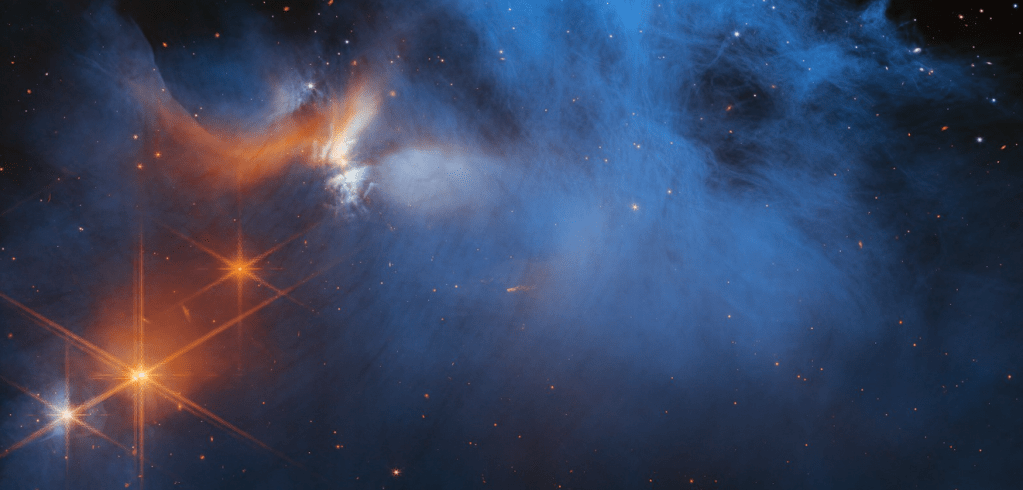
Image (Credit): Globular cluster M92 captured by the JWST. (NASA, ESA, CSA, A. Pagan (STScI))

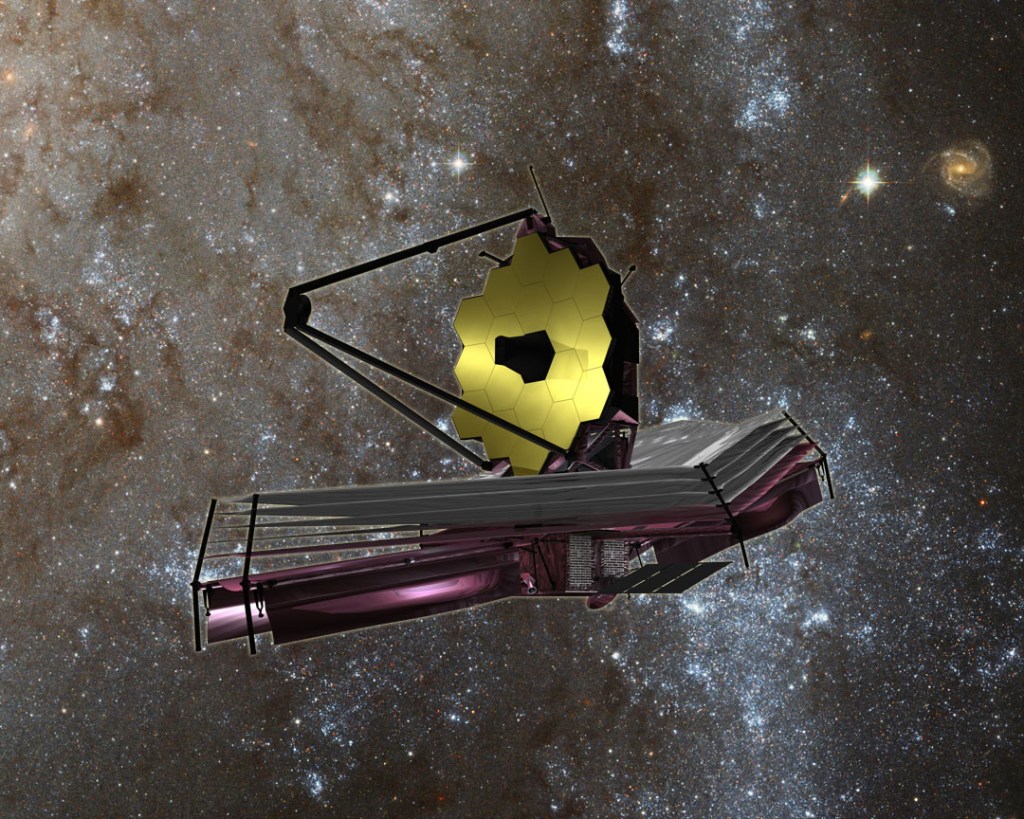
This week’s image was captured by the James Webb Space Telescope (JWST) and shows globular cluster M92 located about 27,000 light-years away within our Milky Way galaxy.

Here is a little more on the image from NASA:

Detail of the globular cluster M92 captured by Webb’s NIRCam instrument. This field of view covers the lower left quarter of the right half of the full image. Globular clusters are dense masses of tightly packed stars that all formed around the same time. In M92, there are about 300,000 stars packed into a ball about 100 light-years across. The night sky of a planet in the middle of M92 would shine with thousands of stars that appear thousands of times brighter than those in our own sky. The image shows stars at different distances from the center, which helps astronomers understand the motion of stars in the cluster, and the physics of that motion

Space Stories: Stalled Martian Rover, Early Mega-Galaxies, and Soviet Space Debris

Image (Credit): Artist’s rendering of China’s Zhurong rover about to roll off the lander and drive onto Mars. (WEIBO)

Here are some recent stories of interest.

SpaceNews: “NASA Mars Orbiter Reveals China’s Zhurong Rover Has Not Moved for Months

Images from NASA’s Mars Reconnaissance Orbiter reveal that China’s Zhurong rover remains stationary on the Red Planet as China remains silent on the status of its spacecraft. The High Resolution Imaging Science Experiment (HiRISE) camera aboard the Mars Reconnaissance Orbiter (MRO) captured images of the rover on March 11, 2022, a second on Sept. 8, 2022 and finally Feb. 7, 2023. The images were published Feb. 21 by the HiRISE Operations Center.

Los Angeles Times: “Space Telescope Spots Massive Galaxies Near Cosmic Dawn and Blows Astronomers’ Minds

Astronomers have discovered what appear to be massive galaxies dating back to within 600 million years of the big bang, suggesting the early universe may have had a stellar fast-track that produced these “monsters.” While the new James Webb Space Telescope has spotted even older galaxies, dating to within a mere 300 million years of the beginning of the universe, it’s the size and maturity of these six apparent mega-galaxies that stunned scientists. They reported their findings Wednesday in the journal Nature.

Newsweek: “Russian Rocket Crashes Back Into Russia After 42 Years

A decades-old Soviet era piece of space junk has crashed back to Earth after over 40 years in orbit, improbably crash landing back in its home country, Russia. The abandoned Soviet Vostok-2M Blok E rocket stage, weighing more than 3,000 pounds, “made an uncontrolled reentry over Novaya Zemlya at 1016 UTC Feb 20 after 42.7 years in orbit,” tweeted Jonathan McDowell, an astrophysicist and group leader at the Chandra X-ray Center Science Data Systems.

Pic of the Week: Spiral Galaxy LEDA 2046648

Image (Credit): Spiral glaxy LEDA 2046648 as captured by the JSWT. (ESA/Webb, NASA & CSA, A. Martel)

This week’s image is from the James Webb Space Telescope (JWST). It shows a spiral galaxy that appears much like our own (bottom center), though this one is a billion light-years away. Do occupants of that galaxy also see us? Good luck communicating when it will take 2 billion years to receive a response to a message you just sent out.

Here is the full story from the European Space Agency (ESA), which posted this as its Picture of the Month just last month:

A crowded field of galaxies throngs this Picture of the Month from the NASA/ESA/CSA James Webb Space Telescope, along with bright stars crowned with Webb’s signature six-pointed diffraction spikes. The large spiral galaxy at the base of this image is accompanied by a profusion of smaller, more distant galaxies which range from fully-fledged spirals to mere bright smudges. Named LEDA 2046648, it is situated a little over a billion light-years from Earth, in the constellation Hercules.

One of Webb’s principle science goals is to observe distant galaxies in the early universe to understand the details of their formation, evolution, and composition. Webb’s keen infrared vision helps the telescope peer back in time, as the light from these distant galaxies is redshifted towards infrared wavelengths. Comparing these systems with galaxies in the local universe will help astronomers understand how galaxies grew to form the structure we see today. Webb will also probe the chemical composition of thousands of galaxies to shed light on how heavy elements were formed and built up as galaxies evolved.

Space Quote: Google’s Expensive Mistake Regarding the JWST

Image (Credit): Actual image of the exoplanet 2M1207b (red) around its star 2M1207A. (European Southern Observatory)

“What new discoveries from the James Webb space telescope (JWST) can I tell my nine-year old about?”

-The one question put to Google’s Bard AI program, which was designed to rival Microsoft’s ChatGPT. In response, Bard stated the JWST took the very first pictures of an exoplanet, which was incorrect. The first image of an exoplanet can be seen above, taken by the European Southern Observatory’s Very Large Telescope back in 2004. The exoplanet, called 2M1207 b, is a gas giant about five times the mass of Jupiter. Following the erroneous feedback, the stock of Google’s parent Alphabet dropped about $100 billion in value. Below is an image from another exoplanet spotted by the JWST last year, called HIP 65426 b, which is about six to eight times the mass of Jupiter.

Image (Credit): First direct image of an exoplanet by the JWST. The exoplanet, called HIP 65426 b, is about 6 to 8 times the mass of Jupiter and only 15 to 20 million years old. The Earth is about 4.5-billion-year-old Earth. (NASA/ESA/CSA, A Carter (UCSC), the ERS 1386 team, and A. Pagan (STScI))

The House Committee Dodged a Killer Asteroid

Image (Credit): U.S. Capitol Building. (U.S. Capitol Police)

The House Committee on Science, Space, and Technology, which oversees NASA’s programs, may have a chance to get some things done this year. Earlier in the week, New York Congressman George Santos stepped down from the Committee on Science, Space, and Technology as well as the House Committee on Small Business. With all of the problems following this man, his presence on either committee would have been a pure distraction.

The House Committee on Science, Space, and Technology has a broad jurisdiction beyond just NASA:

The Committee on Science, Space, and Technology has jurisdiction over all energy research, development, and demonstration, and projects thereof and all federally owned or operated non-military energy laboratories; astronautical research and development, including resources, personnel, equipment, and facilities; civil aviation research and development; environmental research and development; marine research; commercial application of energy technology; National Institute of Standards and Technology, standardization of weights and measures and the metric system; National Aeronautics and Space Administration; National Science Foundation; National Weather Service; outer space, including exploration and control thereof; science scholarships; scientific research, development, and demonstration, and projects therefor. The Committee on Science, Space, and Technology shall review and study, on a continuing basis, laws, programs, and Government activities relating to non-military research and development.

Given the Artemis program as well as the other NASA endeavors currently underway, the Committee should be focusing as much time as possible on space missions rather than bogus resumes and lies to the public.

NASA-related hearings from last year include:

We need a serious Congress if we are going to conduct serious science and space exploration. Let’s hope Washington DC can keep its focus on the real stars (rather than the political black holes that can suck in all light and common sense).