Space Stories: JWST, a Galaxy Catalog, and a Stellar Graveyard

Image (Credit): JWST image of the Tarantula Nebula, which is about 160,000 light-years away. (NASA, ESA, CSA, STScI)

Here are some recent stories of interest.

Nature.com: “‘Bit of Panic’: Astronomers Forced to Rethink Early Webb Telescope Findings

Astronomers have been so keen to use the new James Webb Space Telescope (JWST) that some have got a little ahead of themselves. Many started analysing Webb data right after the first batch was released, on 14 July, and quickly posted their results on preprint servers — but are now having to revise them. The telescope’s detectors had not been calibrated thoroughly when the first data were made available, and that fact slipped past some astronomers in their excitement.

DailyScience.com: “‘Astronomers Map Distances to 56,000 Galaxies, Largest-ever Catalog

How old is our universe, and what is its size? A team of researchers led by University of Hawaii at Manoa astronomers Brent Tully and Ehsan Kourkchi from the Institute for Astronomy have assembled the largest-ever compilation of high-precision galaxy distances, called Cosmicflows-4. Using eight different methods, they measured the distances to a whopping 56,000 galaxies. The study has been published in the Astrophysical Journal.

University of Sydney: “Milky Way’s Graveyard of Dead Stars Found

The first map of the ‘galactic underworld’ – a chart of the corpses of once massive suns that have since collapsed into black holes and neutron stars – has revealed a graveyard that stretches three times the height of the Milky Way, and that almost a third of the objects have been flung out from the galaxy altogether.

Hubble: SpaceX to the Rescue

Image (Credit): The Hubble Space Telescope orbiting Earth. (Hubblesite.org)

The Washington Post reports that NASA and SpaceX are looking into the idea of extending the life of the NASA/ESA Hubble Space Telescope, which has already been in service more than 30 years. The space telescope’s orbit has been deteriorating since 2009, when it was last visited for repairs. The current orbit should be okay until the mid-2030s, and then it will fall to Earth.

To keep the Hubble in service for even more years, it would need to be pushed into a higher orbit. This is where SpaceX comes in. It can assist NASA by moving Hubble just 40 miles higher in order to get another 15 to 20 years out of the space telescope.

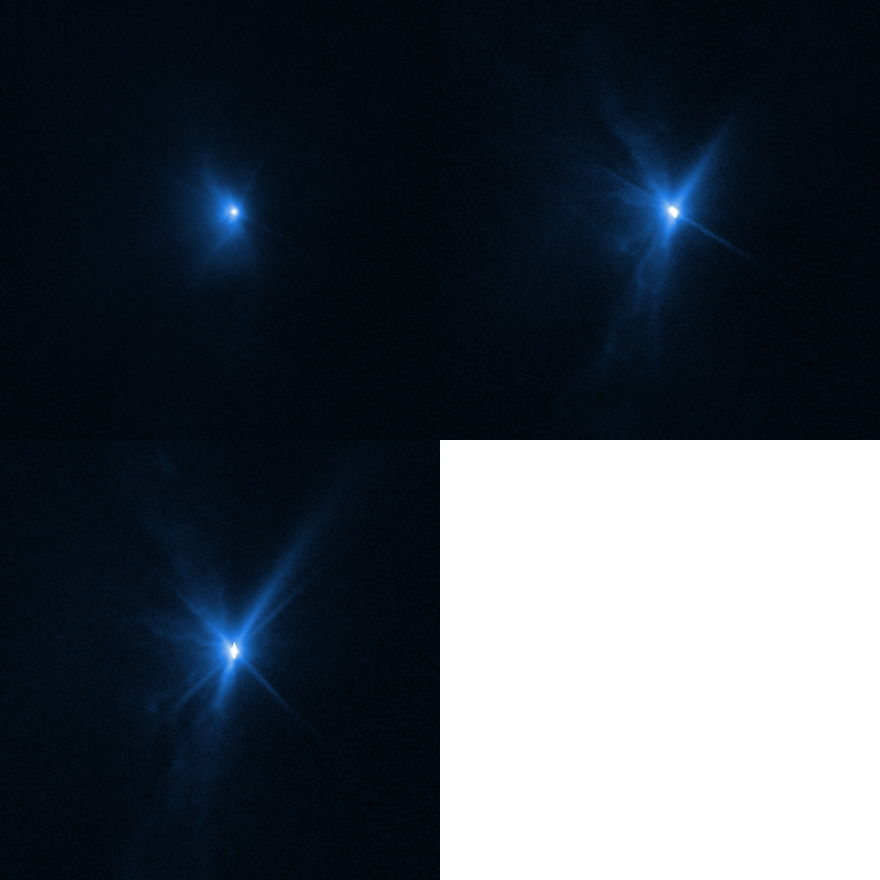
The article notes that the James Webb Space Telescope (JWST) was not developed to replace Hubble but rather to complement it. Hence, the extra life for Hubble means more and better astronomical observations over additional years in conjunction with the JWST. For instance, we will get more shots like the one below where the Hubble captured the Double Asteroid Redirection Test (DART) mission before and after it struck the asteroid.

Update: I have also included the JWST DART image below just to show the two space telescopes can work in tandem.

Image (Credit): This animated GIF combines three of the images NASA’s Hubble Space Telescope captured after NASA’s DART spacecraft intentionally impacted Dimorphos, a moonlet asteroid in the double asteroid system of Didymos. The animation spans from 22 minutes after impact to 8.2 hours after the collision took place. As a result of the impact, the brightness of the Didymos-Dimorphos system increased by 3 times. The brightness also appears to hold fairly steady, even eight hours after impact. (NASA, ESA, Jian-Yang Li (PSI); animation: Alyssa Pagan (STScI))
Image (Credit): This animation gif is a timelapse of images from NASA’s JWST. It covers the time spanning just before impact at 7:14 p.m. EDT, Sept. 26, through 5 hours post-impact. Plumes of material from a compact core appear as wisps streaming away from where the impact took place. An area of rapid, extreme brightening is also visible in the animation. (NASA, ESA, CSA, Cristina Thomas (Northern Arizona University), Ian Wong (NASA-GSFC); Joseph DePasquale (STScI))

Pic of the Week: The Rings of Neptune

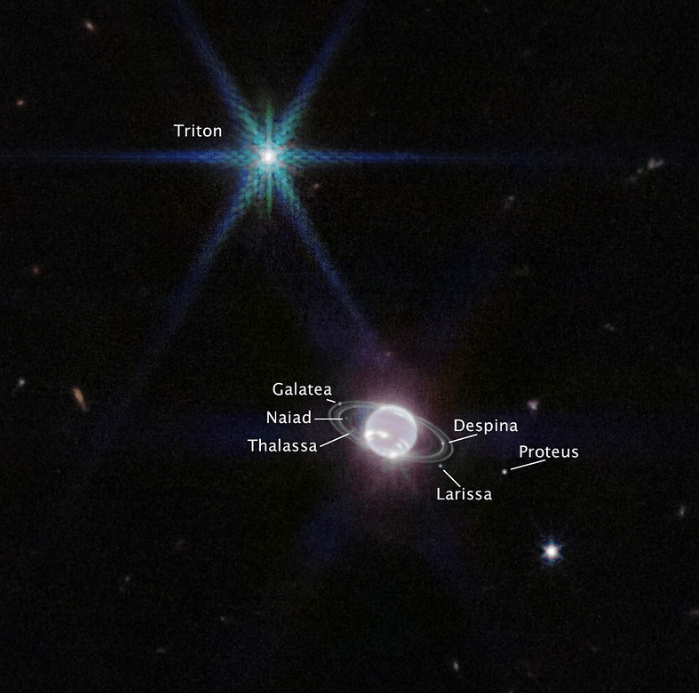
Image (Credit): JWST image of Nepture showing its rings and moons. (NASA, ESA, CSA, STScI)

This week’s image is from the James Webb Space Telescope (JWST). It clearly shows the rings of Neptune as well as a number of its moons (the image below is a broader shot labeling those moons). It is an impressive shot by the JWST within our solar system, similar to the space telescope’s recent image of Jupiter.

Here is more about the image from NASA:

In this Webb image, Neptune resembles a pearl with rings that look like ethereal concentric ovals around it. There are 2 thinner, crisper rings and 2 broader, fainter rings. A few extremely bright patches on the lower half of Neptune represent methane ice clouds. Six tiny white dots, which are six of Neptune’s 14 moons, are scattered among the rings. The background of the image is black.

The Neptune image was uploaded to the NASA website on September 21, just a few days shy of the actual date in the calendar when Neptune was observed for the first time ever – September 23. The year was 1846 and the observer was German astronomer Johann Galle.

Image (Credit): JWST labeled image of Nepture showing its rings and moons. (NASA, ESA, CSA, STScI)

Astronomy Ideas on Borrowed Time?

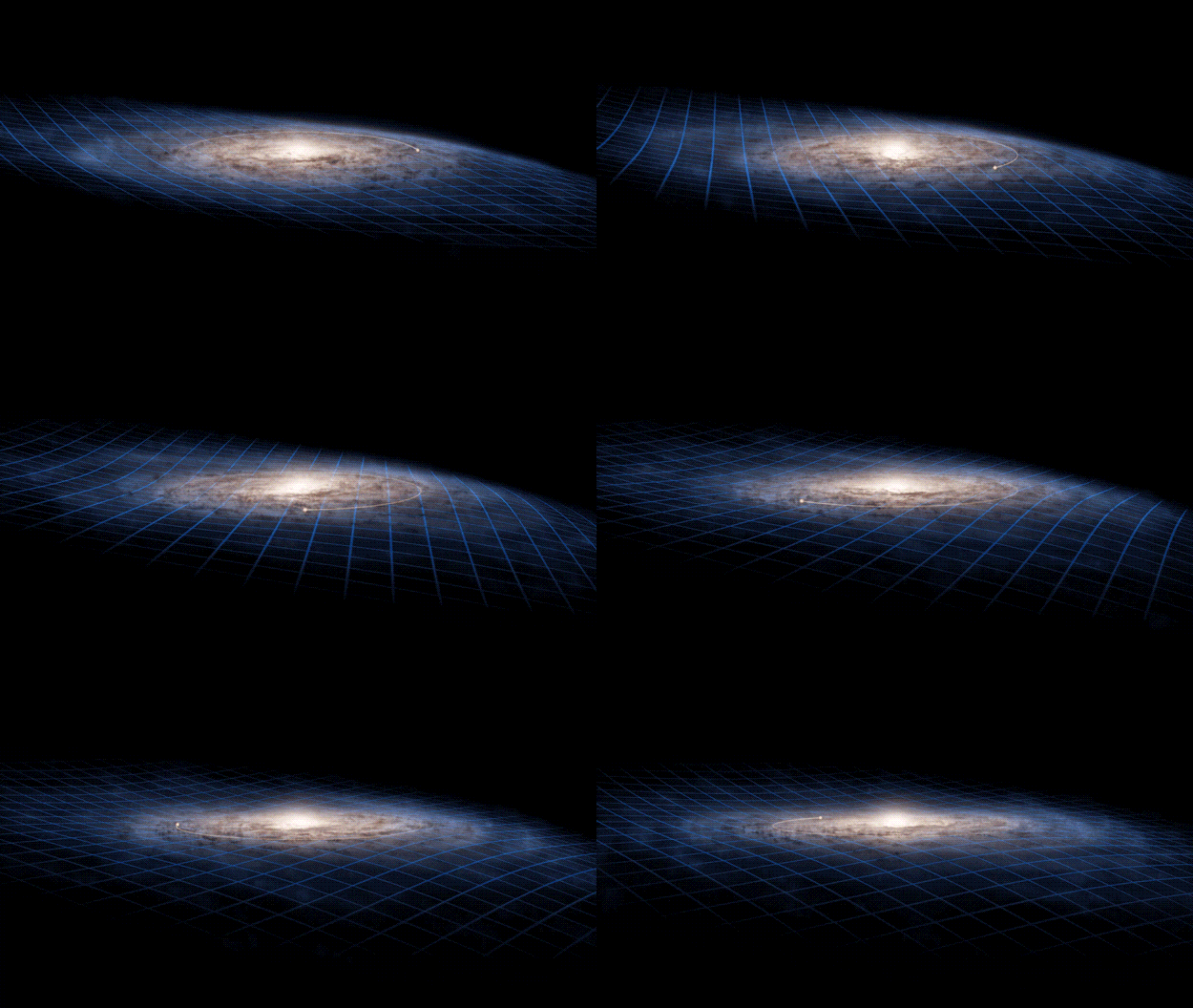
Image (Credit): The position of our Sun as it orbits the Milky Way’s center. (Stefan Payne-Wardenaar)

A recent Big Think story, “5 Consensus Ideas in Astronomy That Might Soon be Overturned,” comes as a good time as we reach further into space and back into time using the James Webb Space Telescope (JWST) and contemplate other telescopes that should come online shortly.

The story highlights these five ideas:

  • Dark energy is a cosmological constant;
  • Stars predate black holes;
  • Jovian planets protect terrestrial ones;
  • Most of the galaxy is uninhabitable; and
  • Globular clusters are planet-free.

For instance, regarding the uninhabitable areas of the galaxy, the Big Think story states:

Among its many discoveries, the ESA’s Gaia mission has found that the Milky Way galaxy not only has a warp to its galactic disk, but that the warp in the disk precesses and wobbles, completing a full rotation for roughly every three revolutions of the Sun [shown in yellow above] around the galactic center. Most astronomers assume that regions with too many stellar cataclysms in them, like the centers of galaxies, may be completely uninhabitable. But this picture is far from certain.

It is worth reading through the list and keeping these ideas in mind, and then following the JWST stories as they unfold. I bet you will be able to make a much longer list as old consensus ideas come apart and new ideas quickly follow.

The JWST’s First Image of an Exoplanet

Image (Credit): Exoplanet HIP 65426 b in different bands of infrared light, as seen from the JWST: purple shows the Near-Infrared Camera (NIRCam) instrument’s view at 3.00 micrometers, blue shows the NIRCam instrument’s view at 4.44 micrometers, yellow shows the Mid-Infrared Instrument (MIRI) instrument’s view at 11.4 micrometers, and red shows the MIRI instrument’s view at 15.5 micrometers. These images look different because of the ways the different Webb instruments capture light. A set of masks within each instrument, called a coronagraph, blocks out the host star’s light so that the planet can be seen. The small white star in each image marks the location of the host star HIP 65426, which has been subtracted using the coronagraphs and image processing. The bar shapes in the NIRCam images are artifacts of the telescope’s optics, not objects in the scene. (NASA/ESA/CSA, A Carter (UCSC), the ERS 1386 team, and A. Pagan (STScI))

It was only a matter of time, but even so it was pretty quick. The James Webb Space Telescope (JWST) has taken a direct image of an exoplanet. HIP 65426 b, a gas giant that lies 355 light-years away, is from 15 to 20 million years old and about 6 to 12 times the mass of Jupiter. This gas giant is also about 100 times farther from its host star than Earth is from the Sun, allowing the JWST to see the exoplanet’s light separate from its sun.

This is not the first direct image of an exoplanet. The Hubble Space Telescope has also captured images of exoplanets. For instance, in 2008 an astronomer using Hubble images reported on Fomalhaut b, a Jupiter-mass exoplanet that is about 25 light-years away and approximately 200 million years old. It takes close to 872 years for the exoplanet to orbit its sun. Fomalhaut b will most likely be another target for JWST in the near future.

Image (Credit): Hubble Space Telescope optical image from 2006 showing the belt of dust and debris (bright oval) surrounding the star Fomalhaut and the planet (inset) that orbits the star every 872 years and sculpts the inner edge of the belt. A coronagraph (center) on the Advanced Camera for Surveys blocks out the light of the star, which is 100 million times brighter than the planet. (Paul Kalas/UC Berkeley, NASA, ESA)